













🔵 5 Reasons to choose BlueVPS VPS hosting for projects in Germany (2026)
A site is lagging, the sketchy provider's tech support has been silent for three days, and a shared hosting plan for a couple of euros a month suddenly asks for an extra fee for "increased load." Sound familiar? Moving to a VPS seems daunting, but the reality is much simpler: you get dedicated resources, full control over the server, and independence from noisy neighbors on the platform.
BlueVPS has been operating since 2016. Headquarters in Estonia, a network of 20+ data centers worldwide, KVM virtualization on all plans. Below: a breakdown of five key reasons to take a closer look at this provider, specific plan figures, and an honest verdict without marketing fluff.
💡 Quick overview:
- KVM VPS: full environment isolation, dedicated cores and memory with no overselling
- Plans from €3.99/mo, 7-day no-questions-asked refund, monthly billing
- 20+ data centers: Frankfurt, Düsseldorf, Amsterdam, USA, Asia, Australia
- Unlimited traffic on all plans, NVMe disks, DDoS protection on request
- 24/7 support (tickets, live chat, phone), Russian-speaking operators
1. Plans that adapt to the task, not the other way around
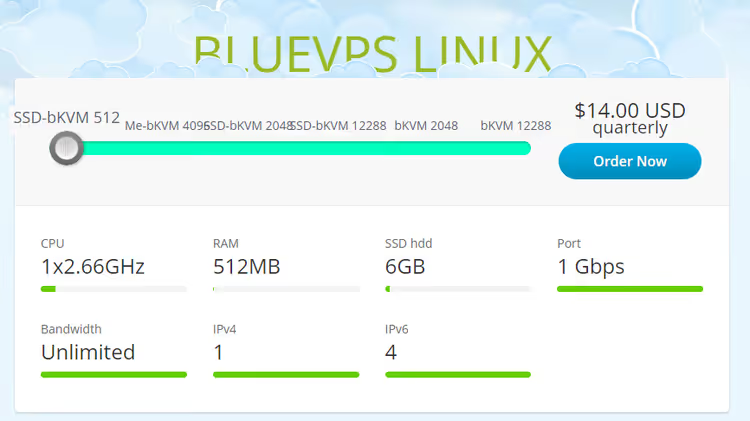
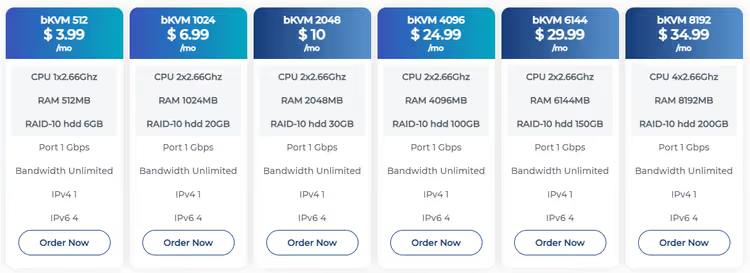
BlueVPS does not lock you into rigid "economy/standard/premium" packages. You configure the server yourself: number of cores, RAM size, disk type (SSD or NVMe), data center location. The entry-level bKVM 512 plan starts at €3.99 per month: 1 core at 2.66 GHz, 512 MB RAM, 6 GB SSD. That is enough for a landing page, a test environment, or a small WordPress site.
As the project grows, the server scales without migrating to another provider. Add 2 GB of RAM and a couple of cores, and the same site handles three times the visitors. Billing is monthly, but paying annually or biennially gives a noticeable discount: the entry-level NVMe plan at €6 per month drops to roughly €4.50 with an annual subscription.
They accept Visa/MasterCard, PayPal, and cryptocurrency (Bitcoin, Monero). No lock-in to long-term contracts: pay for a month, test it, cancel if it does not fit. A 7-day money-back guarantee on the first payment gives you a safety cushion for testing.
Note: plans with NVMe disks and 10-gigabit ports are several times faster on read/write operations compared to regular SSDs. The price difference is small (€6 vs. €3.99 at entry level), while the performance gain for databases is critical.
2. KVM virtualization and hardware: what is under the hood

BlueVPS uses only KVM: each virtual environment gets its own Linux kernel, dedicated memory, and CPU cores. No overselling, where 32 GB of physical RAM is "sliced" into a hundred 2 GB VPS instances on the assumption that not all will request it simultaneously. You paid for 2 GB, you get exactly 2 GB, reserved for your instance.
Unlimited traffic is included on all plans without exception. There are no hidden gigabyte caps or overage charges. For media projects, streaming, and sites with heavy content, this is one of the main advantages: no bill arrives at the end of the month for an "unexpected spike."
According to monitoring data from HostAdvice and VPSBenchmarks, uptime holds at 99.96%: less than 4 hours of downtime per year. Average latency from Europe to BlueVPS German data centers is 12-18 ms, with no packet loss recorded in tests.
3. DDoS protection, backups, and isolation at the virtualization level

DDoS protection is available on request in the Frankfurt, Gravelines (France), and Beauharnois (Canada) data centers. Filtering is enabled at the network level: junk packets are dropped before they reach your VPS. For an online store or a public API, this is a basic necessity, not an option with a separate price tag.
Backups are configured centrally: daily snapshots for €2 per month. In case of failure, restoration is performed by request to support. No one restricts your own backups via rsync or a hosting panel plugin; a "mixed" copy strategy (provider + your own) works most reliably.
Isolation at the KVM level means a vulnerability in a neighboring VPS on the same physical server does not compromise your data. These are not containers with a shared kernel, where a hole in one instance opens access to all. For projects that store user data or process payments, this is a fundamental point.
4. Data centers in Germany and worldwide: where the servers are located
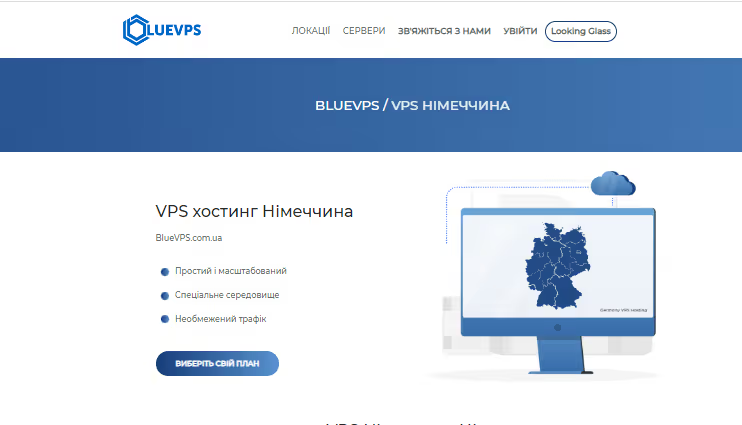
BlueVPS German locations: Frankfurt and Düsseldorf. Servers are housed in Tier III data centers with redundant power and cooling. Latency from Berlin, Munich, or Amsterdam falls within 10-25 ms. If your project targets a European audience and requires GDPR compliance at the infrastructure level, VPS hosting Germany provides both a German IP and physical data storage within the EU.
In total, BlueVPS has over 20 locations: USA (Los Angeles, Atlanta, Ashburn), Canada, UK, Netherlands, Poland, France, Italy, Spain, Sweden, Estonia, Bulgaria, Israel, UAE, Singapore, Hong Kong, Australia. For projects with a globally distributed audience, this means you can spin up VPS instances in three or four regions and route traffic via GeoDNS or a CDN without involving additional providers.
In 2026, BlueVPS added support for 10-gigabit ports on selected plans. For high-load projects and streaming services, this doubles throughput compared to a standard gigabit connection.
5. 24/7 Support and fully managed VPS

Tech support works around the clock: ticket system, live chat on the site, and phone. Average first response time in tickets is about 15 minutes (HostAdvice data for 2023-2026). Russian-speaking operators are on staff: there is no language barrier, you can write in Russian.
For those who do not want to or cannot administer a server, BlueVPS offers managed solutions. The provider's team handles installation and updates of the control panel (cPanel, Plesk, or a free alternative like aaPanel), firewall configuration, uptime monitoring, OS and package updates. Essentially, you get a VPS with the comfort level of managed hosting, but with full root access when needed.
Control panel: SolusVM for server management and WHMCS for billing. The interface is not the most modern visually, but it is functional: reboot, one-click OS reinstall, VNC console for server access even when the network is down, traffic and disk load graphs. It works without glitches.
Linux (CentOS, Ubuntu, Debian) and Windows Server are supported. The OS is chosen when ordering the VPS and can be changed at any time by reinstalling from the panel.
Comparison table: BlueVPS vs. competitors
Feature | BlueVPS | Hetzner | DigitalOcean |
|---|---|---|---|
Virtualization | KVM | KVM | KVM |
Starting plan | €3.99/mo | €3.79/mo | $4/mo |
Traffic | Unlimited | 20 TB | 500 GB - 12 TB |
Data centers | 20+ | 5 (Germany, Finland, USA, Singapore) | 14 |
NVMe at entry level | Yes (from €6) | Yes | No (from $8) |
DDoS protection | On request (free) | €7.50/mo | Free (basic) |
Managed solutions | Yes | No | No |
Support | Tickets, chat, phone | Tickets (paid support) | Tickets |
Cryptocurrencies | Yes | No | No |
⁉️🤔 Frequent questions
How does KVM differ from OpenVZ and why does it matter?
KVM provides full virtualization: each VPS gets its own Linux kernel, dedicated memory, and CPU cores with no overlap with other clients. OpenVZ is cheaper to deploy, but the kernel is shared, and a "noisy neighbor" writing heavily to disk affects the performance of all instances on the node. BlueVPS uses only KVM, and that is a plus for stability.
Is the entry-level BlueVPS plan enough for a WordPress site?
Yes, bKVM 512 (€3.99/mo) or NVMe-bKVM 1024 (€6/mo) handle a site with 20,000-40,000 monthly visitors with caching configured. An Nginx + PHP-FPM + Redis stack on the NVMe plan keeps TTFB within 100-150 ms across Europe. For a WooCommerce store with a catalog of several thousand products, take a plan with 2 GB of RAM or more: the database with JOIN queries across product tables consumes memory actively.
How do I migrate an existing site to BlueVPS?
If the site is on cPanel or Plesk, the built-in transfer tools between servers work normally. A bare Linux server: database dump via mysqldump, files via rsync, and in 20-30 minutes the site is live at the new location. BlueVPS support helps with initial environment setup even on entry-level plans: installing a web server, PHP, database.
How fast are BlueVPS servers in Germany?
According to VPSBenchmarks tests, average latency from Europe to Frankfurt and Düsseldorf is 12-18 ms with no packet loss. For comparison: to New York 80-90 ms, to Singapore 180-220 ms. For projects targeting audiences in Germany and neighboring countries, the BlueVPS German location is optimal in terms of price/latency ratio.
What payment and refund methods are available?
Visa/MasterCard, PayPal, Bitcoin, Monero, and bank transfer. 7-day money-back: cancel in the first week, get the full amount back. No refunds after 7 days, but there are also no long-term contracts: pay monthly and cancel at any time. This compares favorably to providers that require annual prepayment for the minimum plan.
BlueVPS in 2026: an honest summary
BlueVPS is not a giant on the scale of DigitalOcean or Hetzner, and that is its advantage for certain scenarios. Prices are below market average for comparable configurations, traffic is unlimited on all plans, and the choice of data centers is one of the widest among VPS providers of this size.
Who should consider BlueVPS: WordPress site owners (blogs, content projects, mid-sized online stores), freelancers for test and staging environments, startups on a tight budget, those who need hosting in Germany with Russian-speaking support and cryptocurrency payments.
Who should not: enterprise projects with SLA requirements of 99.99% and above (here you need AWS or Google Cloud with their budgets), teams for whom managed Kubernetes or serverless "out of the box" is critical (BlueVPS does not provide such services).
Pragmatic advice: take the entry-level NVMe plan for €6 for a month, deploy a test site, run it under load. A week of the refund period is enough to understand whether BlueVPS fits your stack. If it does, switch to annual billing and save 20-25% off the monthly price.

A professional team of writers and editors specializing in creating quality content.