













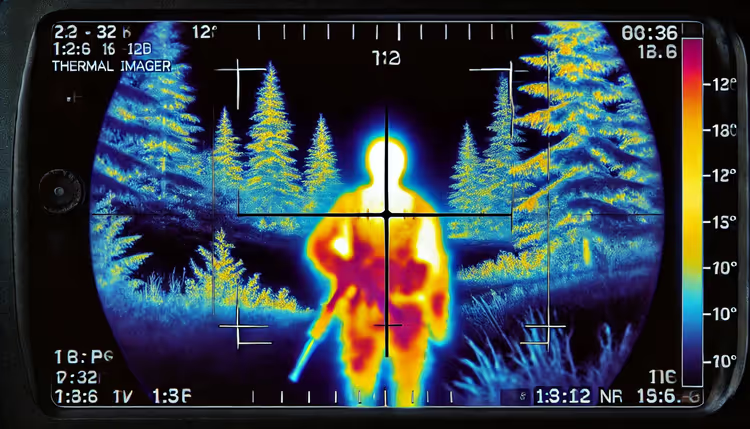
🔭 AGM thermal imagers: which model suits your task
Night hunting, perimeter security in total darkness, searching for a person in thick fog, standard optics are useless here. A thermal imager solves these tasks in seconds: it sees heat, not light.
AGM Global Vision is one of the few manufacturers that covers literally every scenario with its device lineup: from a compact pocket monocular to a professional tactical scope with a range of over two kilometers. And it does so without reaching military-budget price levels.
Below is a breakdown of the key AGM models as of early 2026, their real capabilities, and selection criteria for a specific task.
💡 Quick overview:
- AGM thermal imagers fall into three classes: monoculars (observation), scopes (hunting/sport), and tactical devices (military/professional tasks)
- The key difference between models is sensor resolution and objective lens diameter: the higher both parameters, the farther and clearer the image
- For hunting at distances of 200-400 meters, the mid-range segment is sufficient (Rattler TS35-384); for professional reconnaissance, the higher-end models (Python TS75-640)
- The entire model range is built with aircraft-grade aluminum housings with impact and moisture protection; devices operate at temperatures from -40°C to +50°C
Technology base: what is inside AGM thermal imagers
All AGM devices are built on uncooled microbolometers, thermal sensors that register infrared radiation from objects and convert it into an image. Unlike night vision devices (NVDs), a thermal imager does not need an external light source: it sees the thermal contrast between an object and the background.
Three key parameters that determine a device's capabilities:
- Sensor resolution. Basic: 256×192 (Taipan TM10-256), medium: 384×288 (Rattler, Asp), professional: 640×512 (Python TS75-640). All specifications, according to the manufacturer. The difference in practice: at 256×192 you confidently see an object at 400-600 meters; at 640×512, you distinguish details at one and a half kilometers.
- Sensitivity (NETD). For AGM this figure is below 35 mK; the thermal imager distinguishes temperature differences of less than one tenth of a degree. In practice, this means an animal in the bushes does not blend into the background.
- Objective lens diameter. From 10 mm (pocket models) to 75 mm (tactical). A larger diameter means the sensor collects more light, resulting in a clearer image at distance. But it also means more weight.
The housings of all devices are milled aircraft-grade aluminum. Protection class IP67: dust does not get inside, and the device survives half-hour immersion in one meter of water without consequences.
The built-in Wi-Fi module deserves a separate mention: it is present in most models and allows you to output the image to a smartphone or tablet via the proprietary AGM app. This is convenient both for observation from a concealed position and for video recording, you are not lighting up the device screen in the dark.
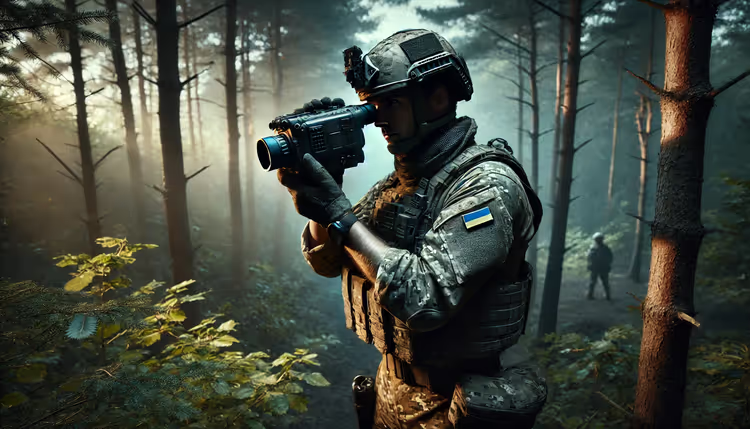
Model range: four lines for four tasks
AGM does not make a "universal device for all occasions"; instead, four lines cover four different scenarios. Here is how they compare:
Model | Type | Resolution | Detection range | Scenario |
|---|---|---|---|---|
Taipan TM10-256 | Monocular | 256×192 | up to 500 m | Observation, security, hiking |
Rattler TS35-384 | Scope | 384×288 | up to 1235 yards (~1130 m) | Hunting, sport shooting |
Asp TM35-384 | Monocular | 384×288 | up to 1400 m | Search operations, observation, hunting |
Python TS75-640 | Tactical scope | 640×512 | up to 2600 m | Military reconnaissance, special operations |
Taipan TM10-256: pocket scout
The most affordable and compact model in the lineup. Weighing about 200 grams, it fits in a chest pocket, yet with a 256×192 sensor and 10 mm lens it delivers an image sufficient for detecting a person or large animal at a distance of 400-500 meters (Taipan specifications).
What is important: the Taipan runs on a single 16650 battery for up to six hours, a full night of observation without recharging. The built-in rangefinder (stadiametric, not laser) helps estimate the distance to an object based on its size in pixels; the accuracy is not sniper-grade, but it is enough for a field estimate.
Who it suits: gamekeepers, perimeter security guards, tourists, and as a first thermal imager to "try the technology" without a serious budget.
Rattler TS35-384: the people's hunting scope
The most popular AGM model among hunters, and not by chance. The 35 mm germanium objective lens and 384×288 sensor provide a clear image at a distance of up to 1130 meters (Rattler specifications). This is enough for a confident shot at ungulates at 200-400 meters, a typical hunting distance.
The key feature of the Rattler is built-in video recording to 16 GB of internal memory and transmission via Wi-Fi. The shot is recorded, and you can immediately review it on your phone; there is no need to buy an external recorder. Operating time from two CR123 batteries is about 4.5 hours.
One nuance: the base magnification of 2× is not always convenient at short distances (under 50 meters); the image is too zoomed in. But for driven hunts and stand hunting, this is not a problem.
Asp TM35-384: observation with serious range
A monocular on the same 384×288 sensor as the Rattler, but with optics tuned for observation, not for shooting. Detection range for a person: up to 1400 meters; for a vehicle: up to 2200 meters (Asp specifications).
Search and rescue teams often choose the Asp: the device is certified to the MIL-STD-810 standard (vibration, shock, humidity) and genuinely withstands drops and operation in the rain. Unlike civilian models, there are no compromises on housing durability here.
An 8× digital zoom on top of the optical zoom allows you to "zoom in" on a distant object without losing the scene context. This is useful when you need to examine details while still maintaining the overall picture of the terrain.
Python TS75-640: professional tool for military tasks
The flagship model with a 640×512 sensor and 75 mm objective lens. Detection range for a vehicle: up to 3300 meters; for a person: up to 2600 meters (Python specifications). This is the level at which military optics operate.
The Python is designed for round-the-clock operation without removal from the weapon. Shutter calibration is automatic, without interrupting observation (on lower-end models, calibration "freezes" the image for a second). The housing withstands the recoil of large calibers, including.50 BMG.
This is the line chosen for military tasks: reconnaissance, situational awareness, and target detection in any weather conditions, rain, fog, smoke screens are no obstacle for a thermal imager.
Selection criteria: what matters and what is marketing
When choosing a thermal imager, it is easy to drown in specifications. In practice, only five parameters matter; the rest are either derivatives of them or marketing.
Sensor resolution. Determines at what distance you stop distinguishing details. For warehouse perimeter observation, 256×192 is enough. For hunting at shooting distance, at least 384×288. For professional reconnaissance, 640×512. Specific range figures are in the table above (manufacturer data).
Objective lens diameter. Affects light-gathering ability and, consequently, image quality in bad weather. 35 mm is the sweet spot for hunting. 75 mm is for tactical tasks. 10 mm is for compactness at the expense of range.
Frame refresh rate. For AGM this is 50 Hz on all models; the image is smooth, without stuttering during movement. Some competitors in the budget segment offer 25 Hz, which noticeably "stroboscopes" when tracking a moving target.
Operating time. Check not by the specification, but by real reviews: for AGM, the stated time generally matches the actual time. Monoculars last 6-8 hours; scopes, 4-5 hours. For a full night of hunting, take a spare set of batteries.
Weight with batteries. Taipan: 200 g, Rattler: 600 g, Python: 900 g. A difference of 700 grams on a march turns into "my arm is falling off" after three hours. If you carry the device on you for an entire shift, compactness is more important than an extra 200 meters of range.
A general rule: do not overpay for resolution that your distance does not require. A higher-end sensor in a forest with a hundred meters of visibility will not give an advantage over a mid-range one; the trees will limit the field of view anyway.
Where to buy AGM thermal imagers in Ukraine
AGM Global Vision is an American brand with manufacturing in the USA. In Ukraine, official distribution is limited: most models are imported through specialized optics and tactical gear stores.
Before purchasing, check three things:
- Official warranty. A thermal imager is complex electronics. Make sure the store provides a warranty of at least 12 months and has a service center, rather than sending the device for examination "within 45 days."
- Availability in Ukraine. A model may be in the catalog but physically located in a warehouse in the USA with a delivery time of 3-4 weeks. Clarify the status before paying.
- Battery compatibility. Some AGM models use CR123 batteries (available in Ukraine); some use 16650 or 18650 (also available, but check). An exotic battery size is a reason to budget for an external battery pack.
Recommendation: start your selection not with a model, but with a scenario. A monocular for observation, a scope for hunting, a tactical device for professional tasks, and within that scenario, choose the resolution and optics for your distances.
Review of new AGM thermal imagers from the Shot Show 2025 exhibition, from budget monoculars to flagship scopes with a laser rangefinder.
⁉️🤔 Frequent questions
How does an AGM thermal imager differ from a night vision device?
A thermal imager registers infrared radiation (heat) and works in total darkness, fog, and smoke. An NVD amplifies residual light; it needs at least some source: the moon, stars, IR illuminator. In a completely dark basement, an NVD goes blind; a thermal imager does not. The cost: a thermal imager is on average 2-3 times more expensive than an NVD of a comparable class.
How long do the batteries last in the Rattler TS35-384 under real conditions?
At a temperature around 0°C, two CR123 cells hold 4-4.5 hours of continuous operation. In frost below -15°C, the time decreases to 3-3.5 hours. Tip: carry a spare set in an inner jacket pocket; cold batteries lose capacity even before being installed in the device.
Is a license required to purchase an AGM thermal imager in Ukraine?
As of 2026, thermal imagers are not considered military goods in Ukraine and are purchased freely, without permits. However, exporting the device abroad may require declaration; check the rules of the destination country.
AGM Taipan TM10-256: is it enough for hunting?
For detecting an animal at a distance of up to 400-500 meters, yes. For a confident shot, no: at 256×192 and a 10 mm lens, you will not distinguish the vital zone at shooting distance (Taipan characteristics). The Taipan is a device for observation and search, not for aiming. For hunting with a thermal imager on a weapon, get at least a Rattler or Asp.
How does the Asp TM35-384 differ from the Rattler TS35-384 given the same sensor?
Optics and housing. The Asp has a larger objective lens diameter and detection range (1400 m vs. 1130 m), and the housing is certified to the military standard MIL-STD-810. The Rattler is a scope for shooting; the Asp is a monocular for observation. The sensor is the same, but the tasks are different.
💎 Summary: which AGM thermal imager to get for your task
The AGM lineup is logically structured: each model covers a specific scenario without unnecessary compromises. The choice comes down to what you do with the device most of the time.
- If you need perimeter observation or searching in the forest, get the Taipan TM10-256. Pocket format, high autonomy, and sufficient range for these tasks.
- If you need hunting with a thermal scope on a weapon, get the Rattler TS35-384. A proven model with video recording and a range of over a kilometer. The most balanced in terms of price and capabilities.
- If you need search and rescue operations or professional observation, get the Asp TM35-384. Military-grade durability and one and a half kilometers of range.
- If you need tactical and military tasks, get the Python TS75-640. The flagship with a 640×512 sensor and a range of over 2.5 kilometers (Python characteristics). No compromises on image quality.
Before purchasing, check with the seller about the availability of the specific model and the warranty terms in Ukraine. And if you have already worked with AGM thermal imagers, write in the comments which model you use and for what scenario: real-world experience is more valuable than any specifications.

A professional team of writers and editors specializing in creating quality content.