













🧱 Sandwich panels: what they are, types, pros and where to buy in 2026
Building a hangar, warehouse or retail pavilion and don't want to wait half a year for brick walls to go up? Sandwich panels close this issue in a matter of weeks.
But the devil is in the details: which insulation to choose, how a wall panel differs from a roofing panel, and why the price from different manufacturers varies twofold. Straight to the point: what this material is, where it's used, and how to avoid mistakes when ordering.
💡 Quick overview:
- Understand the construction: two metal sheets and an insulation layer between them, that's the whole essence of a sandwich panel.
- Decide on the insulation: mineral wool, expanded polystyrene, polyurethane foam (PUR) or PIR, each has its own scenario.
- Choose the panel type: wall panel for vertical structures, roofing panel for the roof.
- Check the dimensions and insulation thickness for your region's climate, from 50 to 200 mm.
- Order with a length margin and custom cutting if the project is non-standard.
What sandwich panels are and how they are constructed
The construction is as simple as a sandwich: two sheets of profiled metal and an insulation layer between them. The sheets are glued together under pressure, producing a ready-made wall or roofing section that simultaneously bears the load and retains heat.
The outer sheets are steel with an anti-corrosion coating (zinc, aluzinc, polymer). This is what protects the metal from rust for the entire service life, 25-30 years under normal operation. The inner layer is the insulation: mineral basalt wool, expanded polystyrene, polyurethane foam (PUR) or polyisocyanurate (PIR). Three critical parameters depend on the filler: thermal conductivity, fire resistance and weight.

Panel thickness varies from 50 to 200 mm, the thicker the insulation, the better the thermal insulation. For unheated warehouses in the middle climate zone, 50-80 mm is sufficient. For residential and office premises, 100 mm and above is used. For cold storage rooms and northern regions, 150-200 mm.
Where sandwich panels are used
The material is used in frame construction, where the load-bearing function rests on a steel frame, and the panels are attached to it with self-tapping screws. No mortar, no "wet" technology.
Typical projects:
- warehouses and logistics centers;
- hangars and production workshops;
- service stations, gas stations and car washes;
- agricultural buildings: grain storages, livestock farms, poultry houses;
- sports facilities and exhibition centers;
- office and retail pavilions;
- cold storage and freezer rooms;
- drying chambers;
- enclosures and internal partitions;
- ventilated facades and roofs.
Refrigerated trucks deserve a separate mention: sandwich panels with PIR insulation maintain a stable temperature inside the van even in forty-degree heat.
Types of sandwich panels: comparing insulation materials
Choosing insulation is a choice between price, fire safety and thermal insulation. Here's how it looks in numbers:
Insulation | Thermal conductivity, W/(m·K) | Fire resistance | Weight | Price |
|---|---|---|---|---|
Mineral wool | 0.038-0.045 | high (NG) | medium | medium |
Expanded polystyrene | 0.035-0.041 | low (G1) | low | low |
Polyurethane foam (PUR) | 0.020-0.025 | medium (G2) | low | above medium |
PIR | 0.019-0.022 | high (G1) | low | high |
Mineral wool, basalt-based, non-combustible (class NG). Ideal for projects with high fire safety requirements: shopping centers, public buildings. The downside is it fears moisture: if the roof leaks, thermal insulation drops.
Expanded polystyrene, the cheapest option. It doesn't fear moisture, retains heat well. But it burns (class G1) and releases toxic smoke when burning. For housing and places with permanent human occupancy, it's not the best choice.
Polyurethane foam (PUR), excellent thermal insulation with low weight. It doesn't absorb water, doesn't rot. The downside is flammability (G2) and a higher price. Often used in cold storage rooms.
PIR, an improved version of PUR with added graphite particles. Thermal conductivity is noticeably lower, and fire resistance is higher (G1). Upon contact with fire, it forms a protective char layer and does not sustain combustion. The most expensive, but also the most effective option.
By construction, panels are divided into wall panels (smooth or profiled outer sheet) and roofing panels (with additional stiffening ribs, capable of withstanding snow load).
7 Reasons why sandwich panels outperform brick and concrete
1. Construction speed. A brick shell takes 6-8 months to build. A 1000 m² hangar made of sandwich panels is assembled in 3-4 weeks. The difference is several times over.
2. Dry installation. No concrete, mortar or water. Panels are attached to the frame with self-tapping screws. Construction doesn't stop in winter, sub-zero temperatures are no obstacle to installation.
3. Low weight. A square meter of panel weighs 10-25 kg depending on thickness. For comparison: a square meter of brick wall is 200-250 kg. A lightweight foundation is needed, and that's direct savings on the substructure.
4. Ready-made finish. The face sheet of the panel is already painted at the factory (RAL polymer coating). The color is chosen from a catalog. The facade doesn't need plastering or painting.
5. Warmth without thermal bridges. Panels are joined with a tongue-and-groove lock; with proper installation, no thermal bridges occur. Heating costs are noticeably cheaper compared to a brick building without additional insulation.
6. Durability. The anti-corrosion coating on the steel lasts 25-30 years. The insulation doesn't settle or lose its properties. Panels don't rot, don't grow mold and are of no interest to rodents.
7. Fire safety is a matter of choice. Panels with mineral wool don't burn at all (class NG). PIR panels char on the surface during a fire and don't spread flame. Expanded polystyrene panels burn, so they aren't used for fire-hazardous projects.
How sandwich panels are manufactured
The technology is refined to the point of automation, but key stages are still controlled manually:
- The steel sheet is cut to the order size.
- Polyurethane adhesive is applied to the sheet.
- The insulation layer is laid, manually, with thickness control.
- A second layer of adhesive is applied on top and covered with the second steel sheet.
- The panel is pressed under pressure, the adhesive polymerizes and sets.
- Geometry is checked: thickness, edge straightness, quality of the lock joint.
The finished product undergoes certification. A responsible manufacturer has certificates of conformity openly available on their website; it's worth requesting them before payment.
Sandwich panels in the 247 online store

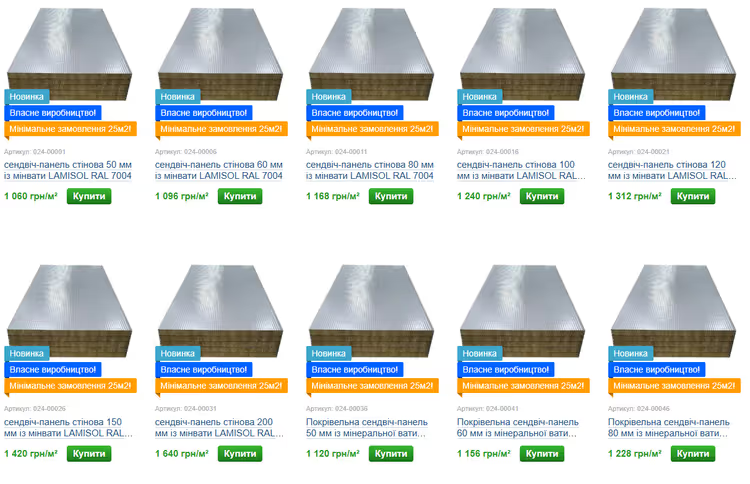
The 247 online store offers sandwich panels of its own production. The catalog includes wall and roofing panels with insulation made of foam plastic, neopor (graphite-filled expanded polystyrene) and mineral basalt wool.
If the decisive factor is price, go for panels with foam plastic. They are the most affordable, handle high humidity and low temperatures excellently, and even outperform mineral wool on these parameters.
If thermal insulation is more important, pay attention to neopor from the manufacturer Lamisol. The graphite particles in the composition reflect infrared radiation: cool indoors in summer, warm in winter. The difference is noticeable.
All panels are bonded with high-quality adhesive; integrity is not compromised during transport or installation. The steel sheets are profiled and have an anti-corrosion coating. Roofing panels are additionally reinforced with stiffening ribs for snow load.
Insulation thickness options: 50, 60, 80, 100, 120, 150 and 200 mm. Length is cut individually to the customer's project. Color according to the RAL catalog. Pickup from the warehouse in Kyiv, delivery to all regions of Ukraine.
⁉️🤔 Frequently asked questions
Can you build a residential house from sandwich panels?
Technically, yes. But with caveats. Walls made of sandwich panels don't "breathe"; forced ventilation is needed. Living is comfortable with insulation thickness from 120 mm and panels with PIR or mineral wool. Expanded polystyrene is not recommended for housing due to toxicity when burning. A frame house made of sandwich panels will cost significantly less than a brick one and is erected in 2-3 months.
Which insulation is best for a cold storage room?
PIR or polyurethane foam (PUR). They have the lowest thermal conductivity among all insulation materials (see the table above). With a thickness of 150-200 mm, the room maintains a stably low temperature even in heat. Mineral wool is not suitable for cold storage: the slightest humidity, and thermal insulation drops.
Do you need to insulate the foundation for sandwich panels?
A lightweight foundation is needed, a shallow strip footing or pile foundation. The panels themselves are light (10-25 kg/m²), so a deep foundation is not required. However, it's worth insulating the plinth with extruded polystyrene around the perimeter to prevent freezing in the zone where panels meet the foundation.
How does a wall panel differ from a roofing panel?
The roofing panel has reinforced stiffening ribs and a deeper profile on the outer sheet. It is designed for snow load and doesn't sag under weight. A wall panel won't work on a roof, it will sag. And vice versa: a roofing panel will fit on a wall, but overpaying for unnecessary rigidity is pointless.
How long do sandwich panels last?
Manufacturers give a 25-30 year warranty on steel with anti-corrosion coating. In reality, panels last longer: a zinc coating with a density of 275 g/m² (the standard for quality panels) lasts up to 40 years in a non-aggressive environment. The insulation doesn't settle or degrade over time. The main enemy is mechanical damage to the coating followed by corrosion.
Sandwich panels in 2026: to build or not to build?
If you need it fast, inexpensive and without "wet" processes, the answer is unequivocal. Sandwich panels won't replace brick in multi-story residential construction, but for commercial, industrial and agricultural projects, this remains the best solution in terms of price, speed and quality ratio.
Look towards PIR insulation if the budget allows. Choose mineral wool if the project has high fire safety requirements. Go for expanded polystyrene if maximum savings are needed and fire risks are minimal.
And most importantly, order with custom cutting for the project. The extra cost for precise sizing pays off through the absence of offcuts and double work on the construction site.

A professional team of writers and editors specializing in creating quality content.