













 AIIllustrative image: AI-generated
🔧 Clutch release bearing: how to choose, buy and replace
Pressed the clutch and heard a squeak that wasn't there yesterday? A familiar sound for owners of cars with a manual transmission. Most often the culprit is the clutch release bearing. It's a small part, but without it you simply can't shift gears.
You can't ignore the noise: a worn bearing gradually "eats" the fingers of the clutch pressure plate, and in advanced cases damages the transmission input shaft. The repair bill grows from a few hundred to thousands of dollars, simply because you didn't get to a shop in time.
Below is everything you need to know about the clutch release bearing: from the first symptoms to step-by-step replacement. No fluff, with real numbers and practical advice.
💡 Quick overview:
- Heard a squeak when pressing the pedal? Check for other wear symptoms: vibration, difficult shifting, changed engagement point.
- Select the bearing by the car's VIN code. Compatibility is primary, brand is secondary.
- Compare prices at online stores and offline locations: online is cheaper, offline is faster.
- Decide: replace it yourself (you'll need a pit and a helper) or go to a shop.
What a clutch release bearing is and how it works
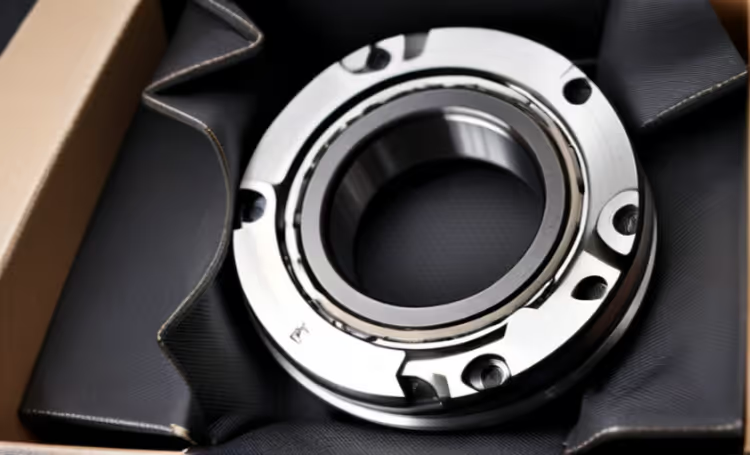
The clutch release bearing (also known as a throw-out bearing), is a thrust bearing that transfers force from the clutch pedal to the diaphragm spring of the pressure plate. It is located inside the bellhousing, between the transmission and the engine, mounted on the input shaft guide sleeve.
The principle is simple: you press the pedal → the master cylinder rod pushes the fork → the fork pushes the bearing toward the pressure plate fingers → the fingers depress the pressure plate → the clutch disc disengages from the flywheel → torque stops being transmitted to the wheels. You shift gears, release the pedal, and the bearing returns to its initial position.
Modern clutch release bearings are sealed and pre-lubricated at the factory. No additional lubrication is required during operation. If the lubricant has "dried out" (from overheating or natural aging), the bearing must be replaced; it cannot be restored.
The hydraulic clutch release bearing (CSC, concentric slave cylinder) deserves a separate mention. Unlike the classic fork type, it combines the hydraulic cylinder and the bearing itself, located concentrically on the input shaft. It is found on many modern cars (Ford, BMW, Opel). Its wear symptoms are the same, but diagnosis is more complex: potential hydraulic leaks add to mechanical wear.
5 Signs of a worn clutch release bearing
The first signal is almost always sound. But there are other indicators you must not miss.
 AIIllustrative image: AI-generated
1. Noise when pressing the pedal. The surest sign: you press the clutch, you hear a squeak, whistle, rustling, or metallic chatter. You release it, the sound disappears. This is exactly how the release bearing behaves: under load (contact with the pressure plate fingers) the "ailing" rollers make themselves known. If the noise is heard in neutral and does NOT disappear when pressing the pedal, the problem is more likely in the transmission input shaft, not the bearing.
2. Vibration and pulsation on the pedal. A worn bearing stops rolling smoothly over the pressure plate fingers; a "step" or runout appears. You feel this as fine trembling, pulsation, or "sand" under your foot when depressing the clutch. An unevenly worn pressure plate produces a similar effect, but combined with the sound, the diagnosis is almost unambiguous.
3. Difficult gear shifting. The bearing fails to fully disengage the pressure plate → the clutch disc does not separate completely → gears "grind" in with effort, especially reverse and first. A characteristic test: on a stationary car, depress the clutch and try to engage reverse; if you hear a distinct crunch, the release mechanism is not working fully.
4. Increased pedal effort. The clutch becomes unusually stiff; you have to press noticeably harder. The reason: a worn bearing binds on the guide sleeve, friction increases. If you hear a grinding sound at the same time, the bearing has almost "seized"; you must not drive.
5. Changed engagement point. The pedal "bites" closer to the floor or, conversely, at the very top, and this has changed over a short period. With a classic fork-type bearing, this pattern occurs when there is critical play or partial destruction of the cage.
If you notice two or three symptoms at once, don't postpone a visit to the shop. The bearing will then disintegrate completely, and fragments will travel around the bellhousing.
How to choose a clutch release bearing
The golden rule: the bearing is selected NOT "by eye," but strictly by the VIN code or car model. There are no universal solutions; the mounting diameter, fork travel, and type (fork/CSC) are specific to each car.
Compatibility is primary. Order the bearing by VIN, and you'll get a guaranteed fit. Selection by make/model/year also works, but be careful: the same model in different production years may have different clutch assemblies.
Manufacturers. There are five brands on the market that mechanics trust:
- Sachs, an original equipment supplier for VAG, BMW, Mercedes. Consistent quality, mid-segment price, comparable to Luk and Valeo.
- Luk, part of the Schaeffler Group, supplies the assembly line for Ford, Renault, Dacia. Luk bearings often come in a kit with the pressure plate.
- Valeo, a French concern, original supplier for Peugeot-Citroën, Renault. High quality, price slightly above average.
- Exedy, a Japanese manufacturer, original for Honda, Toyota, Subaru. If you have a Japanese car, go with Exedy, no question.
- AISIN, a subsidiary brand of Toyota Group, available in retail. A good balance of price and quality for Asian cars.
What to buy: just the bearing or a clutch kit? Since you are removing the transmission anyway, it makes sense to replace the entire kit: pressure plate, clutch disc, and release bearing. The kit will cost a few hundred dollars and save you from doing the job again in a year or two. The exception: the bearing is replaced preventively during a clutch job where the clutch is still "healthy" (for example, during a transmission overhaul).
 AIIllustrative image: AI-generated
Where to buy: online or offline
Each channel has its own advantages; the choice depends on urgency.
Online stores. Wider selection, prices noticeably lower than retail, easy to compare. The downside: delivery takes from 1 to 7 days. Before ordering, be sure to check: return/exchange for VIN mismatch (a normal store accepts without question), availability of brand certificates, real reviews for the specific part number.
Offline stores and auto parts markets. One advantage, but a significant one: the part is in your hands today. You can visually assess the packaging quality, markings, and smoothness of rotation. The downside: the selection is limited to what's in stock, and the salesperson may push a suboptimal brand. Tip: come with a ready list of 2-3 part numbers from your preferred brands.
A common mistake is buying the cheapest no-name bearing. Saving on the part results in replacement after 15-20 thousand km, or even sooner. Removing and installing the transmission is expensive labor; by "saving" on the part, you'll pay for the labor twice.
How to replace a clutch release bearing yourself
Replacing a clutch release bearing is a job of medium complexity. The main obstacle: the need to remove and move aside the transmission, which requires a pit or a lift. If you have a garage with a pit, a set of tools, and a helper, you can do it in 4-6 hours.
What you'll need:
- a floor jack (2-ton minimum) + safety stands;
- a socket and wrench set (metric, with a ratchet);
- a ball joint or tie rod end puller;
- a transmission support (or a second jack);
- a syringe for transmission fluid + fresh gearbox oil;
- threadlocker (medium strength);
- a new clutch release bearing + grease for the guide sleeve (comes with the kit or purchased separately).
Procedure:
Preparation. Drive the car onto the pit, engage the parking brake, place chocks under the rear wheels. Disconnect the battery terminal. Remove the engine splash shield, if present.
Drain the transmission oil. Unscrew the drain plug, drain the fluid into a clean container. If the oil was changed recently, it can be reused (strain it through cheesecloth).
Disconnect the driveshafts. Unscrew the hub nuts, disconnect the ball joints or tie rod ends, pull the CV axles out of the transmission. On some cars, it's enough to disconnect the inner CV joints and move the axles aside without removing them completely.
Remove accessories. Disconnect the clutch cable/slave cylinder, wiring (speed sensor, reverse light), and hoses. Unbolt the starter and move it aside (without disconnecting the wires). Remove any brackets blocking access to the transmission.
Remove the transmission. Support the engine and transmission. Unscrew the bolts securing the transmission to the engine block. With a helper, carefully slide the transmission off the guide pins; it's heavy (30-50 kg assembled), don't drop it on yourself.
Replace the bearing. Remove the old bearing from the guide sleeve. Clean the sleeve of dirt and old grease. Apply a thin layer of fresh grease to the sleeve. Install the new bearing; it should slide freely, without binding.
Reassembly. Attach the transmission back, tighten the bolts crosswise with a torque wrench (torque spec per the manual). Reconnect all accessories and wiring. Fill the transmission with fresh oil. Bleed the clutch (for hydraulic actuation).
Check. Start the engine, let it warm up. Check the shifting of all gears while stationary. Take a short test drive with smooth shifts; there should be no extraneous noises.
The first 500 km after replacement is the break-in period for the new clutch kit. Avoid hard launches, slipping, and prolonged holding of the pedal depressed (for example, at a traffic light; shift to neutral).
⁉️🤔 Frequent questions
Can you drive with a worn clutch release bearing?
If the noise has just appeared and is only heard when the pedal is fully depressed, you can drive to a shop on your own. But you must not delay for weeks or months: crumbling bearing rollers damage the pressure plate fingers (and replacing the pressure plate is already hundreds of dollars), and in extreme cases scratch the guide sleeve on the transmission case.
Is it mandatory to replace the entire clutch kit along with the bearing?
Strictly speaking, no, you can replace only the bearing. But this makes practical sense only with very low clutch mileage (up to 20-30 thousand km). In other cases, it's wiser to renew the entire kit: the labor cost for removing the transmission is the same whether for just a bearing or for the kit. Paying that money again a year later because of a worn disc is not the best decision.
How much does it cost to replace a clutch release bearing?
According to Car Treatments data for 2026, the bearing itself costs $30-$100 depending on the car make and brand. The labor for replacement with transmission removal is $400-$700 at an average shop. A full clutch kit with labor is $800-$1600. These figures are approximate for the US market; rates may vary in different regions.
How to distinguish clutch release bearing noise from input shaft noise?
There is a simple test: on a running car, depress the clutch. If the noise appears specifically when pressing and disappears when releasing, the release bearing is at fault. If the noise is present in neutral with the pedal released and disappears/changes when depressed, the problem is in the transmission input shaft or the pilot bearing.
What is the difference between a mechanical and a hydraulic clutch release bearing?
The mechanical one is moved by the clutch fork; the hydraulic one (CSC) is itself a hydraulic cylinder and fits over the input shaft. The hydraulic one is more expensive, harder to replace (requires bleeding the system), but provides smoother disengagement. When a CSC fails, brake fluid leaks from the bellhousing, an additional diagnostic sign.
Do you need to lubricate a new clutch release bearing during installation?
Most modern bearings are sealed and pre-lubricated. You should ONLY lubricate the guide sleeve, with a thin layer of high-temperature grease that comes with the bearing. Do not use "lithol" or other universal greases: when heated to the bellhousing's operating temperatures, they lose their properties.
Should you replace the bearing yourself or go to a shop
If you have a pit, a set of tools, a helper, and at least minimal experience with suspension/brake repair, replacing the release bearing yourself is realistic. You'll save on labor and gain invaluable understanding of your car's design.
If you don't have a pit, and your maximum experience is oil and brake pad changes, it's better to pay a shop. The transmission weighs 30-50 kg; without a lift and support, dropping it is a matter of seconds. Plus, there is a risk of incorrect bolt tightening, misalignment during installation, and subsequent clutch "judder."
The main thing is not to ignore the first symptoms. A squeak when pressing the pedal today = replacing one bearing. The same squeak six months later = replacing the pressure plate, disc, and possibly repairing the input shaft. The difference in money is several times over.
What clutch release bearing is on your car and how long did it last? Share your experience in the comments.

A professional team of writers and editors specializing in creating quality content.