













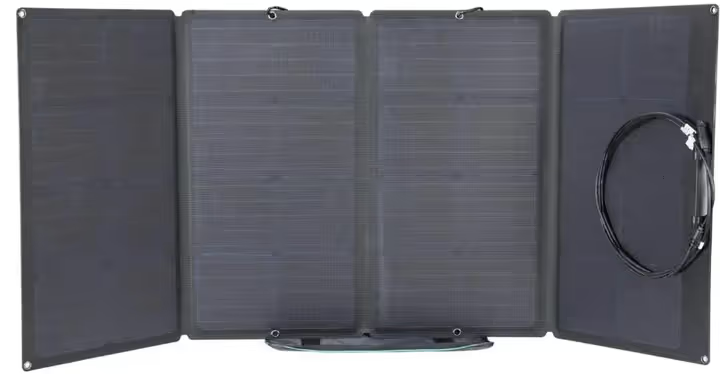
🔋 EcoFlow 160W solar panel review: specs, tests and is it worth buying
Charge a laptop and a portable coffee maker in the woods, without burning gasoline or listening to a generator drone. Sounds like a dream, but that is exactly what the foldable solar panel from EcoFlow promises.
The brand was founded in 2017 by alumni of the DJI team, engineers who spent years wrestling with drone batteries: lightweight, durable, and maximally efficient. They brought that same approach to ground-based products. Their DELTA and RIVER power stations are already familiar to campers and homeowners, and today we are taking a close look at the panel that connects to them, the EcoFlow 160 W.
Below, an honest breakdown: what the specs say, how it performs in real conditions, which power stations it works with, and whether it is worth buying instead of cheaper alternatives.
💡 Quick overview:
- Unfold the panel, connect the MC4 cable to an EcoFlow power station, and charging starts within seconds.
- In direct sunlight the panel delivers 120-140 W of real power, enough for slow but steady charging of RIVER and DELTA.
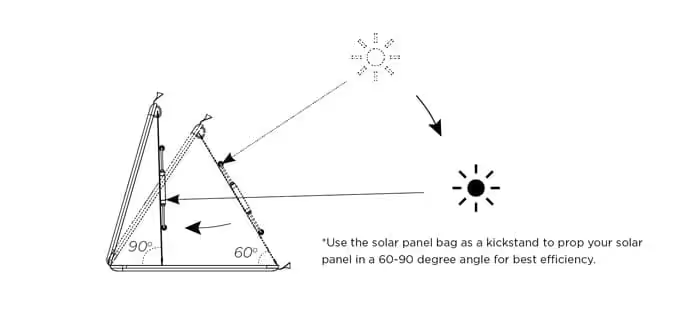
- The case-stand lets you set the tilt angle without extra accessories.
- IP67 and ETFE film protect against rain, dust, and UV during year-round use.
- You can connect up to three of these panels to a single DELTA via the MC4 connector.
Technical specifications: what is inside
The panel is built from 32 premium monocrystalline silicon cells. The claimed conversion efficiency of 21-22% (manufacturer specifications) is a standard figure for portable panels in this class. Nominal power is 160 W with a tolerance of ±5 W.
Parameter | Value |
|---|---|
Nominal power | 160 W (±5 W) |
Conversion efficiency | 21-22% |
Cell type | Monocrystalline silicon |
Dimensions (unfolded) | 68 × 157 × 2.4 cm |
Dimensions (folded) | 68 × 42 × 2.4 cm |
Weight | 7 kg (15.4 lbs) |
Connector type | MC4 |
Open circuit voltage | 21.4 V (Vmp 18.2 V) |
Short circuit current | 9.6 A (Imp 8.8 A) |
Protection rating | IP67 |
Coating | ETFE (UV protection) |
Warranty | 12 months |
Operating temperature | -20°C to 85°C |
We also recommend: Download.
Portability and build quality
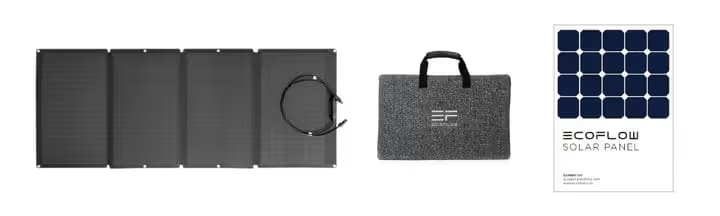
Seven kilograms is not a record among solar panels, but for a 160-watt model the weight is justified. The panel folds in half to 68 × 42 cm, fits in a sedan trunk, and does not need a separate bag: the rigid carrying case doubles as a stand.
The seamless unibody construction is not marketing fluff. The IP67 rating means full protection against dust and water spray. The panel will survive a sudden rainstorm on a hike and does not fear dust on a dirt road. The ETFE film over the cells absorbs ultraviolet radiation and extends service life; panels without ETFE show noticeably faster cell degradation after just two or three seasons.
The adjustable stand lets you set the panel at the right angle to the sun. A useful feature: at high noon you place it almost flat, in the morning and evening, at a tilt. And importantly, several panels can be placed side by side without overlapping each other.
Efficiency and real-world performance
21-22% efficiency is standard for monocrystalline panels in this segment. In practice, according to test data, on a clear afternoon you will get about 120-140 W, not the rated 160. This is normal for any portable panel: the nominal figure is measured under lab conditions with ideal light and a temperature of 25°C.
The MPPT algorithm in EcoFlow power stations squeezes the maximum out of the panel in cloudy weather and at low temperatures, where a regular PWM controller gives up. According to owner feedback, even on an overcast day the panel keeps delivering 40-60 W, which is already enough for slow trickle-charging of a small power station.
An important nuance: shade is enemy number one. If even one of the panel's four segments is shaded by a branch or a backpack, total power drops sharply. The cells are wired in series, and the weakest link drags down the entire chain.
Compatibility with EcoFlow power stations
The panel uses the universal MC4 connector, and via an MC4 to XT60 adapter it connects to all EcoFlow power stations. The charging cable is included, so you do not need to buy anything extra.
How many panels you can connect simultaneously:
Power station | Max. 160 W panels |
|---|---|
RIVER | 1 |
RIVER Max | 1 |
DELTA 1300 | 3 |
Approximate charging time from a single panel in bright sunlight:
Power station | 1 × 160 W |
|---|---|
RIVER (288 Wh) | 2.5-5 hours |
RIVER Max (576 Wh) | 5-10 hours |
DELTA 1300 (1260 Wh) | 3.5-7 hours (with three panels) |
For DELTA, three 160 W panels give 480 W nominal, or about 360-420 W of real power in the sun. A full charge of the DELTA 1300 in that setup takes from three and a half to seven hours.
If you are charging a small RIVER, a single panel is more than enough. For DELTA it makes sense to get two or three right away.
Video review
To see the panel in action, unboxing, tilt angle setup, and charging a real power station, watch this review:
Pros and cons
What is great:
- IP67 and seamless body: rain, dust, and dirt are no threat to the panel.
- Two-in-one case-stand: no need for a separate bag or prop.
- Universal MC4: compatible not only with EcoFlow but also with third-party power stations.
- ETFE coating extends the service life of the cells.
- The panel is ready to work in seconds: unfold, connect, and current starts flowing.
What to be prepared for:
- 7 kg, not for long-distance backpacking. For car camping the weight is acceptable, but you will not take it on a 30 km hike in a backpack.
- Sensitivity to shading: even partial shade on one segment cuts the power of the entire panel.
- 12-month warranty, modest compared to the 5-10 years of stationary panels.
⁉️🤔 Frequently asked questions
Where can I buy the EcoFlow 160 W solar panel?
You can purchase the panel from official EcoFlow dealers. One verified option is https://norfin.com.ua/solnechnaya-panel-ecoflow-160w-solar-panel/. Before buying, check the package contents: the box should contain the panel itself, the MC4 to XT60 cable, and clips for securing it on the stand.
How do I get the maximum output from the panel?
Three rules. First: position the panel perpendicular to the sun's rays and adjust the angle every 2-3 hours; according to a BackupPowerHub review, the daily yield gain reaches 20-30%. Second: avoid shade on any of the segments, even partial. Third: use direct sunlight; through a car windshield or windows the power drops noticeably, and the power station charges many times slower.
Can I charge a power station from the panel through a window or in a car?
Technically, yes, the MC4 connector and cable allow it. But efficiency drops sharply: glass reflects and absorbs part of the solar spectrum. The power station will charge 2-3 times slower than outdoors. It works for emergency top-up, but not for primary charging.
How many 160 W panels can I connect to DELTA?
You can connect up to three 160 W panels to the EcoFlow DELTA 1300 in series via the MC4 connector. This gives up to 480 W of nominal power and roughly 360-420 W real in bright sunlight. RIVER and RIVER Max accept one panel, limited by the power station's input voltage.
Does the panel work with third-party power stations?
Yes, the MC4 connector is a universal standard for portable solar panels. If your power station has an MC4 or XT60 input (via an adapter), the panel will work. However, the MPPT algorithm is optimized specifically for EcoFlow power stations; with third-party models the yield may be slightly lower.
How durable is the panel with regular use?
The ETFE coating and seamless IP67 construction give the panel a durability margin for several seasons of active use. Owners who have been using the panel since 2022 report no noticeable cell degradation, provided it is stored folded in its case. The warranty is 12 months, but the actual service life of monocrystalline cells under normal operation is 10-15 years with a gradual decline in efficiency.
Is the EcoFlow 160 W worth buying: final verdict
The EcoFlow 160 W is a solid middle ground in the brand's portable panel lineup. It is not the lightest, nor an efficiency record-breaker, but it wins with a combination of reliability, weather protection, and deployment convenience. The case-stand and ETFE coating are the details you appreciate not at unboxing, but after six months of regular use.
This panel is for you if you:
- already own a RIVER or DELTA power station and want to charge it from the sun;
- drive out into nature and value all-weather capability (IP67);
- appreciate a "pull out, unfold, connect" experience with no fuss.
Get a more compact panel if:
- you go backpacking and every kilogram counts;
- you need charging through glass (in a car or indoors) as your primary scenario.
If you plan to power a DELTA seriously and for extended periods, get two panels right away. A single 160-watt panel for the DELTA 1300 means charging over a full daylight day. Three, and the power station fills up in 4-6 hours.
Start with one: check whether the charging speed is sufficient for your scenario. You can buy a second and third later, since the MC4 connector lets you expand the array without replacing the panel you already bought.

A professional team of writers and editors specializing in creating quality content.