













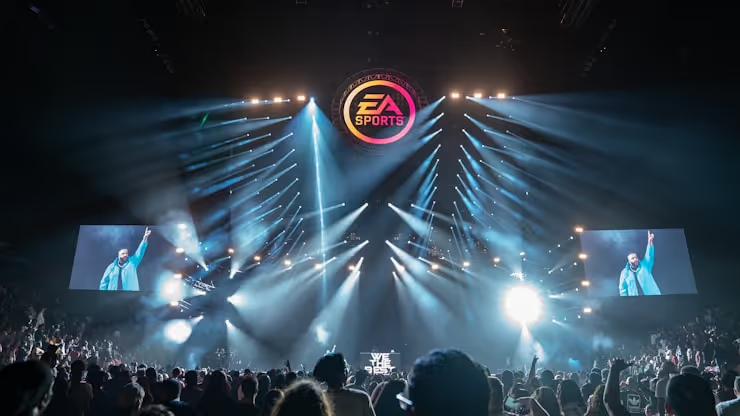
🎮 Esports as a new form of competition: analysis of the phenomenon and its place in the sports ecosystem
Ten years ago, esports was called "entertainment for geeks," and tournament prize pools were measured in tens of thousands of dollars. Today it is a multi-billion-dollar industry with an audience exceeding NBA Finals viewership. According to Esports Charts, the total prize pool for the 2025 season exceeded $270 million, and that is just the official figures without sponsor contributions.
The pandemic became a catalyst: when traditional sports went on pause, esports not only retained its audience, it doubled it. Streaming platforms, interactive chats, real-time analytics, all of this transformed watching a match from passive observation into participation. Among the platforms reflecting the scale of digital competition, GG BET Україна stands out, an example of a service that mirrors the pulse of this industry.
But esports is not just shows and betting. Behind the scenes, a highly complex machine operates: coaching staffs, sports psychologists, analytical departments, and multi-million-dollar contracts. Let's break down this phenomenon without the hype, through numbers, structure, and market logic.
💡 Quick overview:
- How esports differs from traditional sports in terms of load, accessibility, and economics
- Which disciplines dominate in 2026 and how many viewers watch them
- Who works on a pro team and how much players earn
- How the industry's economy is structured: sponsorship, media rights, merch, and prize money
- What to expect from esports in the next five years: VR, AI, and Olympic prospects
What sets esports apart from traditional sports
At first glance, the difference is obvious: one exists in the physical world, the other in the digital one. But let's dig deeper.
Mental load. An esports athlete performs 500-600 actions per minute (APM) during a match. An average gamer rarely exceeds a hundred. A pro's reaction speed, 180-220 ms, is 30-40% faster than the average PC user (data from NAVI and Team Liquid analysts). This is parallel processing of a dozen variables in real time: ally positions, ability timings, team economy, map state.
Digital environment. The rules of the game are defined by code. The referee is the server. Referee error is impossible. At the same time, the environment changes with patches every two weeks, and players adapt faster than in any traditional sport.
Global accessibility. Football requires a stadium, equipment, and a team in one city. For esports, a computer and a stable internet connection. NAVI, one of the strongest organizations in the world, trained for years with players in different countries simultaneously.
Interactivity. The esports viewer votes for MVP, watches statistics in real time, switches between cameras, and discusses every round in a chat with half a million fans. This is not passive observation, it is participation.
The most popular disciplines and audience in 2026
According to the Esports Charts 2025 report, the top esports disciplines look like this:
Game | Genre | Peak online (million) | 2025 Prize money ($ million) |
|---|---|---|---|
League of Legends | MOBA | 6.75 | 18.5 |
Counter-Strike 2 | FPS | 2.9 | 32.2 |
Dota 2 | MOBA | 2.8 | 22.1 |
VALORANT | FPS | 1.7 | 8.4 |
Honor of Kings | MOBA | 2.1 | 19.6 |
A key shift: CS2 overtook Dota 2 in prize money, as Valve built a new tournament ecosystem with transparent qualification. Honor of Kings, a Chinese MOBA with an audience of nearly 200 million players, broke into the top ranks thanks to the Esports World Cup 2025.
The esports audience reached 640.8 million viewers by the end of 2025 (DemandSage). Growth to 925 million is projected by 2030. The average viewer age is 16-30: Generation Z, who consciously tune into streams, comment, donate, and vote. The share of women in the audience grew from 15% in 2019 to 25% in 2025, inclusion here is not a slogan but a market trend (QuantumRun).

Who stands behind the success of esports athletes
A professional CS2 or League of Legends team today is not five friends with a Discord server. It is an organization with a coaching staff, a sports psychologist, an analytical department, SMM managers, and lawyers.
A contracted player's regimen: 6-8 hours of practice daily, reviewing opponent recordings, drilling tactics and combos, physical exercises for vision and posture. Major organizations like Team Liquid rent bootcamp spaces where the team lives and trains for months before important tournaments.
Sports psychologists became standard in esports only in the last 5-7 years. An 18-20 year old player, watched simultaneously by half a million viewers, must handle pressure no worse than an Olympic athlete.
Here is a characteristic quote from s1mple (Oleksandr Kostyliev), a CS scene star from Ukraine:
"We train more than some people work. You have no right to make a mistake when half a million people are watching."
Why viewers choose esports
Three factors retain the audience and bring in new viewers:
Accessibility. Broadcasts are free. Twitch, YouTube Gaming, and official tournament sites, three clicks away. No ticket, visa, or cross-country trip needed. The Worlds 2025 final for League of Legends was watched by 6.75 million people concurrently, and that is just the peak online count.
Interactivity. Chat, MVP voting, round outcome predictions, donations with on-screen messages, the viewer is not an observer but a participant. Analyst streamers run parallel broadcasts with tactical breakdowns, this is a second layer of content on top of the match.
Content consistency. The esports calendar is never empty. One major ends, another starts a week later. Off-seasons are filled with transfers, show matches, and streamer content. The viewer never falls out of the habit.
Where esports is integrated into the real economy
According to Grand View Research, the global esports market was valued at $2.6 billion in 2025. The forecast for 2026 is $3.3 billion, and growth to $12 billion is expected by 2033 at a compound annual growth rate of 20.4%.
Industry revenue structure:
Revenue source | Share |
|---|---|
Sponsorship | 38% |
Advertising | 21% |
Media rights | 17% |
Merch and tickets | 15% |
Platform fees | 9% |
Sponsorship remains the main engine: Intel, Red Bull, Mercedes-Benz, Louis Vuitton, brands far removed from gaming, invest tens of millions in esports assets. In 2025, the Esports World Cup in Riyadh awarded $70.45 million in prize money, more than the Wimbledon prize fund.
Universities in Europe and the US are launching esports scholarships. NASEF (North America Scholastic Esports Federation) integrates esports into the school curriculum as a tool for teaching STEM disciplines. A graduate with esports team management experience on their resume is no longer exotic, it is a competitive advantage.
Esports and traditional sports: a direct comparison
Pitting one against the other is pointless, but comparing them is useful. Here is how the two industries look by key parameters:
Parameter | Esports | Traditional sports |
|---|---|---|
Accessibility | High - needs a PC and internet | Limited by infrastructure |
Career start | From age 14 | Often from childhood |
Career duration | 5-8 years | 10-15 years |
Physical load | Minimal | High |
Viewer influence | Online chats, voting, donations | Stadiums, television |
Broadcast platforms | Twitch, YouTube Gaming | TV, streaming, stadiums |
The main advantage of esports is resilience to external shocks. Quarantines, closed borders, cancellation of mass events? For esports this is not a problem: a tournament for 5 million viewers is held online, and the only requirement for players is a stable ping. Traditional sports lose a season under such conditions.
Where to start diving into esports
If you haven't followed esports yet, here is a quick map:
Game | Who it suits | What to follow |
|---|---|---|
CS2 | Fans of dynamics and tactics | PGL Major, BLAST Premier |
Dota 2 | Those who love depth and variability | The International |
League of Legends | Team players and lore enthusiasts | Worlds, LCK |
VALORANT | Beginners in tactical shooters | VCT Champions |
Rocket League | Those who just want spectacle | RLCS World Championship |
The easiest entry for beginners is through CS2 or VALORANT: the rules are transparent (one team attacks, the other defends, understood in a second), the match is dynamic, tournaments run year-round.
What awaits esports in the next five years
According to Grand View Research estimates, the market volume will exceed $12 billion by 2030, and the viewer audience will approach one billion. Key development vectors:
Olympic prospects. The IOC has already conducted test esports series. Full integration into the Olympic program is a question not of "if" but "when." VR disciplines and simulators will become the bridge between traditional and digital sports.
VR and AR formats. Full immersion of the viewer into a virtual arena, where you can watch the match from any angle. The first prototypes are being tested at Beat Saber and Echo VR tournaments.
Artificial intelligence in coaching staffs. AI analytics of draft stages, prediction of opponent strategies, personalized training plans, AI is becoming a coach's assistant, and in the future a full-fledged analyst.
University esports. NCAA-like leagues with full scholarships and transfers. For the generation that grew up with a controller, this is as legitimate a path into the profession as a basketball scholarship was for millennials.
Esports will not replace football and will not cancel the Olympics. But it is already the third largest spectacle industry on the planet by reach, and it is growing faster than any traditional sports direction.
⁉️🤔 Frequently asked questions
Do you need a special education to work in esports?
Formally, no. But a technical foundation and understanding of the disciplines radically increase your chances. Universities in Europe and the US are launching master's programs in esports management. A graduate with practical experience gets offers before they even graduate.
Are there esports teams in Ukraine?
Yes, and one of them is world-class. NAVI (Natus Vincere), champions of PGL Major Stockholm 2021, one of the most titled organizations in CS2. B8, Monte, and Passion UA also compete, all in top disciplines: CS2, Dota 2, VALORANT.
Can you start an esports career after 25?
The competition will be higher, most pros start before 20. But exceptions exist, especially in disciplines emphasizing strategy over reaction. The career age ceiling in esports is also gradually shifting: 27-30 is no longer retirement but the peak of experience for captains and analysts.
How much do esports athletes earn?
The range is huge. According to Esports Earnings, top-team players earn $10,000-$30,000 per month in salary alone, plus prize money and sponsorship contracts. Newcomers on the tier-2 scene earn from $500 to several thousand. Streamers can earn more than tournament players through donations and advertising.
Do women's esports teams exist?
Yes, and some have achieved impressive results. G2 Gozen, the women's VALORANT roster that won the Game Changers Championship. Riot Games runs separate women's tournaments with prize pools comparable to men's tier-2 competitions.
Is it realistic to combine studies or work with esports?
At the beginner and intermediate level, absolutely. The key to success is strict time management and discipline. Most tier-2 and tier-3 scene players study or work in parallel. The professional level with daily 8-hour training sessions cannot be combined with full-time employment, it is a full-time job.
So is esports a sport or not?
The debate over terms is pointless. The facts matter: 640 million viewers, a $2.6 billion market, prize pools exceeding the budgets of traditional tournaments, and an ecosystem that has created hundreds of thousands of jobs, from coaches to data analysts.
Esports does not cancel football and does not replace basketball. It exists in a parallel reality, digital, global, and around the clock. And a generation already lives in this reality, for whom a mouse click means no less than a kick of a ball.
If you want to understand the industry, start with one tournament. Turn on the broadcast of a CS2 major or League of Legends Worlds. Not for the victory of a specific team, but for the sense of scale. Half a million people in one chat are not wrong: this is no longer the future. This is the present.

A professional team of writers and editors specializing in creating quality content.