













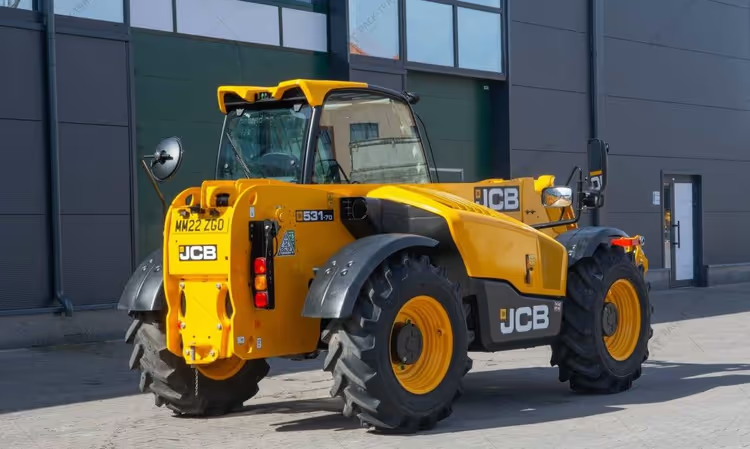
🚜 Forklifts in agriculture: types, applications and selection
A tractor and a combine are not the only machines without which a modern farm comes to a standstill. Between the field and the warehouse, between the truck bed and the hangar, there is a critical gap. The forklift closes it.
Every ton of grain, every bale of hay, and every pallet of fertilizer passes through the same forks. When there is no forklift, people do this work. Slowly, with the risk of injury and product loss. And when there is one, the chain from field to storage runs without manual handling of heavy loads.
Below, a breakdown of the main forklift types, their real advantages in the agricultural sector, and specific scenarios where the machine pays for itself in a single season.
💡 Quick overview:
- Which forklift types are used in agriculture and how they differ
- Why even a small farm benefits from mechanized loading and unloading
- In which specific operations a forklift replaces manual labor: from moving hay to harvesting vegetables
- What to look for when choosing a machine for your tasks: fuel, load capacity, attachments
Main forklift types for the agricultural sector

There are three main types on the market, and each covers its own niche.
Electric forklifts, the choice for enclosed spaces. Zero exhaust, low noise level, compact dimensions. Ideal for warehouses, vegetable storage facilities, and packing shops. Limitations: range on a single charge (on average 6-8 hours of intensive work) and the need for a level floor. Not suitable for field tasks.
Diesel forklifts, the workhorse of open areas. High power, high ground clearance, operation on uneven ground. Diesel is the choice for loading grain into trucks, moving bales over long distances, and working on field threshing floors. Fuel consumption is higher, but productivity is incomparable to electric models.
LPG forklifts, a compromise. They work both indoors and outdoors, refueling is faster than charging, exhaust is cleaner than diesel. Popular in mixed scenarios: part of the day in a hangar, part on a loading platform. Gas cylinders require care during storage and replacement.
This video clearly shows the differences between all the main forklift types, from the classic counterbalance to narrow-aisle models. If you are choosing a machine and want to see it in action before buying, it is worth watching.
What a forklift brings to agricultural production
Mechanized loading and unloading delivers more than just "convenience". These are specific, measurable results.
Speed of operations. A forklift moves a pallet weighing a ton in minutes. A team of three people spends half an hour on the same task and risks back injuries. The difference in pace accumulates: over a season, one machine frees up hundreds of man-hours.
Reduced product loss. Manual handling of grain, vegetables, or bales means spillage, damage, and spoilage. Forklift forks lift the load whole, without contact with the ground and without extra transfers.
Safety. Labor ministries in various countries classify manual lifting of heavy loads as one of the main causes of workplace injuries in agriculture. A forklift removes the most dangerous operation: load carrying by a person.
Versatility. One machine with a set of attachments replaces several pieces of equipment. Pallet forks, a bucket for bulk materials, a bale clamp, a rotating carriage: all of this mounts on a single forklift.
Where a forklift is indispensable: four scenarios
Moving hay and straw
Bales of 300-500 kg, standard for cattle. Without a forklift, they are manhandled or moved with a tractor boom that has limited maneuverability. A forklift with a bale clamp stacks them for storage and loads them onto a trailer for transport in a matter of minutes.
Transporting grain
Grain is discharged from the combine into a buffer hopper or directly into a truck bed. Then it needs to be transferred to a warehouse or elevator. A forklift with a bucket picks up grain from the threshing floor and feeds it into a grain elevator or directly into a truck bed. Without it, the "field to storage" chain stretches out for hours.
Harvesting crops
Potatoes, carrots, beets, onions: all of these are collected in containers and boxes that weigh tens of kilograms. A forklift with forks or a special clamp lifts the entire container and places it on transport. The same scheme works in orchards with fruit crops.
Soil treatment and field preparation
Some forklift models with a mounted plow or leveler participate in soil preparation: they level areas for threshing floors, clean silage pits, and spread compost. This is not their primary function, but it is an option that saves buying a separate piece of equipment for seasonal work.
How to choose a forklift for your tasks
The choice comes down to four points.
Where the machine works. Enclosed warehouse: electric. Open area and field: diesel. Mixed mode: LPG.
Load capacity. For standard agricultural tasks, 1.5-3 tons is sufficient. If you work with large bales or load grain with large buckets, look at models for 3-5 tons.
Attachments. Check with the supplier which clamps and buckets are compatible with a specific model. It is better to take a forklift for which a wide range of attachments is available; this will extend the machine's usage season.
Budget and condition. A new diesel forklift with a 3-ton load capacity costs from $25,000. The used machine market allows you to fit into a smaller amount. If you are considering a pre-owned option, you can buy a used forklift through specialized platforms where the equipment undergoes a pre-sale inspection.
⁉️🤔 Frequent questions
Which forklift is better for a small farm?
A diesel forklift with a 1.5-2.5 ton load capacity is the most versatile option. It works outdoors, hauls bales, loads grain, and does not require charging infrastructure. For a farm with one hangar and a field, this is sufficient. Electric models are justified only if all work is done indoors.
Can one forklift be used for different tasks?
Yes, and that is exactly what interchangeable attachments are for. Forks are swapped for a bucket, a bucket for a bale clamp. Retooling takes 5-10 minutes. The main thing is to check the compatibility of the forklift carriage with the required attachment before buying.
How much fuel does a diesel forklift consume per shift?
On average, 4-7 liters per hour during intensive work, depending on the model and load. Over an 8-hour shift, that amounts to 30-55 liters. LPG models consume roughly the same in equivalent, but the cost of gas is usually lower than diesel fuel.
Do you need a license to operate a forklift?
Yes, operating a forklift requires a tractor operator's license with the appropriate category. Training is conducted in specialized centers, with a duration of 1 to 3 months depending on the program. Without this document, the employer risks a fine during an inspection.
Which is more cost-effective: a new or a used forklift?
For seasonal work on a farm, a used machine from a trusted supplier often pays for itself faster. A new forklift depreciates noticeably in its very first year of operation. If the equipment is needed for six months of field work, not for daily warehouse operation, a pre-owned option gives the same functionality for less money.
Is it worth mechanizing loading on your farm
If you handle more than 50 tons of cargo per season (grain, bales, vegetables, or fertilizers), a forklift ceases to be an "option". It is a direct calculation: the cost of the machine versus man-hours, product loss, and injuries.
For a small farm, a 2-3 ton diesel model with basic attachments will cover the main tasks. For a large one, it makes sense to look towards a fleet of two machines: an electric one for the warehouse and a diesel one for field work. In any case, the first season with a forklift shows the real difference between "hauling by hand" and "working with machinery".

A professional team of writers and editors specializing in creating quality content.