













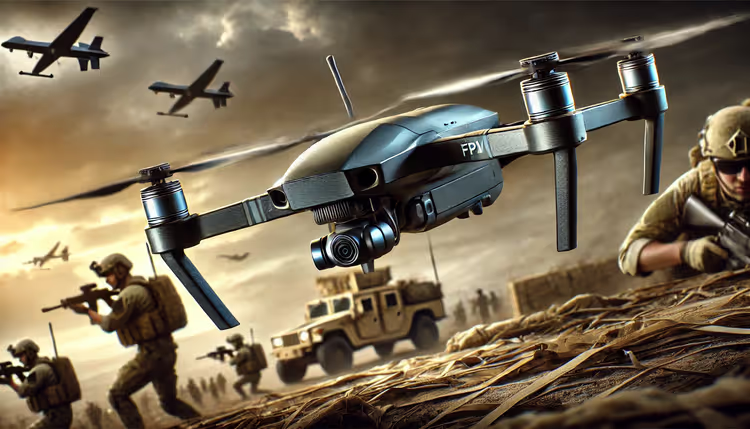
🎯 FPV drones: how a first-person view drone is changing sports, construction and war
Flying a drone as if you’re sitting in its cockpit sounds like science fiction. But that’s exactly what FPV drones have been doing for over a decade. The technology, born from garage racing by enthusiasts, has by 2026 grown into a multi-billion-dollar industry and rewritten the rules of modern warfare.
FPV stands for First Person View. The pilot puts on VR goggles and sees exactly what the camera on the drone’s nose sees, in real time. No lag, no "third-party" perspective. Full sense of being in the air.
But the real surprise is how far this technology has moved beyond its racing roots. Today FPV drones fight fires, inspect bridges, rescue people in the mountains, and destroy armored vehicles on the battlefield. Meanwhile a basic combat FPV drone costs $300-500, cheaper than an average smartphone. Let’s break down how it works and why FPV has become the defining drone technology of the decade.
💡 Quick overview:
- What an FPV drone is and how it differs from a regular quadcopter
- How an FPV system is built: camera, transmitter, goggles, and controller
- Three main application areas: racing, combat missions, and civilian tasks
- What to look for when choosing your first FPV drone
What an FPV drone is and how it works
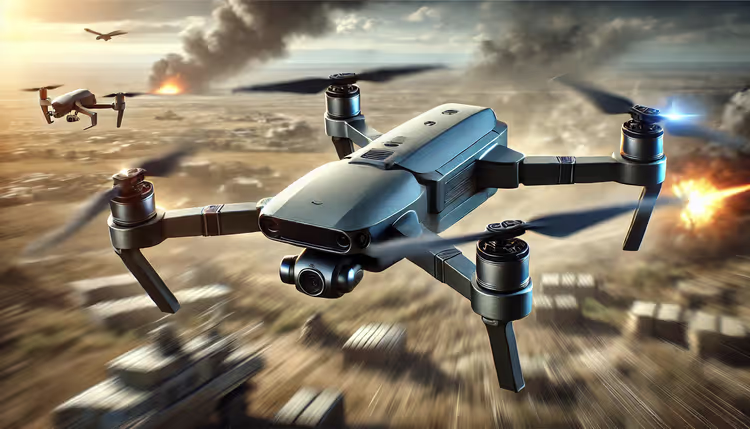
A regular quadcopter captures a top-down view; you see the ground from a bird’s-eye perspective. An FPV drone does the exact opposite. The camera on its nose faces forward at a slight upward angle, and the feed is transmitted to the pilot’s goggles with no perceptible delay. The result: you’re not watching the flight, you’re in it.
Technically the chain works like this: camera (analog or digital) → video transmitter on the drone → 5.8 GHz radio link → receiver in the goggles or on a ground monitor. Analog systems deliver minimal latency (10-30 ms) and are cheap. Digital systems, DJI, Walksnail, HDZero, provide an HD picture but with slightly higher latency and a higher price tag. For racing every millisecond counts, so analog is still alive. For filming and commercial work digital has long been the standard.
The key difference from a typical DJI drone: full manual control. No GPS position hold, no automatic return-to-home, no obstacle avoidance. You manage throttle, roll, pitch, and yaw with your hands at every moment of flight. It’s harder, but that’s exactly what delivers the agility and speed that FPV exists for.
FPV racing: a sport at the edge of what’s possible
FPV drone racing is Formula 1 in the air. Drones weighing 250-500 grams accelerate to 160-200 km/h on courses with gates, flags, and sharp turns. Pilots tear through abandoned warehouses, parking garages, and purpose-built tracks. It’s all streamed to spectators in real time and looks like a scene out of Star Wars.
The main international league, DRL (Drone Racing League), runs seasons with cash prizes and contracts for top pilots. Alongside it there’s a huge amateur community: local meetups, open practice sessions, and championships in the MultiGP format. The barrier to entry for the hobby is lower than ever: a ready-to-fly kit with a drone, controller, and goggles can be put together for a few hundred dollars.
Racing is more than just a sport. It was the racing community that spawned the culture of building, tuning, and repairing your own gear, the foundation of the entire FPV market. The ability to solder a drone from scratch or swap a burnt-out ESC 15 minutes before a heat is a core pilot competency. And those very skills turned out to be critically important when FPV arrived on the battlefield.
FPV drones in combat: why they changed everything
Since 2023 Ukraine has become the largest FPV drone battlefield in history. What began as improvisation by individual units had by 2026 grown into an industry with annual production exceeding 8 million drones by 160+ companies. According to Ukraine’s National Security and Defense Council (January 2026), FPV drones account for roughly 60% of all Russian army losses on the front.
Economics play a decisive role here. A single FPV kamikaze drone with a shaped charge costs $300-500. The tank it destroys costs $2-5 million. That’s a 1-to-10,000 ratio, a figure unseen in military history before FPV arrived. And the drone is controlled by an operator in cover several kilometers from the target. Human risk is reduced to zero.
A separate technological breakthrough: fiber-optic FPV drones. Instead of a radio link they are connected to the operator by an ultra-thin fiber-optic cable up to 20 kilometers long. Such a drone is physically impossible to jam with electronic warfare systems, it simply has no radio signal to suppress. The first mass-produced units appeared in 2024. By 2026 fiber-optic FPVs are a standard tool on the most EW-saturated sections of the front.
According to Bloomberg (November 2025), Ukraine now produces more drones of all types than the entire NATO bloc combined. Monthly FPV output grew from 20,000 in January 2024 to 200,000+ by the end of 2025, a tenfold increase in a year. This is not just a military fact; it’s evidence of how fast an industry adapts when the cost of failure is measured not in profit but in lives.
Civilian applications: from rescue to construction
News from the front overshadows everything else, but FPV drones are quietly transforming civilian professions too. Rescue workers fly drones into smoke-filled buildings where a person can’t enter without an oxygen tank. The FPV camera shows the floor layout, fire locations, and, crucially, whether there are people inside. Saving minutes that make all the difference.
Construction companies use FPV drones to inspect high-rise structures. Instead of an industrial climber risking their life, a 15-minute façade flyby with an HD camera and thermal imager. The drone flies into ventilation shafts, under bridge spans, inside tanks, anywhere a person needs clearance, safety gear, and a pile of permits.
In agriculture FPV drones with multispectral cameras assess crop health: healthy plants reflect light differently than sick ones. Precision down to an individual tree or row. In logistics, delivery of medical supplies by FPV drones to hard-to-reach areas is being tested: faster than a vehicle and cheaper than a helicopter. These aren’t PR experiments; they’re working use cases being replicated around the world right now.
How to choose an FPV drone for your needs
The first rule for a beginner: don’t buy a ready-made "all-in-one" kit without understanding what you need it for. The FPV world splits into three broad categories, and a racing drone is radically different from a filming or inspection drone.
For racing the priorities are speed and agility. The drone is built on a 5-inch frame; weight without battery is 250-400 grams. An analog camera gives minimal latency. The controller runs the ELRS (ExpressLRS) protocol: it has become the de facto standard because of its range and reliability. A ready-to-fly racing kit with goggles will cost a few hundred dollars.
For aerial filming and commercial work you need a drone with a digital system, DJI O4 Air Unit or Walksnail Avatar HD. 1080p image, Gyroflow stabilization, extra flight time margin. Add a GPS module and a barometer: they aren’t mandatory for FPV as a class, but they’re useful for positioning during shoots. Budget: $800 to $1,500 for a fully equipped setup.
For professional tasks (inspection, rescue operations, agriculture) payload and time in the air matter most. A 7-10 inch frame, a Li-ion battery instead of LiPo (lasts longer), a thermal imager or multispectral camera. Pricing starts at a couple thousand dollars and climbs easily depending on the payload equipment.
General advice: start with a simulator. Uncrashed, VelociDrone, or Liftoff cost pennies compared to repairing a real drone and will give you dozens of hours of stick time without a single broken propeller. Once you can fly consistently in manual mode in the sim, buy your first kit.
If you want to see all of this live before buying, here’s a detailed guide to getting started in FPV piloting with a hardware breakdown, Betaflight setup, and first flights.
⁉️🤔 Frequently asked questions
Do I need a license to fly an FPV drone?
In most countries, yes, if the drone weighs more than 250 grams. Ukraine has airspace rules in effect: drone registration, an identification number on the airframe, and a ban on flying over crowds without permission. During martial law civilian flights in front-line zones are completely prohibited. Before your first flight check your country’s current requirements: rules change fast.
How long does it take to learn to fly?
Basic control in Acro mode (manual control without stabilization) takes 10-15 hours in a simulator. Confident real-world flying takes about 30-40 hours of stick time with inevitable crashes and repairs. The first month you’ll spend more time soldering than flying, that’s normal. After 3-4 months of regular practice most pilots can comfortably run a medium-difficulty race course.
Do I have to build the drone myself?
No, but it’s strongly recommended. Ready-made kits (BNF, Bind and Fly) save time but not knowledge. When the drone crashes and breaks, and it will crash, more than once, you need to understand what to replace and how. Building your first drone yourself is the best way to learn the hardware. You’ll also save on repairs: you’ll swap a failed ESC for half the price of a pizza in 15 minutes yourself instead of sending it in for service.
Which is better: analog or digital?
For racing analog is still king: 10-30 ms latency versus 25-50 ms for digital. For everything else go digital. DJI O4 gives a clean HD picture, Walksnail is compatible with various goggles, HDZero balances latency and quality. Analog is like a manual transmission: cheaper, simpler, more control, but for everyday driving digital is objectively more convenient.
Can you really make money with FPV drones?
Yes, and demand is growing. Commercial building inspection, filming for realtors and construction companies, agricultural monitoring, training beginners, all these areas are actively hiring FPV pilots. Income depends heavily on region and specialization: in the US a commercial FPV operator can charge anywhere from a few hundred to fifteen hundred dollars for a day of shooting. In Europe and Ukraine the numbers are more modest, but the niche isn’t saturated yet and competition is lower.
Is it worth getting into FPV in 2026
FPV drones have stopped being a niche hobby for geeks with soldering irons. In three years they’ve gone from entertainment to a strategic technology: combat, commercial, and sporting all at once. The market is growing at double-digit rates every year. Tools are getting cheaper and simpler. The barrier to entry has never been lower, a simulator, a ready-made kit for a few hundred dollars, and a month of practice separate you from your first solo flight.
The only wrong approach is waiting for the technology to "mature." It’s already mature. If the topic grabs you, get a simulator today and a drone in a couple of weeks. Everything else will catch up along the way.

A professional team of writers and editors specializing in creating quality content.