













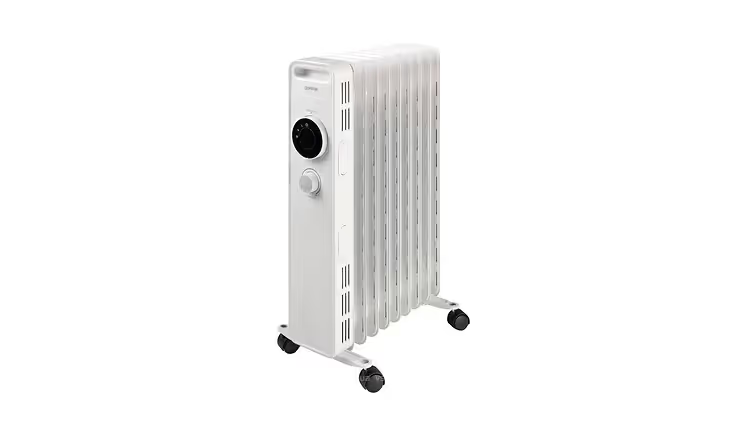
🔥 Oil heaters: an economical choice for winter heating
Heating bills go up every season, yet the radiators at home barely get warm. A familiar picture for hundreds of thousands of Ukrainian apartments with old-style central heating. In this situation, an oil-filled radiator is not a luxury but a practical tool: it covers a cold room without overpaying to heat the entire apartment.
The main thing is not to make a mistake when choosing. There are dozens of models, different wattages, and sellers' descriptions promise "innovative heating" for pennies. Below, without the hype: how it works, what types exist, what to look for before buying, and what it actually costs in real money.
💡 Quick overview:
- An oil-filled radiator heats a room in 30-60 minutes through circulation of diathermic oil inside a sealed housing: no fan, no noise, no oxygen burning.
- For a bedroom up to 15 m², a 1500 W model is enough; for a living room of 20+ m², go for 2000-2500 W, and make sure it has a thermostat, it pays for itself within a month of regular use.
- Unlike a fan heater, an oil-filled radiator continues releasing heat for another 20-30 minutes after switching off: the oil acts as a thermal accumulator.
- Compare not only the price but also the number of sections (the more sections, the more even the heating) and the presence of tip-over protection, especially if you have children or pets at home.
How an oil-filled radiator works
Inside the metal housing, mineral (diathermic) oil is hermetically sealed. It does not burn and does not evaporate: its sole job is to accumulate heat and release it slowly.
The chain is simple:
- You plug the device into an outlet, the heating element at the bottom heats the oil.
- The heated oil rises through the radiator sections, natural convection does the work.
- The metal fins of the housing heat up and release warmth into the room air.
- The thermostat monitors the temperature and switches off the heating element when the set threshold is reached.
The key point: the oil cools down slowly. After switching off, the radiator continues heating for another 20-30 minutes. It is this thermal inertia that delivers savings: the device does not guzzle electricity continuously but works in "heat, release, heat" cycles.
The wattage is stated on the rating plate, but actual consumption is lower due to the cycling. A 1500 W model operating with a thermostat in an insulated room consumes around 6-8 kWh per day, not 36 (as would be the case with continuous 24-hour operation). At 2026 Ukrainian household rates, that is about 25-35 UAH per day.
Types of oil-filled radiators: what is on the market
Not all oil-filled radiators are the same. The difference lies in the controls and additional features.
Type | Control | Suitable for |
|---|---|---|
Standard | Manual regulator, on/off | Budget option for a dacha or garage |
With thermostat | Maintaining a set temperature | Daily use at home |
With timer | Schedule-based programming | Savings: heating only during occupied hours |
Smart models | Wi-Fi, control via app | Smart home, remote start |
Portable | Castors and carry handle | One device for several rooms |
Standard models without a thermostat are the cheapest, but they are also the most power-hungry: they heat as long as they are plugged in, with no temperature control. A thermostat adds 200-400 UAH to the price but recoups that difference within the first month of regular use (calculations are in the efficiency section below).
Smart models are interesting for those who leave for work and return in the evening: you set a schedule "switch on at 17:00, switch off at 23:00" and come back to an already warm room. If that scenario is not yours, there is no point overpaying for Wi-Fi.
Oil-filled radiator, convector, or infrared heater: what to choose
There are three main types of electric heaters on the market, and each solves its own task.
Parameter | Oil-filled radiator | Convector | Infrared heater |
|---|---|---|---|
Principle | Oil heating → release through housing | Heating element → air through grille | IR radiation → heating objects |
Heating speed | 30-60 minutes | 10-15 minutes | Instant within the beam zone |
Noise | Silent | Silent (fanless) or quiet click | Silent |
Heat retention | 20-30 min after switching off | Cools down immediately | No heating outside the beam |
Best scenario | Bedroom, nursery, long-term heating | Quick heating of a living room, office | Spot heating: workstation, balcony |
An oil-filled radiator wins where you need stable background warmth for several hours: a bedroom at night, a nursery, a home office. A convector handles the task of "quickly warming up a large room in the morning" better. An infrared heater is a specialized tool: it heats you, not the air, and is good for a balcony or a workshop.
For an apartment with central heating, where a heater is needed as a supplementary source in one or two rooms, an oil-filled radiator with a thermostat is the most balanced option in terms of price, quietness, and electricity consumption.
How to match wattage to room size
The rule is simple: 100 W per 1 m² for a well-insulated room. If insulation is poor (old windows, corner apartment), allow 120-130 W per square meter.
Area | Wattage | Typical room |
|---|---|---|
Up to 10 m² | 1000 W | Small bedroom, study |
10-15 m² | 1500 W | Standard bedroom |
15-20 m² | 2000 W | Living room |
20+ m² | 2500 W | Open-plan kitchen-living room |
Getting a unit "with extra capacity" is a waste of money. A 2500 W model in a 12 m² room will constantly switch on and off (short cycles) instead of operating in an efficient mode of infrequent activations. The thermostat does not save the situation: the device itself is more expensive, and it does not heat any more effectively.
And vice versa: 1000 W in a 20 m² living room will run non-stop and still won't cope, leaving you cold and with an unpleasant electricity bill.
Efficiency: let's calculate in real money
The main myth circulating on forums: "oil-filled radiators consume electricity like crazy." The truth, in numbers.
Let's take a 1500 W model with a thermostat in a standard 14 m² bedroom. The thermostat is set to 21 °C, outside temperature is 0 °C:
- Initial heating to the set temperature: ~40 minutes, consumption ~1 kWh.
- Temperature maintenance: the heating element switches on for 8-10 minutes every half hour. Per hour, about 0.25 kWh.
- Per day (average 16 hours of active use): ~5 kWh.
- Per month: ~150 kWh.
At the Ukrainian household tariff, a month comes out to roughly 650 UAH. For comparison: a fan heater of the same wattage in the same mode consumes noticeably more due to the lack of thermal inertia, the oil continues heating when the element is already off, while a fan coil cools down instantly.
The specific consumption depends on insulation, outdoor temperature, and habits. But the principle is simple: a model with a thermostat and timer, all else being equal, is more efficient than a basic version with manual control. The price difference (200-400 UAH) is recouped within a month to a month and a half of regular use.
You can browse models and compare prices in the catalog: oil-filled radiators at Cactus.
What to look for before buying: 5 points
Number of sections. The more sections, the more even the heat distribution. For a 15 m² room, 7 sections or more; for 20 m², 9 or more. Fewer sections = a hot housing in one spot and cool air in the corners.
Thermostat. Without it, the device runs "always on," and the electricity bill will be an unpleasant surprise. A thermostat is not an option, it is a necessity.
Tip-over protection. If it falls, the device switches off automatically. Essential if you have children, a dog, or simply a cramped room where the heater could be knocked over.
Automatic overheat shut-off. Basic protection found in most modern models. Check for it in the specifications; cheap no-name devices sometimes skimp on this.
Weight and castors. An oil-filled radiator weighs 8-12 kg. Without castors, moving it from room to room becomes a sport of its own. Almost all manufacturers include them in the box, but double-check.
⁉️🤔 Frequent questions
Is it safe to leave an oil-filled radiator on overnight?
Yes, under two conditions: the model has overheat protection and tip-over protection. Oil-filled radiators have no exposed heating elements, the housing temperature rarely exceeds 60-70 °C, which is not enough to cause a fire. The main rule: do not cover the device with fabric and keep it at least 50 cm away from furniture and curtains.
Does the oil in the radiator need to be changed?
No. The oil is sealed in a hermetic housing at the factory and is designed for the entire service life of the device, usually 10-15 years. It requires neither topping up nor changing. If you hear a gurgling sound when first switching it on, that is normal: the oil heats up and expands, and the sound disappears after a couple of cycles.
Can an oil-filled radiator be used in a bathroom?
Not recommended. Even with an IPX4 (splash-proof) rating, high humidity and direct contact with water pose a risk of short circuit. For a bathroom, it is better to get a wall-mounted infrared heater with an IP24 protection rating or higher.
How long does it take to heat a room?
From 30 to 60 minutes depending on the area, insulation, and outdoor temperature. A 15 m² room with modern windows heats up to a comfortable 21 °C in about 40 minutes at 1500 W. This is not instant heating; if you need to "warm up urgently after coming in from the cold," an oil-filled radiator is not the best choice, go for a fan heater or a convector.
Why does a new radiator smell when first switched on?
The smell is residue of factory lubricant on the heating element, which burns off during the first 2-3 heating cycles. This is normal for any new device with a heating element. Ventilate the room during the first couple of hours of operation, and the smell will disappear completely.
Oil-filled radiator: buy or not?
If you need a quiet, safe source of background warmth for a bedroom or nursery for several hours a day, get an oil-filled radiator with a thermostat. It is not the fastest, but it is one of the most economical electric options for regular use.
The main thing is not to skimp on the thermostat and tip-over protection. A difference of 300-400 UAH at purchase translates into either peace of mind or overpaying for electricity and a fire risk.
Compare models within your budget, and may your home be warm without surprises in the utility bill.

A professional team of writers and editors specializing in creating quality content.