













🔍 What to check before choosing an alternative ventilation filter
The air people breathe inside a building passes through a filtration system, and if the filter is chosen incorrectly, not only does air quality suffer, but so does the energy efficiency of the entire ventilation unit. Dust, pollen, fine PM2.5 particles, and even microorganisms, all of this must be captured by the filter before the air enters the room.
Original filters from the ventilation unit manufacturer are a proven, but often expensive, option. Alternative (analog) filters can deliver the same performance for less money. But cost-cutting without checking specifications results in fan overload, higher electricity bills, and reduced air quality.
Below is a step-by-step breakdown of exactly what you need to check before buying an analog filter to avoid mistakes.
💡 Quick overview:
- Measure the exact dimensions of the old filter; even a millimeter gap leads to unfiltered air bypass.
- Verify the filtration class: the modern ISO 16890 standard (ePM1, ePM2.5, ePM10, ISO Coarse) has replaced the outdated EN 779, so use it as your reference.
- Request the pressure drop curve from the supplier; high resistance kills energy efficiency and shortens fan service life.
- Check certificates and independent test reports; a reputable analog manufacturer provides them without hesitation.
- Research the supplier's reputation: real reviews, time on the market, warranty terms.
What an analog filter is and when to consider one
An analog filter is a filter element manufactured by a third party to the specifications of a specific ventilation unit. It replicates the geometry, filtration class, and design of the original but is sold under the alternative manufacturer's brand, not the ventilation equipment manufacturer's brand.
The market for such filters in Europe is quite mature. Specialized suppliers, for example, https://cleanfilter.se/, offer alternative filters for a wide range of ventilation units. When chosen correctly, an analog filter provides the same air purity at a noticeably lower cost of ownership.
When switching to an analog filter is justified:
- the cost of the original consumable is significantly above market price;
- the original filter has been discontinued or has long lead times;
- you need a wider choice of filtration class (for example, upgrading from ePM10 to ePM2.5 for allergy sufferers), and the original manufacturer may not offer such an option.
Technical specifications: what to check first
Dimensions and tolerances
The first and most critical parameter is geometry. A filter that is even a millimeter smaller than the mounting slot leaves a gap through which unfiltered air bypasses the filter media. One that is too large will not fit or will deform during installation, which also creates gaps.
Measure the length, width, and depth of the old filter with a caliper or tape measure to the nearest millimeter. Compare with the analog filter's drawing or specification. If the supplier does not provide exact dimensions, that is a red flag.
Filtration class: ISO 16890 instead of EN 779
Since July 1, 2018, the ISO 16890 standard has been in effect in Europe, replacing EN 779. It classifies filters by their efficiency in capturing particles of a specific size:
ISO 16890 class | What it captures | Typical application |
|---|---|---|
ISO Coarse | Large dust, fibers (>10 µm) | Pre-filter, coarse filtration |
ePM10 | Pollen, medium dust (≤10 µm) | Offices, retail spaces |
ePM2.5 | Fine dust, mold spores (≤2.5 µm) | Residential buildings, schools, hospitals |
ePM1 | Ultrafine particles, bacteria (≤1 µm) | Cleanrooms, laboratories, operating rooms |
If a seller indicates a class according to the old EN 779 (G4, F7, F9), ask for the equivalent using the ISO 16890 transition table. There is no direct one-to-one correspondence: an F7 class per EN 779 can be either ePM2.5 or ePM1, depending on the manufacturer. Look at the test report, not the marketing description.
Pressure drop
Pressure drop is the difference in air pressure before and after the filter. Every filter creates resistance to airflow. The denser the filter media and the finer the particles captured, the higher the resistance.
A high pressure drop means the fan needs more energy to push air through. This directly increases the electricity bill and accelerates fan motor wear. Request the pressure drop graph at various airflow rates (the resistance vs. airflow curve) from the supplier and compare it with the original. A slight excess is acceptable within the measurement tolerance; a significant deviation is a reason to choose a different analog.
Material and construction
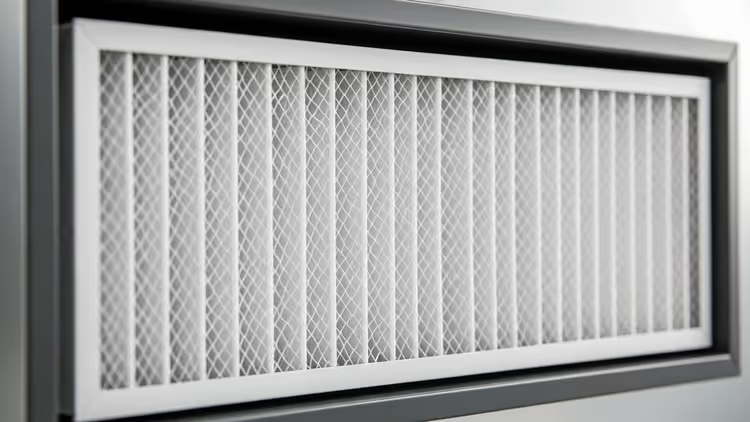
A quality filter has a multi-layer construction. The filter media (usually synthetic fiber or glass fiber) is pleated to increase surface area and reinforced on the sides with a rigid frame, either metal or plastic. Check the following:
- Frame: must be rigid, without play, and not deform during installation.
- Pleats: uniform, without sticking together; stuck pleats reduce the effective area.
- Material: must not shed fibers or particles into the airstream. Synthetic is preferable; glass fiber can "dust" microfibers.
- Perimeter gasket: mandatory for rigid (rigid-frame) filters; without it, bypass is guaranteed.
How to assess the quality of an alternative filter
Certificates and test reports
The main sign of a reputable manufacturer is open reports from independent testing. A Eurovent certificate, ISO 16890 test results from an accredited laboratory, a declaration of conformity, the supplier provides all these documents upon request. If you are shown only a promotional brochure instead of test reports, look for another supplier.
A good test includes: efficiency for ePM1, ePM2.5, and ePM10 (all three classes simultaneously, not selectively), pressure drop at nominal airflow, dust holding capacity, how many grams of dust the filter can hold before reaching the final pressure drop.
Supplier reputation
A supplier with a long history, its own warehouse, and open contact details is the minimum. Check the following:
- reviews on independent platforms (Google Maps, Trustpilot), not just on the supplier's website;
- time on the market: a company operating for 5+ years has already passed natural selection;
- presence of a physical address and phone number; fly-by-night suppliers hide behind an email and a contact form.
Warranty and returns
A manufacturer confident in its product provides a warranty and specifies return conditions. Clarify: what constitutes a defect (frame breakage, media delamination, excessive pressure drop), the timeframe for returning a filter, and who pays for return shipping. The absence of a clear warranty policy is another red flag.
Can you combine original and alternative filters
Yes, and this is common practice. A typical ventilation unit has two filtration stages: a coarse pre-filter (ISO Coarse) and a fine final filter (ePM1 or ePM2.5). The pre-filter is a consumable with a high replacement frequency, and it is precisely here that it makes sense to use a quality, but cheaper, analog. The final filter, especially in systems with high purity requirements (hospitals, pharmaceuticals), can remain original; it is replaced less often, and the price difference is less significant.
This two-tier strategy delivers savings without compromising air quality. The analog pre-filter takes on the bulk of the dust and protects the expensive final filter from premature clogging, so the latter lasts longer and total costs decrease.
⁉️🤔 Frequent questions
What is more important when choosing an analog: dimensions or filtration class?
Dimensions are critical: incorrect geometry means bypass, air goes around the filter, and the filtration class no longer matters. First, exact dimensions and a rigid frame with a gasket, then the ISO 16890 class. Both parameters are mandatory, but they must be checked in exactly that order.
How does ePM1 differ from ePM2.5 in practice?
*According to ISO 16890, an ePM1 filter captures at least 50% of particles sized ≤1 µm, which includes bacteria, viruses on aerosol carriers, and ultrafine dust. ePM2.5 captures at least 50% of particles ≤2.5 µm: pollen, mold spores, fine urban dust. For an office or residential building, ePM2.5 is sufficient; for an operating room or clean manufacturing, only ePM1 will do.
Is it mandatory to require a Eurovent certificate?
*Eurovent is the most authoritative European certification for air filters, but not the only one. Reports from any accredited laboratory operating according to ISO 16890 are acceptable. The key point is that the test must be independent, not an in-house factory test.
How often does an alternative filter need to be changed compared to the original?
*The replacement interval is determined by dust holding capacity and pressure drop, not by brand. Monitor the pressure gauge or differential pressure sensor in the system: when the pressure drop reaches the final value (stated in the filter documentation), it is time for a replacement. A quality analog has a service life comparable to the original; if a filter clogs twice as fast, the savings are illusory.
Can an alternative filter be used in a system with heat recovery?
*Yes. The filter is located before the heat exchanger and does not directly affect the recovery process. The only nuance: in systems with a rotary heat exchanger, it is important that the filter does not let through large particles capable of damaging the rotor surface. An ISO Coarse or ePM10 class on the pre-filter solves this task.
The EN 779 standard has been withdrawn; can you buy filters marked with the old standard?
*Formally, production of filters with EN 779 marking ceased in July 2018. In practice, warehouse leftovers and some manufacturers from non-EU countries still use the old marking. You can buy them, but request a transition report to ISO 16890; responsible suppliers provide a correspondence table.
What to do about filter selection right now
There is no universal "best" analog filter; everything depends on the specific ventilation unit and operating conditions. Here is an action plan that covers the main risks:
- Remove the old filter, measure length × width × depth to the nearest millimeter.
- Determine the required ISO 16890 class: residential building, ePM2.5; manufacturing, ePM10; medical, ePM1.
- Request test reports and the "pressure drop vs. airflow" curve from two or three suppliers.
- Compare the pressure drop with the original and ensure the difference is non-critical (the resistance vs. airflow graph runs level, without a steep rise at the working airflow).
- Check certificates, warranty conditions, and reviews, and only then place your order.
Savings on an alternative filter are real, but only with a thorough comparison of specifications. An analog filter with test reports and a warranty from a known supplier works no worse than the original. An anonymous "cheap analog" without documentation is a direct path to ventilation unit overload and electricity bills that will eat up all the illusory savings.
Before choosing an alternative ventilation filter, take a look at how the ISO 16890 testing process works; this will help you understand where the numbers in the reports you will request from suppliers come from:

A professional team of writers and editors specializing in creating quality content.