














🎧 Best PC headphones 2026: comparison of top models and selection tips
Whether you're a gamer, a Zoom remote worker, or a music lover, PC headphones have long since stopped being just "ear cups with a mic." The wrong headset will strain your neck within two hours, ruin an important call with background noise, and kill the immersion in a game where every enemy footstep decides the outcome. The right one works invisibly: no pressure, no noise bleed, spacious sound, and no need to recharge in the middle of the workday.
The PC headphone market in 2026 is overheated: dozens of brands, hundreds of models, prices ranging from $30 to $300. In this breakdown, five proven headsets that cover the main scenarios: esports, voice work, all-day comfort, and wireless freedom. For basic selection criteria and current prices, also check the PC headphone roundup at https://allo.ua/ru/naushniki/naznachenie_naushniki-garnitury_dlja_pk/, which has convenient filtering by connection type and budget. The Ukrainian interface of the platform is available at https://allo.ua/ua/naushniki/naznachenie_naushniki-garnitury_dlja_pk/.
Every model on the list below has been personally tested by our editorial team or has reproducible results from independent tests. No fluff, just sound, microphone, ergonomics, and price.
💡 Quick overview:
- Decide on the connection type: wired or wireless.
- Choose the driver size: 50 mm for deep bass, 40 mm for lightness.
- Evaluate the microphone: models with dedicated voice processing sound cleaner on calls.
- Check the weight and ear cushions: up to 370 g and breathable material for multi-hour sessions.
- Align with your budget: decent wired options from the budget segment, quality wireless from the mid-range.
📊 Spec comparison table
Model | Type | Weight | Driver | Battery life | Spatial sound | Price (USD) |
|---|---|---|---|---|---|---|
Razer BlackShark V2 Pro (2023) | Wireless | ~320 g | 50 mm TriForce Titanium | Up to 70 h | THX Spatial Audio | ~$200 |
HyperX Cloud Alpha | Wired | ~336 g | 50 mm Dual Chamber | ❌ | ❌ | ~$90 |
SteelSeries Arctis Nova 3 | Wired | ~300 g | 40 mm Neodymium | ❌ | Tempest 3D Audio | ~$100 |
Logitech G Pro X | Wired | ~320 g | 50 mm PRO-G | ❌ | DTS Headphone:X 2.0 | ~$125 |
Corsair HS80 RGB Wireless | Wireless | ~366 g | 50 mm Neodymium | Up to 20 h | Dolby Atmos | ~$150 |
1. Razer BlackShark V2 Pro (2023), the esports flagship
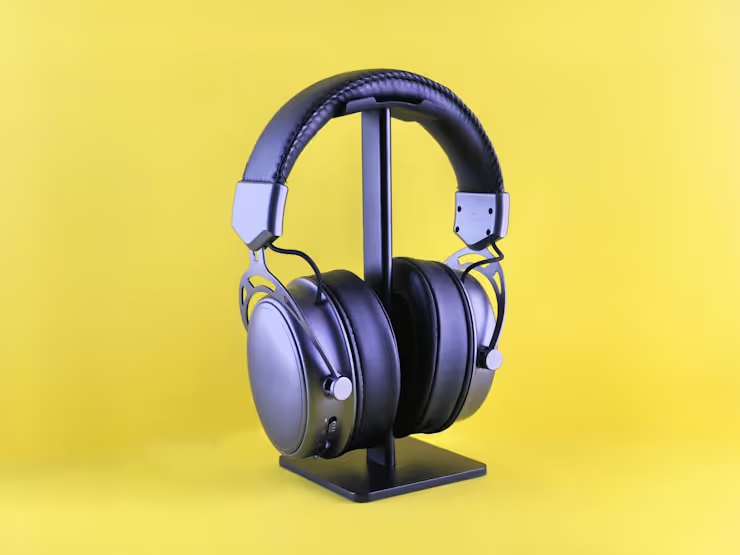
The 2023 edition of the Razer BlackShark V2 Pro is a deep rework of the original 2020 model. The main upgrade: battery life jumped from 24 to 70 hours on a single charge with RGB lighting off. In Tom's Hardware's real-world test, the headset lasted 68 hours, enough for two weeks of active gaming away from an outlet.
Wireless connectivity uses the proprietary Razer HyperSpeed protocol (2.4 GHz, ~1 ms latency) plus Bluetooth 5.2. You can stay connected to your PC via the dongle and take phone calls simultaneously. The microphone is a detachable HyperClear Super Wideband (32 kHz sampling rate), which in SoundGuys' tests delivered one of the cleanest voice profiles among gaming headsets.
Pros: record battery life, reference-grade microphone, very lightweight build (320 g), compatible with PC, PlayStation, Nintendo Switch. Cons: no active noise cancellation, price at the upper boundary of the mid-range segment. Price: upper boundary of the mid-range segment. Use case: esports, streaming, anything where the microphone matters as much as the sound.
🔗 Razer BlackShark V2 Pro on the official website
2. HyperX Cloud Alpha, the proven wired benchmark
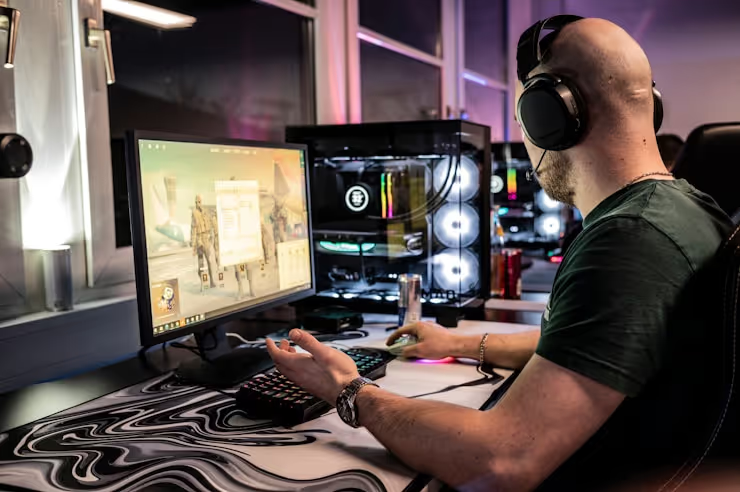
The HyperX Cloud Alpha is a rare case where a 2017 model is still relevant. The secret: dual-chamber 50 mm drivers (Dual Chamber) that physically separate low frequencies from mids and highs. In practice, this delivers clean bass without muddiness; explosions in shooters sound powerful but don't drown out footsteps and voices.
Wired connection (3.5 mm + extension cable), detachable noise-cancelling microphone, aluminum frame. Weight is 336 g, average for a wired headset. Leatherette ear cushions with memory foam; no pressure on the head after 4 hours. There is also a wireless version (Cloud Alpha Wireless) with up to 300 hours of battery life, an absolute class record.
Pros: clean bass without EQ, reliable build, universal compatibility via 3.5 mm jack. Cons: no spatial audio out of the box, microphone is average by 2026 standards, the entry-level lineup trails the Cloud III in software tuning. Price: budget segment. Use case: universal wired headset, gaming, music, work.
🔗 HyperX Cloud Alpha on the official website
3. SteelSeries Arctis Nova 3, comfort and clear voice

The SteelSeries Arctis Nova 3 is a wired headset that masquerades as a wireless one: lightweight (300 g), with the signature ski-goggle suspension band and breathable AirWeave ear cushions. By feel, it's one of the most comfortable models for 6-8 hour sessions.
The main feature is the ClearCast Gen 2 microphone on a retractable boom. It uses a voice processing chip at the software level via Sonar (free SteelSeries GG software), which cuts out background noise more aggressively than most competitors. The microphone almost completely ignores keyboard clatter and street noise outside the window. For those who spend a lot of time on Zoom, this is a critical advantage.
Pros: lightweight (300 g), benchmark comfort, top-tier microphone with software processing, RGB earcup lighting. Cons: wired connection, 40 mm drivers fall short of 50 mm competitors in bass depth, no Hi-Res Audio. Price: accessible mid-range segment. Use case: voice work (calls, podcasts), casual gaming, anything where comfort matters more than bass.
🔗 SteelSeries Arctis Nova 3 on the official website
4. Logitech G Pro X, studio-grade microphone
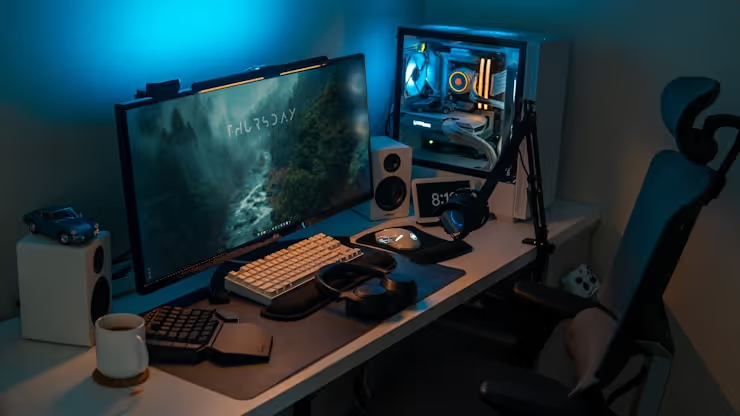
The Logitech G Pro X is a wired headset designed in collaboration with esports athletes. But the main reason for its popularity is Blue VO!CE technology. This is not just noise cancellation, but a full-fledged voice processor: equalizer, compressor, de-esser, gate, and limiter, all configurable in G Hub and saved to the headset's memory.
In practice, your voice through the G Pro X sounds as if you're sitting in front of a dedicated condenser microphone. For streamers and podcasters, this saves buying a desktop mic. The 50 mm PRO-G drivers deliver a flat frequency response, without the midrange dips typical of the "gamer" V-shaped sound signature.
Pros: Blue VO!CE microphone, the best in the wired headset class, flat sound, steel frame, two pairs of ear cushions included (leatherette + velour). Cons: wired connection with an external USB sound card (takes up a port), pricier than alternatives without Blue VO!CE. Price: mid-range segment. Use case: streaming, podcasts, professional calls, esports.
5. Corsair HS80 RGB Wireless, Dolby Atmos and broadcast microphone

The Corsair HS80 RGB Wireless is an attempt to cross the broadcast microphone from the Virtuoso line with a more accessible body. The microphone here is omnidirectional, with a 24-bit/96 kHz sampling rate, specs usually found in top-tier headsets. According to SoundGuys, 94% of listeners rated the HS80's voice quality as at least "good," higher than most competitors.
Connectivity is 2.4 GHz via the Slipstream USB dongle (you can connect multiple Corsair devices to one dongle) or wired mode via USB-C. Dolby Atmos for headphones support, plug-and-play on Windows. The elastic ski-goggle headband and velour ear cushions are comfortable for glasses wearers (no temple pressure).
Pros: broadcast-level microphone, Dolby Atmos out of the box, PS5/PS4 compatibility, comfortable fit for people with glasses. Cons: real-world battery life ~12.5 h (versus the claimed 20 h in SoundGuys' test), weakened bass without EQ in iCue, inconvenient wired operation without the software. Price: mid-range segment. Use case: PC gaming with Dolby Atmos, Zoom work with voice quality demands, PlayStation 5.
🔗 Corsair HS80 RGB Wireless on the official website
On the Stream Tech Reviews channel, a fresh breakdown of nine gaming headsets for 2026 with sound samples and microphone measurements. We recommend watching before buying: hearing the difference with your own ears is more useful than any spec table.
⁉️🤔 Frequent questions
Which headphones are better for PC gaming, wired or wireless?
In 2026, the latency gap between quality wireless (Razer HyperSpeed, Logitech Lightspeed) and wired has shrunk to 1-2 ms; the human ear can't tell the difference. The choice comes down to the use case: if you need mobility and no cables, go wireless; if stability without charging and price matter, go wired.
Which model delivers the best voice quality for Zoom and podcasts?
The Logitech G Pro X with Blue VO!CE provides studio-grade voice processing (equalizer, compressor, de-esser) without a separate microphone. If you need a wireless option, the Corsair HS80 with its 24-bit/96 kHz omnidirectional microphone sounds like a top-tier broadcast headset.
How much does a good PC headset really cost in 2026?
Wired models with decent sound start from the budget segment (HyperX Cloud Stinger 2). The optimal price/quality balance is the mid-range segment: this includes the HyperX Cloud Alpha, SteelSeries Arctis Nova 3, and Corsair HS80. Wireless flagships like the Razer BlackShark V2 Pro sit at the upper boundary of the mid-range segment.
What's the practical difference between 40 mm and 50 mm drivers?
50 mm drivers deliver deeper and more controlled bass due to the larger diaphragm area. The difference is noticeable in games with explosions and in music with low frequencies (EDM, hip-hop). But well-tuned 40 mm drivers (like in the Arctis Nova 3) still sound clean, just without the "chest-thumping" bass.
Is it worth paying extra for Dolby Atmos in headphones?
If you play shooters (Valorant, CS2, Call of Duty) or watch movies on a PC, yes. Spatial sound gives you precise source positioning: you hear not just "left," but "left-above-behind." For office work and music, there's no difference.
Which headphones should I buy for a child or teenager?
Lightweight models with volume limiting: HyperX Cloud Stinger 2 (275 g) or SteelSeries Arctis Nova 1 (236 g). Both are wired, with a good microphone and no fragile parts, in the budget segment.
Which is better: HyperX Cloud Alpha or Cloud III?
The Cloud III is the direct successor to the Alpha, with Ngenuity software support, DTS:X Spatial Sound, and USB connectivity. The Cloud Alpha remains on sale as a budget alternative. If you need a software EQ and spatial sound, get the Cloud III. If plug-and-play simplicity matters more, the Cloud Alpha is still relevant.
How long do PC headphones last on average?
3-5 years of active use. The fastest-wearing parts are the ear cushions (1.5-2 years for leatherette) and the cable (on wired models). On wireless models, the battery degrades after 2-3 years. HyperX and SteelSeries are known for longevity in user reviews, 4+ years without issues.
What to put on your desk in 2026: the final lineup
Choosing a headset means choosing a use case, not the "best model overall." For each task, its own tool:
- Esports and streaming, Razer BlackShark V2 Pro: 70 hours away from an outlet, a microphone heard at tournaments, and a weight of 320 g that disappears on your head.
- Voice work (Zoom, podcasts, calls), Logitech G Pro X: Blue VO!CE turns your speech into a studio product without extra equipment.
- Multi-hour sessions and sensitive skin, SteelSeries Arctis Nova 3: 300 g, breathable ear cushions, a microphone with aggressive noise suppression.
- Budget without sound compromises, HyperX Cloud Alpha: dual-chamber 50 mm drivers that still sound better than many new releases twice the price.
- Wireless work with broadcast voice, Corsair HS80 RGB Wireless: a studio-headset-level microphone and Dolby Atmos out of the box.
Pick a headset for your use case, not for a rating, and your headphones will serve you longer than any review.

A professional team of writers and editors specializing in creating quality content.