













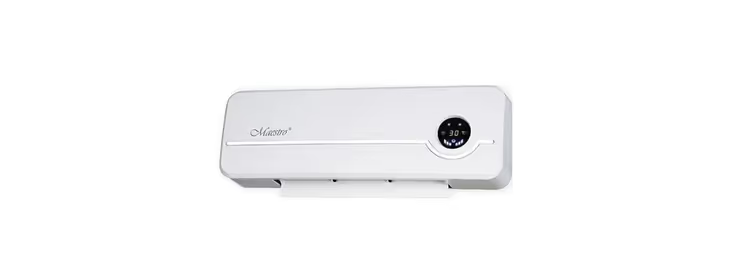
🌡️ Wall-mounted fan heater: how to choose, install and avoid mistakes
It’s gotten colder and the radiators still aren’t heating? Every apartment or house owner knows this off-season: it’s five degrees Celsius outside, but already uncomfortable indoors. An oil-filled radiator takes half an hour to warm up, a heat gun sounds like a runway, and a regular floor fan with a heating element takes up half the room and collects dust from the floor.
A wall-mounted fan heater solves these problems with a single installation. It doesn’t take up usable floor space, warms the air in minutes, and when properly installed works for years without needing attention. This article covers everything you need to know before choosing: types of heating elements, calculating wattage for your square footage, installation details, and real energy consumption figures.
💡 Quick overview:
- Ceramic vs. spiral heating element: a comparison of durability, safety, and warm-up speed, with a table.
- Power selection formula: 100 W per 1 m² at standard ceiling height, plus a table matching area to wattage.
- DIY wall mounting vs. hiring an electrician: pros, cons, and cost of both options.
- Key safety features: automatic overheat shut-off, tip-over protection, and IP rating.
- Real numbers: how many kilowatt-hours a fan heater consumes per month with daily use.
Ceramic or spiral: which heating element is better
Inside any fan heater there is a heating element, a tubular electric heater, but the implementation varies. The market splits into two camps: spiral and ceramic models. The difference is not in the housing design, but in exactly how the air is heated.

A spiral heating element is a nichrome wire, coiled into a spiral and openly positioned behind the fan. The wire temperature reaches 800-1000 °C. The air heats almost instantly: you turn it on, and within 30 seconds it’s warm. But speed comes at a cost: the exposed spiral burns oxygen (more precisely, it oxidizes dust, creating that characteristic burnt smell), dries the air, and causes burns on contact. The lifespan of a spiral is 2-3 heating seasons with regular use: nichrome thins out and breaks over time.
A ceramic heating element consists of aluminosilicate ceramic plates with a pressed-in resistive layer. The operating temperature of the plates is 150-300 °C, which is significantly lower than a spiral. Ceramic does not oxidize dust (no smell), does not burn oxygen, and most importantly, the heat exchange area is larger at the same wattage: the air warms more evenly and gently. Lifespan is 5-7 seasons. The trade-off for durability is a slower time to reach operating temperature: 2-4 minutes instead of 30 seconds.
Parameter | Spiral | Ceramic |
|---|---|---|
Heating speed | 30-60 seconds | 2-4 minutes |
Element operating temperature | 800-1000 °C | 150-300 °C |
Burnt smell during operation | Yes (dust oxidation) | No |
Lifespan | 2-3 seasons | 5-7 seasons |
Touch safety | Burn | Warm surface |
For a bedroom or child’s room, definitely go with ceramic. A spiral is only justified in utility rooms, garages, and on construction sites, where speed matters more than air quality.
How to calculate wattage: formula and table
The basic rule for apartments and houses with standard ceilings (2.5-2.7 m): 100 W per 1 m² of heated area. This is an industry standard confirmed by manufacturer calculators. A 15 m² room requires 1,500 W, a 10 m² kitchen requires 1,000 W. For ceilings above 3 m, add a 10% margin for each extra meter.
Room area | Minimum wattage | Recommended range |
|---|---|---|
5-8 m² (bathroom, hallway) | 500 W | 700-1,000 W |
10-15 m² (bedroom, kitchen) | 1,000 W | 1,200-1,500 W |
16-22 m² (living room) | 1,500 W | 1,800-2,000 W |
23-30 m² (studio, large room) | 2,000 W | 2,200-2,500 W |
Wattage above 2,000 W requires a dedicated power line from the panel; a standard 16 A outlet can handle up to 3.5 kW, but sustained load at the limit heats up contacts and the circuit breaker. Models up to 1,500 W plug into a standard outlet without modifications.
Pay attention to the number of power levels. A single level means the unit runs only at maximum or is off. Two or three levels let you adjust the heat: for example, 750 / 1,500 W. In the off-season, this saves up to half the electricity.
Wall mounting: DIY or a professional
Wall mounting is the main advantage of this type of heater over floor-standing units. The device hangs on the wall year-round, doesn’t block the walkway, doesn’t occupy a floor outlet, and won’t tip over from accidental contact. But installation comes in two types, and the choice between them depends on your willingness to work with wiring.

Models with a plug: installation in 20 minutes
Most household wall-mounted fan heaters up to 1,500 W come with a standard plug and a mounting template. The steps are:
- Choose a wall, either a load-bearing wall or a drywall partition with backing, at least 15 cm from curtains and furniture.
- Mark the holes using the paper template from the kit.
- Drill, insert wall plugs, screw in the bracket.
- Hang the unit and plug it into an outlet.
This takes half an hour with a break. The only nuance: the outlet must be nearby, and the cord shouldn’t hang across a walkway; secure it with a cable channel.
Models with a terminal block: you need an electrician
Units with 1,800-2,500 W more often come without a plug, with a terminal block for fixed wiring. Here three wires (phase, neutral, ground) are connected directly into a junction box through a dedicated 16 A circuit breaker. Doing this yourself without authorization to access the electrical panel is a fire risk and a reason for your insurer to deny a claim after a neighbor’s flood. Calling an electrician costs 1,500-3,000 UAH depending on the complexity of the chase and cable length, and it’s a justified investment in safety.
What to look for when choosing: 4 key parameters
Safety shut-off. An overheat sensor breaks the circuit when the housing reaches a critical temperature. A tip-over sensor is mandatory, even for a wall-mounted model: if it falls (bracket torn off, kids pulled on it), the unit must shut off instantly. Look for "tip-over protection" in the specifications.
Thermostat and timer. A mechanical thermostat is cheap and reliable, but its accuracy is ±2-3 °C. An electronic one maintains temperature to within a degree and often comes with a programmable on/off timer. The price difference is 300-600 UAH, but over a heating season an accurate thermostat pays for itself on your bills.
Remote control. A wall-mounted unit hangs above outlet level; reaching for the buttons every time is inconvenient. A remote solves this problem. For elderly people and families with children, this is not an option but a necessity.
Noise level. The fan always hums; the question is how many decibels. 35-45 dB is comparable to a quiet conversation and acceptable for a living room. 50+ dB is audible at night and unsuitable for a bedroom. Check the "noise level" spec in the datasheet, not in the marketing description.
How much electricity a fan heater consumes: real numbers
A 1,500 W fan heater running 5 hours a day consumes 7.5 kWh per day. At a rate of 4.32 UAH/kWh (Kyiv, 2026), that’s 32.40 UAH per day, or roughly 970 UAH per month. Is that a lot? Compare it to central heating: heating the entire apartment for the sake of one cold room often costs more.
Three factors help lower the bill. First, stepped power control: half wattage (750 W) is often enough to maintain background heat. Second, a thermostat: when the set temperature is reached, the unit switches off instead of running non-stop. Third, zone heating: you heat only the room you’re in, not the entire area.
For a bathroom, choose a model with an IP24 rating or higher; splashes won’t damage the electronics. For living rooms, IP20 is sufficient.
Below is a video review of a wall-mounted smart heater with a ceramic element and app control. In 8 minutes, the author demonstrates real heating of an 18 m² room from 16 to 22 °C with time measurement:
⁉️🤔 Frequent questions
Can I leave a fan heater on overnight?
Models with a ceramic element, thermostat, and overheat protection: yes, provided the outlet is in good condition and there are no flammable objects within a one-meter radius. Spiral models: no. The exposed heating element and lack of a precise thermostat make overnight operation unsafe.
Does a wall-mounted fan heater dry the air?
Any heating device lowers relative humidity because warm air holds more moisture than cold air. But the fan heater itself does not remove water from the air; this is a physical consequence of heating, not a feature of the device. Ceramic models affect humidity less than spiral ones because they operate at a lower element temperature. A humidifier placed next to the unit completely solves the issue.
How is a wall-mounted fan heater different from a convector?
A fan heater warms air forcibly: a fan pushes it through the heating element. A convector works on natural circulation: cold air enters from below, heats up over the element, and exits through the top grille. The first warms a room faster but makes noise. The second is silent but slow: 10-15 minutes pass between turning it on and feeling noticeable heat. For quickly warming a frozen cottage, use a fan heater. For constant background heating, use a convector.
Does a wall-mounted fan heater need maintenance?
Yes, once a season. Remove the housing (4-6 screws) and blow out the fan and heating element with compressed air or a vacuum cleaner with a narrow nozzle. Dust on a spiral is the source of burnt smell and a cause of overheating. Ceramic plates accumulate less dust, but preventive cleaning every six months doubles the lifespan.
How long does a wall-mounted fan heater last?
A spiral one: 2-3 seasons of intensive use. A ceramic one: 5-7 seasons with annual cleaning. The main cause of failure is not the element burning out, but the fan bearing failing due to accumulated dust. Expensive models (from 2,000 UAH) often use ball-bearing fans with a lifespan of 30,000+ hours.
What to install in a room: the bottom line
In practice, the choice comes down to three scenarios. For a bedroom or child’s room: ceramic, electronic thermostat, noise level no higher than a quiet conversation, wattage matched to the square footage with a 20% margin. For a bathroom: IP24, ceramic, half a kilowatt with margin, mandatory safety shut-off. For a garage or workshop: spiral, maximum wattage the existing wiring can handle, mechanical thermostat.
Don’t chase maximum wattage: 2,000+ W in a 12 m² room means a draft of hot air, not comfort. Choose a model with two power levels and let the thermostat do its job. And don’t skimp on installation: have an electrician handle the fixed wiring via a terminal block; the cost of their work is five times less than the cost of a short circuit’s consequences.
Browse current models of wall-mounted fan heaters in the catalog; you’ll also find reviews from customers who have already tested specific units in real-world conditions.

A professional team of writers and editors specializing in creating quality content.