🛠 Remote WordPress development with VS Code on Amazon EC2
Step-by-step VS Code and AWS EC2 setup: from SSH keys to workspace. Write code directly on a production server without…

Code is equally needed for a CMS-powered site and a project built from scratch. This section is about development outside the WordPress ecosystem. Frontend and backend, tools and ready-made techniques. For those who do layout, write scripts, or install Git on their computer for the first time.
Frontend is broken down layer by layer. HTML as the page skeleton. CSS for styling: grids with Flexbox and Grid, responsiveness, smooth transitions and clean effects without excess code. JavaScript and jQuery for behavior: toggles, click handling, form validation, on-page dynamics. There are breakdowns of specific tasks like the .toggle() method, generating a random number, a countdown timer or smooth scrolling to an anchor. Not abstract theory. Ready-to-use code you can paste and test.
The backend rests on PHP. We show how to call external APIs (programming interfaces through which websites exchange data). For example, pulling the Bitcoin rate, the weather or a product price from a third-party service. We cover sending a form to email, working with JSON, basic database queries. Also regular expressions — that pattern-search language many people fear for no good reason. Email and phone validation, string cleanup. We explain through real examples, not dry syntax.
Code needs to be written and stored somewhere. Hence a separate block on tools. Git and GitHub for version control and collaboration. Installing Git on Windows from scratch, basic commands, your first repository, rolling back changes, working with branches. Markdown for documentation and READMEs. CodePen for quick experiments in the browser. Local environment: Laragon, Open Server, XAMPP, the Atom editor. Everything you can actually work comfortably with every day.
Who we keep in mind when we write. The beginner is just figuring out how a tag differs from a selector and copies code without understanding half the lines. The experienced dev knows the basics but is looking for a short solution to a pinpoint task so as not to reinvent the wheel. For the first, we explain every line and show the result in the browser. For the second, we provide a ready snippet and immediately note where it will break.
Typical mistakes we highlight. A script in the head instead of the footer, causing jQuery not to find the element. A forgotten semicolon and mismatched quote types. A regex that greedily grabs too much. A direct database query without data validation. We show not only working code but also the pitfalls around it.
The materials are written by people who actually write code, not those who retell other people's tutorials. We've stumbled over these same mistakes and remember where a beginner gets stuck. That's why every breakdown is structured simply. First, a short working solution. Then an explanation of why it works and where the hidden traps are. No fluff and no copy-paste from official documentation.
If you're just starting out, move from simple to complex. First HTML and CSS. Then JavaScript and basic PHP. And only then Git, APIs and regular expressions. Each text answers a specific question rather than trying to cover everything at once.
The section is linked to the WordPress category. When the code specifically concerns the WP core, hooks, functions.php or plugins, we take you there. Here you'll find everything universal and useful for any project. A CSS snippet will work just as well on a landing page, a blog or an online store.
Content is regularly updated to match current standards and tool versions. Languages evolve, old techniques become obsolete, new ones appear. We keep the examples working rather than leaving decade-old code lying around. Doing layout, writing scripts or learning Git? Come back here whenever you need to figure out code or find a ready-made solution.
Step-by-step VS Code and AWS EC2 setup: from SSH keys to workspace. Write code directly on a production server without…
Beautiful SVG dividers for WordPress: six ready-made styles, SVG Divider for Elementor plugin review, built-in Shape…
Beaker Browser was an experimental P2P browser built on the Hypercore protocol: how it worked, what APIs it offered…
Creating custom Elementor widgets: from plugin structure to inline editing, custom controls and migration to current…
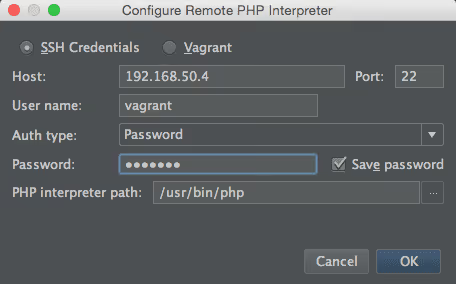
Setting up PHP CodeSniffer and WordPress Coding Standards in PhpStorm: installation via Composer, auto-fixing with…
A step-by-step guide to creating and running JavaScript snippets in Chrome DevTools. Practical examples: collecting…
Breaking down the rarely used CSS property display: inline-flex: how it works, how it differs from flex, and when to…
We've compiled 21 open source plugins for tooltips: from CSS snippets to product tour frameworks. Comparison table,…
9 tools for identifying fonts in 2026: online services, extensions and bookmarklets. Plus a step-by-step guide for…
3v4l.org runs PHP code on 300+ versions simultaneously. No VMs or Docker: paste a snippet and instantly see where code…