













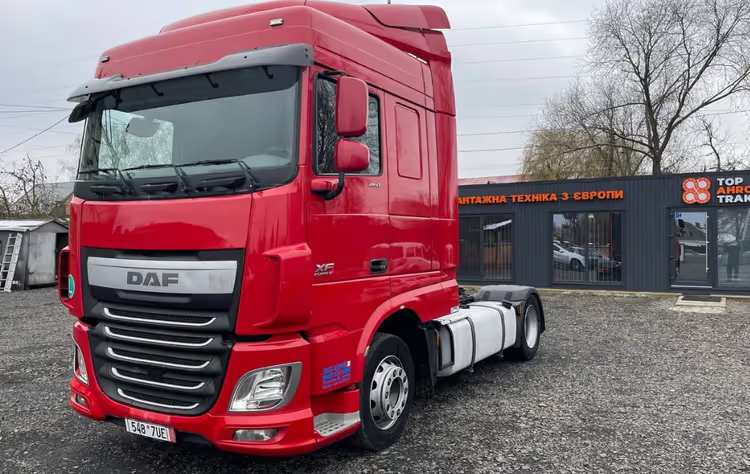
🚛 DAF trucks: reliability, efficiency and real numbers
Transportation is the circulatory system of any agricultural business. Harvest is in, but there is no way to haul it out? Or equipment breaks down at the peak of the season? Every day of downtime means direct losses.
The market for long-haul tractors is overflowing with offers, but farmers don't need "something powerful", they need predictable equipment: something that pulls, doesn't break down, and doesn't drain the budget on diesel. DAF is one of the few brands that has consistently held the bar on exactly these three parameters for decades.
💡 Quick overview:
- what the current DAF model range includes and how the XF, XG, XG+, and XD differ;
- which engine sits under the cab and why the PACCAR MX-13 is considered one of the most reliable in its class;
- how much fuel the new DAF tractors actually save on long hauls;
- which safety and comfort systems come as standard;
- whether it's worth looking at electric versions or sticking with diesel for now.
DAF model range: what to choose for your needs
Since 2022, DAF has completely renewed its lineup, and this is not a facelift but a new generation of cabs, aerodynamics, and electronics. Today the range includes four families.
DAF XF, the classic long-haul tractor for distance transport. The cab uses the older architecture, but it's proven over the years: spacious, with a flat floor and two berths. If the budget is tight and the hauls are long, the XF is still a workhorse.
DAF XG and XG+, the new-generation flagships. The cab is noticeably roomier than its predecessor: according to DAF's technical documentation, the XG+ interior volume was one of the largest in the European segment among series-production tractors at the time of the model's launch. Huge windshield, low beltline, side cameras instead of mirrors (optional). The aerodynamics are refined to the point that on highway routes the XG+ consumes tens of thousands of euros less fuel over the vehicle's lifecycle compared to its predecessor.
DAF XD, a tractor for regional and distribution transport. The cab is lower, entry and exit are easier for frequent stops, and the turning radius is smaller. For farmers who run equipment within a 300-500 km radius from the farm, the XD often proves more practical than long-haul tractors.
To simplify the choice down to one phrase: XF, budget entry into long-haul, XG, comfort and fuel savings, XD, work on short hauls.
A detailed video review of the current DAF lineup from a specialized channel, showing the cabs, engine, and electronic systems.
PACCAR MX-13 engine: what's inside
The heart of any modern DAF, an inline 6-cylinder PACCAR MX-13 diesel with a displacement of 12.9 liters. Three power options: 315, 355, and 390 kW. Torque ranges from 2300 to 2600 N·m, and the plateau is available from low revs.
Key technical solutions:
- Latest-generation Common Rail, injection pressure up to 2500 bar, precise fuel metering.
- Variable geometry turbocharger (VGT), quick throttle response without turbo lag.
- Euro 6 exhaust aftertreatment system, triple circuit: EGR (exhaust gas recirculation), SCR (selective catalytic reduction with AdBlue injection), and an active particulate filter.
In practice, this means: the engine runs through service intervals without needing oil top-ups, isn't fussy about diesel quality, and delivers its designed service life. According to the manufacturer's own data, the MX-13 was designed for a mileage of 1.6 million kilometers before overhaul, and independent reports from European fleets confirm that many units surpass the 2 million mark.
Fuel consumption depends on the model and load. An XG+ with a gross combination weight of 40 tons at a cruising speed of 85 km/h fits within 24-26 liters per 100 km, which is an excellent figure for a long-haul tractor, especially compared to competitors that demand 28-32 liters under similar conditions.
Driver comfort and safety: not marketing, but hardware
A tractor is a home on wheels for a driver who spends 10-12 hours behind the wheel. DAF understands this and invests in ergonomics no less than in the engine.
In the XG+ cab, a driver can stand at full height (interior height over 2 meters). The seat is air-suspended, with heating and ventilation in the top specification. The lower bunk is a full-fledged mattress 80 cm wide, not a cot. Climate control includes a separate parking "battery": the air conditioner and heater work without starting the engine.
Electronic assistants come as standard on the new generations:
- adaptive cruise control with Stop & Go function, maintains distance and can bring the vehicle to a complete stop in traffic;
- automatic emergency braking system (AEBS), recognizes cars, trucks, and pedestrians;
- lane departure warning system (LDWS), alerts the driver to unintentional lane departure;
- side-view cameras (instead of mirrors, optional), eliminate blind spots and improve visibility in rain and darkness.
Worth a separate mention is the DAF Connect system, a telematics platform that collects real-time data on fuel consumption, driving style, component condition, and predicts maintenance. For a fleet owner with 5-10 vehicles, this means control without calling drivers: everything is visible on the dashboard.
Electric DAF: a foundation for tomorrow
Since 2023, DAF has been series-producing battery-electric versions: XD Electric and XF Electric. Range is up to 500 km on a single charge (XD Electric, on the urban distribution cycle). This is not yet sufficient for long-haul transport, but for regional logistics and the agricultural sector with predictable routes, it's quite viable.
Charging from a 325 kW station replenishes the battery from 20 to 80 percent in about 45 minutes. The electric modifications retain the same cab and chassis as the diesel versions, mechanics don't need retraining, and spare parts are partially unified.
Practical conclusion: if a farm operates within a radius of up to 200-250 km from its base and has the ability to install charging infrastructure, the XD Electric pays for itself through the difference in electricity and diesel costs plus reduced maintenance expenses (no oil, filters, EGR/SCR system). For long hauls, diesel remains without alternative for now, and DAF understands this, continuing to develop the MX-13 in parallel with electric vehicles.
Reliability backed by numbers
By the end of 2024, DAF's share of the European market for tractors with a gross weight over 16 tons reached 15.8 percent in the fourth quarter, a record figure for the brand (up from 15.6 percent a year earlier). The growth is not explosive but steady, and in the commercial vehicle segment, stability is valued above all else.
Why farmers choose DAF:
- Low total cost of ownership (TCO): fuel savings, long service intervals, high residual value on the secondary market.
- Extensive dealer network in Europe: over 1000 service points, fast spare parts supply.
- Adaptation for specific tasks: DAF offers factory preparation for tipper platforms, reefers, tankers, no need for makeshift solutions at a third-party shop.
⁉️🤔 Frequent questions
How does the DAF XG+ differ from the XF?
The XG+ cab is 160 mm longer, with an interior volume of 12.5 m³ versus roughly 10 m³ in the XF. The XG+ has a lower beltline, improved aerodynamics, and comes standard with a digital instrument panel. The difference in fuel consumption can be up to 10 percent in favor of the XG+ on highway routes.
What is the service life of the PACCAR MX-13 engine before overhaul?
The manufacturer designed the MX-13 for a mileage of 1.6 million kilometers before overhaul. Independent data from European transport companies shows that, with adherence to the maintenance schedule, many engines reach 2 million without being opened up. The key factors are oil and fuel quality, as well as timely replacement of accessory drive belts.
Is DAF a European or an American manufacturer?
DAF is a Dutch company (headquarters in Eindhoven) and has been part of the American PACCAR corporation since 1996. PACCAR MX-13 engines are developed and produced in Europe, as are the chassis and cabs. In practice, it is a European product with American investment in development.
Is it worth buying an electric DAF for agricultural transport?
If routes are predictable and do not exceed 200-250 km per day from the base, yes, the XD Electric already pays for itself through the difference in energy costs and reduced maintenance volume. For long hauls (500+ km per day), diesel remains the only practical option at least until 2027-2028, until the density of charging infrastructure on highways increases.
Where is the most advantageous place to buy a DAF tractor for agribusiness?
The choice of platform depends on the budget and required condition: a new tractor from an official dealer with a factory warranty, or a used one with mileage from specialized marketplaces like Autoline, where hundreds of options with verified history are presented. Before buying a used vehicle, be sure to order an engine and transmission diagnostic, check the legal compliance and real mileage through technical inspection databases.
Should a farmer buy a DAF in 2026?
In short: yes, if you need equipment that won't let you down during the season. The current DAF lineup is a mature product without teething problems. The PACCAR MX-13 engine is one of the most proven in its class, the new-generation cabs genuinely save fuel, and the dealer network allows for repairs without long downtime.
For farms with intensive logistics, the XG+ will be the optimal choice; the premium for aerodynamics pays for itself within the first year of diesel savings. For smaller farms with short hauls, the XD, either diesel or (if charging is available) electric. And if the budget is tight, a proven XF on the secondary market still does its job without compromises on reliability.
The main thing is not to postpone fleet renewal until the last moment. The season doesn't wait, and good vehicles get snapped up quickly.

A professional team of writers and editors specializing in creating quality content.