













🔒 Getac laptops: advantages and how to choose
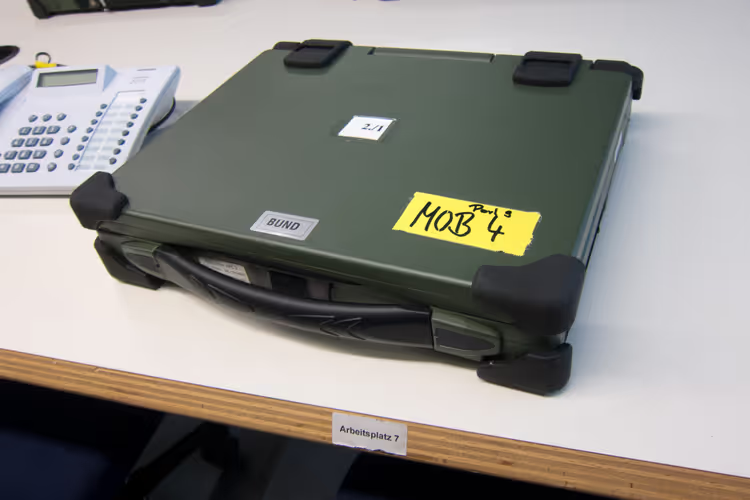
A regular laptop falls off a desk, and the screen shatters. What about rain? What about a construction site or a field base in the steppe? Consumer tech dies there within a week. Meanwhile, geologists, military personnel, and field engineers work with laptops for years out in the open and have no issues. The secret: rugged Getac machines.
Getac, a Taiwanese brand that has been making laptops and tablets since 1989, builds devices that survive what would destroy any ThinkPad or MacBook. Their hardware is certified to military standards and operates in a range from arctic frost to desert heat. Straight to the point: which models are relevant in 2026, how they differ from regular laptops, and how to choose a Getac for your task without overpaying for armor you don't need.
💡 Quick overview:
- Rugged Getac laptops are certified to MIL-STD-810H and have IP65 to IP67 protection; dust, water, shocks, and vibration are not a threat.
- The current lineup includes the B360, S510, S410, V110, and X600, from compact semi-rugged to ultra-rugged workstations.
- Key selection criteria: usage scenario, required protection level, performance, and budget (new vs. used).
What Getac laptops are and who they are built for
Getac Technology Corporation, a subsidiary of MiTAC-Synnex Group, one of Asia's largest technology holdings. Since the late 80s, they have specialized in rugged computing devices for extreme environments. No consumer lines: all R&D goes into a single direction.
A rugged laptop differs from a regular one not just by having a "reinforced case." It is a machine redesigned from the ground up: a motherboard with damping pads, sealed ports with covers, a hard drive in a shock-absorbing frame, a display with chemically strengthened glass. Every component is engineered to withstand a drop, vibration, temperature swing, or a direct stream of water.
Who actually needs this:
- Emergency services and fire departments, working in smoke, high humidity, and with gloves.
- Military and defense, field headquarters, reconnaissance, repair depots.
- Oil and gas sector and geological exploration, drilling rigs, rotation camps, tundra routes.
- Construction and infrastructure, dust, dirt, falls from height.
- Field service for telecom and energy companies, diagnostics on poles and in manholes.
If your laptop sits on an office desk almost all the time, you don't need a Getac. But if the hardware works where you work (in a hard hat, in the rain, in an excavator cab), a standard ultrabook will give up within a month.
Key advantages of rugged Getac laptops
A rugged laptop is not just "a laptop in a rubber case." Let's break down what makes Getac's survivability tick at the engineering level.
MIL-STD-810H standards and IP ratings. This is not marketing. MIL-STD-810H, a battery of 29 tests from the U.S. Department of Defense: a 1.2 m drop onto concrete (26 times, on every face, edge, and corner), vibration in three axes, thermal shock from -51 to +71 °C, salt fog, explosive decompression. The IP rating (Ingress Protection) shows dust and water protection: IP65, full dust-tightness + a pressurized water jet; IP67, the same + immersion up to 1 m for 30 minutes. Most Getac models are certified to IP66; flagships, to IP67.

Performance without compromises. A rugged case does not mean "weak internals." Current Getac B360 and S510 models are equipped with Intel Core Ultra (Meteor Lake) processors with an NPU module for local AI, up to 64 GB of DDR5 RAM, and NVMe drives up to 4 TB. This is enough for CAD applications, GIS systems, 3D modeling, and analyzing large geodata sets right in the field.
Sunlight-readable displays. A standard laptop screen outdoors on a sunny day is a mirror where you can only see your own reflection. Getac uses panels with 1200-1400 nits of brightness (an office monitor outputs 250-300) and LumiBond technology, optical bonding of display layers without an air gap that causes glare. The result: the screen is readable under direct sunlight. Select models support operation with gloves and in the rain (multi-touch "wet hands" mode).
Hot-swap batteries. On a field trip, there is no outlet for days. Getac batteries are removable, and many models have two; you can pull out the main one and swap it for a charged one without shutting down the laptop (hot-swap). Plus optional high-capacity batteries and bridge chargers for several batteries at once.
Ergonomics for harsh conditions. The keyboard is sealed and has a backlight with adjustable color (red, for night operations, to avoid giving away your position). The carry handle is not an accessory but a chassis element that supports the weight of the entire device. Ports are closed with sealed screw-on covers, not flimsy rubber flaps. Every detail is thought through for the "working on my knee in a truck cab" scenario.
How to choose a Getac laptop: what to look at
Choosing a rugged laptop comes down to four parameters: where you work, what you run, how much weight you are willing to carry, and your budget.
Protection level. Fully rugged models like the B360 and X600 are for construction sites, quarries, and military operations. Semi-rugged S510 and S410 are for field engineers, police, and utility workers: splash and drop protection is there, but weight and price are lower. The rule is simple: the higher the IP rating and the wider the temperature range, the heavier and more expensive the device.
Screen. For outdoor work, brightness from 1000 nits is mandatory. If you work in a vehicle or under a canopy, 700-800 nits is enough. For night shifts, adjustable backlight color temperature and a minimum brightness level are important (some models go almost to zero to avoid glare in the dark).
Performance. Intel Core Ultra processors (Series 1 and 2) are installed in the current B360 and S510. For resource-intensive tasks (GIS, CAD, 3D scanning), get a Core Ultra 7/9 with 32+ GB RAM. For terminal access and reporting, a Core Ultra 5 with 16 GB is sufficient.
Weight and portability. The fully rugged B360 weighs about 2.3 kg. The X600, a full 4.5 kg. This is not a "grab with one hand on the subway" device. But the safety margin is directly proportional to the mass: thicker magnesium alloy chassis, more stiffening ribs, more powerful shock absorption.
Getac 2026 lineup: what to pick for what
A quick guide to the current series:
B360 / B360 Pro / B360 Plus. Flagship fully rugged laptops. 13.3-inch 1400-nit display, Intel Core Ultra (Arrow Lake) with NPU, up to 64 GB DDR5, Wi-Fi 7, optional 5G and GPS. The Pro version adds two hot-swap battery slots and an additional SSD. B360 Plus, a Copilot+ PC with a dedicated AI button. The gold standard for defense and oil and gas.
S510 / S510AD. Semi-rugged laptops with a 15.6-inch screen. Thinner and lighter than fully rugged lines (about 2 kg) but retain MIL-STD-810H and IP53. Good for police, field engineers, and utility workers. S510AD, a Copilot+ PC with AI acceleration.
S410. Compact 14-inch semi-rugged laptop. A lighter version of the S510 for those who prioritize mobility. Suitable for inspections and installation crews.
V110. An 11.6-inch convertible laptop with a rotating screen. Fully rugged, IP65, works in tablet mode. Scenario: military medicine, aviation, logistics terminals.
X600 / X600 Pro. Ultra-rugged mobile workstation with a 15.6-inch display and Intel Core i9 HX-series processors. Up to 128 GB RAM, NVIDIA RTX graphics. Weighs 4.5 kg, IP66. For combat engineers, oil exploration, and heavy engineering calculations.
Where to buy a Getac laptop and not overpay
A new Getac B360 in a base configuration starts from three and a half thousand dollars. A top-spec X600 Pro with RTX graphics can exceed ten thousand. This is a professional tool, not a consumer purchase.
The used Getac market is a different story. Rugged laptops are designed with a triple mechanical safety margin: the magnesium alloy chassis does not fatigue, shock absorbers do not lose their properties, port seals last the entire lifecycle. A three- or five-year-old Getac after corporate decommissioning surpasses a new consumer laptop from a store in reliability. Before sale, such machines undergo full diagnostics, and sellers provide a warranty. Buy a used Getac laptop from specialized stores with delivery and inspection of each device before shipping.
⁉️🤔 Frequent questions
How does Getac differ from Panasonic Toughbook?
Both brands are leaders in the rugged laptop market, but with different approaches. Toughbook bets on modularity (removable expansion bays) and is traditionally strong in the "police + ambulance" segment. Getac wins on display brightness (1200-1400 nits vs. 1000-1200 for Panasonic), hot-swap battery support in more models, and a more aggressive price for comparable specs. The choice often comes down to which brand a specific agency's or corporation's supply chains are geared toward.
Both manufacturers are certified to MIL-STD-810H and IP66+. Panasonic is strong in modularity, Getac wins with screen brightness and price. If you already work with one brand, it's easier to stay in its ecosystem: accessories, docking stations, and chargers are interchangeable within the lines.
Can I install Windows 11 on an old Getac?
Yes, most models starting with the B360 (2019+) and S410/S510 (2021+) are fully compatible with Windows 11, including TPM 2.0 and Secure Boot requirements. Older lines (Getac V110 G3 and older, S410 G2 and older) are not officially supported but work with installation workarounds. Before buying a used device, check the generation (G-number) of the model.
Models from 2019 and newer have TPM 2.0 and Windows 11 compatibility out of the box. On older devices, installation is possible with workarounds, but without official driver support.
How long does a Getac battery really last in field conditions?
In "medium brightness, Wi-Fi on, office applications" mode, 8-12 hours on a fully charged standard B360 battery. Models with two batteries (B360 Pro, X600) deliver up to 18-20 hours without recharging. Hot-swap technology means that with a kit of three to four batteries and a bridge charger, you are autonomous indefinitely. In frost below -20 °C, all lithium-ion batteries lose capacity; factor in a significant reserve against the nominal rating.
A standard battery holds 8-12 hours of office work. Dual-battery versions, up to 20 hours. With a set of spare batteries and a charging station, autonomy is unlimited.
Is it worth getting a Getac for office work with rare field trips?
Probably not. A rugged laptop is heavier, thicker, and noticeably more expensive than a regular business laptop of comparable performance. For the "mostly office, occasionally a shop floor or construction site" scenario, it is more practical to get a Dell Latitude Rugged or a ThinkPad T/P series with a reinforced case; they will survive an accidental drop but won't carry the price tag and mass of a fully rugged machine. A Getac is justified when field trips take up most of your working time.
For occasional trips, a reinforced business laptop (Dell Latitude Rugged, ThinkPad T) is enough. A Getac pays off with regular field work.
Does Getac offer an international warranty and what about service?
Getac provides a standard three-year warranty with an option to extend up to five years. The service network covers most regions through authorized partners. A special feature: the warranty includes protection against accidental damage in the standard package; for rugged devices this is logical, but nice. Check the terms with your local distributor: in some countries, accidental damage is an option, not a base part of the package.
Three years base warranty, up to five years extension. Accidental damage is included in the standard package in most regions. Check with your local distributor.
Which Getac to get: a final guide
If you work on a drilling rig or in a field headquarters, get the B360 Pro with a dual battery and 5G module. Field engineer or police patrol, your choice is the S510: lighter, cheaper, a 15.6-inch screen for reports and maps. Need a mobile workstation for on-site calculations, the X600 Pro with RTX graphics. For specific aviation and logistics tasks, the V110 convertible.
Budget is tight, look at used B360 and S410: Getac reliability is such that a three-year-old unit after diagnostics works like new and costs half as much. The main thing is to buy from sellers with a warranty and service history.
Choose not the most tricked-out Getac, but the one that will cover exactly your field tasks. Overpaying for armor that will never be needed is not worth it.

A professional team of writers and editors specializing in creating quality content.