













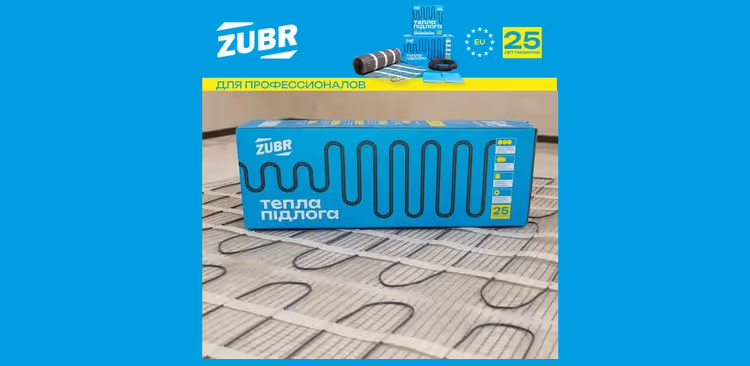
🔥 Heating mats under tiles: features, advantages and selection nuances
Cold bathroom floor barefoot early in the morning is an acquired taste. And if a full screed with a water circuit doesn't fit into the renovation, while a regular radiator eats up wall space and heats unevenly, it's time to look at a thin electric mat under tile.
This system goes directly into the tile adhesive layer, requires no demolition of the old floor, and starts with a single click of the thermostat. Let's break down how a heating mat works, how it differs from cable and infrared film, and what to look for before buying.
💡 Quick overview:
- Choose a heating mat with the right power output: 150 W/m² for bedrooms and living rooms, 200 W/m² for bathrooms and kitchens. Twin-conductor shielded cable is mandatory for living spaces.
- Prepare the subfloor before installation: clean the rough floor from dust and debris, apply a deep-penetrating primer, wait until fully dry.
- Roll out the mat over the marked area, cutting only the fiberglass mesh between cable loops. Route around plumbing outlets, corners, and stationary furniture.
- Connect the mat's cold lead to the thermostat through a dedicated circuit breaker and a 30 mA RCD. Place the temperature sensor in a corrugated tube strictly between the cable loops.
What a heating mat is and how it works
At its core, a thin heating cable laid in loops and fixed onto a reinforcing fiberglass mesh. The mesh serves two functions: it maintains the layout spacing (usually 7-9 cm between loops) and acts as reinforcement for the tile adhesive.
The mat operates on the resistive principle: current passes through a high-resistance conductor, which heats up and transfers warmth through the adhesive and tile into the room. No heat transfer fluid, no pump, no manifold cabinet, just the cable, a temperature sensor, and a controller on the wall.
The vast majority of modern mats are twin-conductor shielded. In a twin-conductor cable, the supply and return conductors run in parallel, currents flow in opposite directions, and the electromagnetic field cancels out. Plus a copper braided shield that drains induced currents to ground. In practice, this means that in a bedroom or nursery, such a floor emits no more interference than regular wiring in the wall. Single-conductor mats without a shield are cheaper, but they should not be installed in living rooms, only in bathrooms and hallways.
Key design features
What sets a mat apart from other types of electric underfloor heating:
Minimal floor height increase. Mat thickness is 2.5-4 mm. It embeds into the tile adhesive layer, which is needed for tile installation anyway. The final buildup: mat + 3-5 mm adhesive + tile = an additional 8-12 mm. No 4-6 cm cement screed on top, as required when installing a loose heating cable.
Pre-set layout spacing. The cable is already bonded to the mesh with the calculated distance between loops. No need to calculate and maintain spacing manually, as with a spooled cable. The error of "too close, overheating" or "too far, cold zones" is eliminated.
90° and 180° turns. The mesh can be cut (not the cable!) and turned to route around plumbing outlets, corners, and furniture. The cable remains intact; you simply turn the mat strip in the desired direction. This gives layout freedom without "dead" unheated areas.
Uniform heating across the entire area. Thanks to the fixed spacing, the tile surface temperature differs by no more than 1-2°C between the center and the edge of the zone. No "thermal stripes" typical of unevenly laid cable.

Advantages over cable and film systems
To have something to compare against, here is the breakdown for the three main types of electric underfloor heating under tile:
Criterion | Heating mat | Spooled cable | Infrared film |
|---|---|---|---|
Buildup thickness | 8-12 mm | 30-60 mm (with screed) | 4-6 mm |
Installation complexity | Low: roll out and secure | Medium: manual layout and fixing | Medium: moisture-sensitive |
Under tile | ✅ Yes, designed for this | ✅ Yes, classic approach | ❌ Not recommended |
Heating uniformity | High (fixed spacing) | Depends on installer | High |
Kit price for 5 m² | From $90 | From $60 | From $70 |
Electromagnetic background | Minimal (twin-conductor + shield) | Depends on cable type | Virtually zero |
The conclusion is straightforward: for tile and porcelain stoneware, a mat is the optimal compromise between installation simplicity, heating uniformity, and buildup thickness. Cable is for when the budget is extremely tight and you have experience. Film is for laminate and linoleum; it is not installed under tile.
Energy efficiency deserves a separate mention. Tile and porcelain stoneware are the best heat conductors among floor coverings: thermal conductivity of 1.3-1.5 W/(m·K) versus 0.15-0.20 for laminate. The mat heats the tile, the tile quickly releases heat to the air, and the room reaches a comfortable temperature in 20-40 minutes. With laminate, the same mat would take two to three times longer.
An important point often overlooked during planning: the mat's efficiency directly depends on the thermal insulation beneath it. If you lay the mat directly on a concrete slab without a reflective underlay, up to a third of the heat goes downward, warming the neighbors' ceiling rather than your tile. Therefore, before installation, a 3-5 mm foil-faced thermal insulation is laid on the subfloor. It serves a dual function: reflecting thermal radiation back upward and leveling the rough floor surface before mat installation. For ground floors above an unheated basement, the insulation layer is increased to 10 mm.
What to look for when choosing a mat
Five parameters that genuinely affect the outcome, not just listed on the product card:
Specific power output. For a tiled floor in a living room, 150 W/m² (comfort heating). For a bathroom and kitchen, up to 200 W/m² (fast temperature ramp-up). A balcony or loggia with poor thermal insulation, 200-250 W/m². Don't chase the maximum "just in case": you'll overpay for the mat and keep overpaying for electricity.
Cable type. Twin-conductor shielded is the standard for living spaces. Check that the specifications state "shielded" and "twin-conductor". If the marking simply says "heating cable" without clarification, it's most likely single-conductor without a shield; use it only for utility rooms.
Roll width. Rolls of various widths are available, from narrow to meter-wide. Choose so that the mat covers the area with a minimum of turns and flips. For example, for an elongated bathroom, two narrow rolls are more convenient than one wide roll with fold-backs.
Cold lead length. This is the wire from the mat to the thermostat. The standard is 3-4 m. If the junction box is far away, check the possibility of ordering with an extended cold lead or buy a separate connection kit. You cannot extend it with ordinary wire; the cross-section and insulation are different.
Temperature sensor included. Some manufacturers include a sensor, some do not. If not included, get a sensor with a 3 m wire and some slack: it goes into a corrugated tube between the cable loops and must be easily removable for replacement without breaking into the floor.
Manufacturer reputation and warranty period. European brands (Devi, Nexans, Ensto) offer a 20-25 year warranty on the heating cable, provided it is professionally installed. Budget alternatives often come with 5-10 years. The heating conductor itself (nichrome) is roughly the same everywhere; the differences lie in the quality of the shielding braid and outer insulation. A good-quality mat has a dense braid with no gaps, and the outer PVC jacket does not stiffen or crack when heated to an operating temperature of 80°C. A simple test upon receipt: bend the edge of the mat in your hand; the insulation should remain elastic, with no whitening at the bend.
⁉️🤔 Frequent questions
Can a mat be installed under porcelain stoneware?
Porcelain stoneware is practically an ideal covering for underfloor heating. Its thermal conductivity (1.3-1.5 W/(m·K)) is higher than that of regular tile, so heating is fast and uniform. The only nuance: the adhesive must be elastic and heat-resistant, designed for temperature fluctuations. Regular cement-based adhesive can crack from heating-cooling cycles.
How much electricity does the mat consume?
A mat with a power output of 150 W/m² over an area of 5 m² is 750 W during continuous operation. But thanks to the thermostat, it works cyclically: 15-20 minutes heating, then 25-30 minutes resting. Actual consumption, as a rough estimate, is 250-350 W per hour, or 6-8 kWh per day with constant use. With a programmable thermostat that lowers the temperature at night and during working hours, costs decrease by another quarter to a third.
Do I need a permit to install electric underfloor heating?
In an apartment building, yes, if the total system power exceeds the capacity of the dedicated circuit. A single mat for a bathroom (500-750 W) usually requires no approval. However, it is better to power it via a separate line from the panel through a 30 mA RCD; this is a safety requirement, not bureaucracy. In a private house, there are no restrictions other than common sense regarding the load on the main breaker.
Can the mat be cut if it's longer than needed?
The mesh, yes; the cable, no. You cut only the fiberglass base between the loops and turn the strip in the opposite direction. Cutting the heating cable itself is strictly prohibited: the resistance will be disrupted, the mat will stop heating, and the cut point will become a hotspot and a potential short circuit. If the roll turns out to be noticeably longer than the area, it's better to choose a different width or a model with the ability to cut segments.
How long does a heating mat under tile last?
A quality twin-conductor mat with a copper shield is designed for 25-50 years of service with proper installation. The heating cable inside has no moving parts and does not degrade from heating cycles, unlike water pipes with a risk of leakage. The weakest link is the temperature sensor (service life 10-15 years), which is why it is placed in a corrugated tube with the possibility of replacement without removing the tile.
Underfloor heating without screed: the final breakdown
A heating mat under tile is a technology that solves a specific household task without unnecessary complexity. Thin, quick to install, compatible with tile and porcelain stoneware, it covers the "I want underfloor heating but don't want a major renovation" scenario better than any alternative.
The heating mat is compatible with any type of tile and porcelain stoneware. The only condition is a quality elastic adhesive for underfloor heating: regular cement-based adhesive delaminates over time from cyclic heating. Before buying adhesive, make sure the packaging states "for underfloor heating" or "heat-resistant". We should also add that the mat works equally well as the primary heat source in a room and as supplementary comfort heating. In the first case, it is laid over the entire free area; in the second, only in the walkway zone.
If the room is rectangular and without complex geometry, choose a mat with 7-8 cm spacing and 150 W/m² power. If the configuration is complex (protrusions, niches, a toilet and sink in a small footprint), look toward a heating cable, but be prepared for manual layout and a screed. In any case, don't skimp on the thermostat: an affordable programmable model with WiFi pays for itself within the first heating season through nighttime temperature reduction.

A professional team of writers and editors specializing in creating quality content.