













📱 Mobile accessories wholesale: what to buy in 2026 and how to choose the right supplier
Markup on cases and chargers in retail easily reaches triple digits. But only until the first force majeure. One defective batch before the holiday season, and the entire margin gets eaten up by downtime and returns.
The mobile accessories market in 2026 has definitively shifted from commodity goods to a tech-driven segment. Fifth-generation GaN chargers the size of a credit card deliver 100 W to three ports simultaneously. TWS earbuds with active noise cancellation have dropped into the budget procurement segment. Eco-friendly cases made of bamboo fiber sell better than classic silicone. The buyer has become discerning, and retail needs a supplier who understands these shifts.
Below, which categories deliver maximum turnover right now, what criteria to use when filtering a supplier, and how to run your first purchase without freezing capital in illiquid stock.
💡 Quick overview:
- Six accessory categories with maximum margin and demand in 2026
- Four criteria for choosing a wholesale supplier: from certifications to defective returns
- A real example: a platform that covers a matrix of 13+ brands in a single window
- A step-by-step plan for the first purchase: from a test batch to a repeat order
What pays to buy: 6 categories with maximum turnover
The average ticket for accessories has been growing for the fourth consecutive year. But the growth is uneven: some categories stagnate, others take off due to changing standards and user habits. Here is what is in focus in 2026.
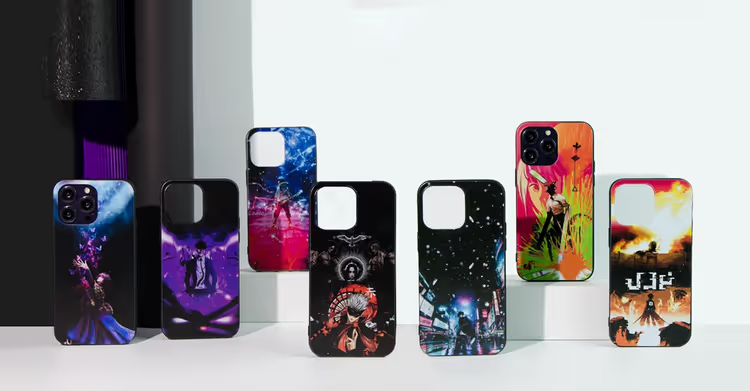
Protective cases and glass. A basic category, demand never drops. A phone without a case is a risk for a device worth 15-30 thousand hryvnias. Trending: eco-materials (bamboo, linen fiber, recycled ocean plastic) and magnetic cases with Qi2 support. Classic silicone and TPU are also in circulation, but margins are lower and competition is extreme. Glass: 3D tempered with an oleophobic coating is the minimum the buyer expects.
Charging devices. Fifth-generation GaN has made multi-port chargers the standard, not a premium option. A 65-100 W model with a 2C1A configuration (two USB-C + one USB-A) charges a laptop, phone, and watch simultaneously. The GaN charger market is estimated at 1.2 billion dollars (2025) with a growth forecast to 5.5 billion by 2034, a CAGR of 18.5% (data from Verified Market Reports). This is a bestseller, make sure to include it in your matrix. Qi2 wireless stations with magnetic alignment are the second tier: demand accelerates as Android flagships with native support for the standard are released (Google Pixel 10 was the first, Samsung and OnePlus are catching up).
Cables and adapters. USB-C has definitively become the single standard: iPhone 15/16, MacBook, Android, earbuds, tablets, everything on one connector. A USB-C to USB-C cable with 100 W Power Delivery support is the number one item. Lightning is still needed for older iPhones, but its share is falling at double-digit rates year over year. The premium segment: nylon-braided cables with magnetic tips, the margin here is noticeably higher.
Audio. TWS earbuds with active noise cancellation (ANC) are no longer a flagship feature. In 2026, ANC is present in models within the budget procurement segment. Hits: earbuds with touch controls and a case offering 30+ hours of battery life. Open-ear headphones and bone conduction are a niche but growing segment: runners, cyclists, people who do not want to isolate themselves from their surroundings. Portable Bluetooth speakers have stable demand, especially in the warm season.
Car mounts and chargers. Magnetic mounts with Qi2 support are the number one trend: the phone locks onto the magnet and charges simultaneously. Vent mounts without magnetic attachment are rapidly becoming a thing of the past. Car GaN chargers for the cigarette lighter with 2-3 ports are a mandatory item for any matrix.
Gaming accessories. Mobile gaming in 2026 generates more revenue than console and PC gaming combined. Trigger clip-ons for the body, clip-on controllers, active cooling on a Peltier element, all of these are bought not only by gamers. Streamers who broadcast from their phones are also an audience. The margin in the gaming category is noticeably higher than for basic items.
How to choose a supplier: 4 filters
The price per unit is not the main thing. Missed deadlines, a defective batch, and a refusal to accept returns cost far more than savings on procurement. The four criteria below filter out problematic partners before the first payment.
Certifications and compliance with standards. For Europe, CE and RoHS; for the USA, FCC. Without them, the goods will not clear customs. Request the certificates before the first payment. A reliable supplier will send them within a day. If you hear "certificates later," that is a red flag.
Breadth of assortment. One partner covering the lion's share of the matrix is more profitable than ten with two items each. Savings on logistics, uniform terms, one manager for all questions. A simple test: ask them to put together a commercial proposal for your profile (retail, marketplace, kiosk in a shopping center). The accuracy of hitting the target audience immediately reveals their expertise.
Logistics and timelines. The standard for wholesale in 2026: order processing within 24 hours, shipment the next day, nationwide delivery in 1-3 days. If the supplier does not provide a tracking number on the day of payment, prepare for a cash gap during the peak season.
Return and defect policy. Defects in accessory batches are a reality, not an exception. A small percentage of defects is normal even for quality wholesale. It is critical that the supplier replaces defects without questions, rather than offering a "discount on the next order." Clarify this point before the first delivery; afterwards it will be too late.
A partner instead of a dozen: the Itsellopt example

When the assortment matrix numbers 30-50 items and customers expect cases, chargers, and glass in one delivery, assembling an order from five different suppliers is a sure way to lose both time and money.
The Itsellopt platform has built a model where retail receives mobile accessories wholesale from 13+ brands in a single window. Nillkin, TETDED, Rock, Dreamplus, Melkco, Zenus, SGP, Epik, Nuoku, Noreve, TTX, Ballistic, Clear-Coat are brands with a multi-year history that maintain quality from batch to batch.
For a retail outlet, this means three things. First: a single warehouse, you are not reconciling tracking numbers from five suppliers, everything ships in one parcel. Second: predictable quality, every brand in the pool has passed incoming inspection, defects are measured in fractions of a percent. Third: seasonal rotation, in summer you strengthen the category of car mounts and portable speakers, in winter you shift into rugged cases and power banks.
For marketplaces (Rozetka, Prom, OLX), the model is even more interesting. You create product cards with ready-made content from the supplier and compete not on "zero margin" pricing, but on the speed of new arrivals. While competitors wait three weeks for a delivery from China, you are already selling.
Where to start: a step-by-step plan for the first wholesale purchase
Step 1. Assemble the assortment matrix. List 15-20 items that cover the basic needs of your buyer: cases for iPhone 14-16 and Samsung S24-S25, glass (3-4 popular models), 2-3 GaN chargers, 2-3 TWS earbud models, car mounts (magnetic and classic). Do not spread yourself thin over 50 items right away, depth in popular models is more profitable than breadth in illiquid stock.
Step 2. Request a test batch. Do not take a container, take 10-20 units of each item. The goal is not a sale with margin, but verification: correspondence of photos to the actual product, integrity of packaging upon delivery, order processing speed, actual timelines. One test order will give you more information than a month of correspondence with a manager.
Step 3. Check quality in practice. Unpack every item. Connect the charger to a phone, does it deliver the claimed watts? Put the case on, is there any play in the corners? Apply the glass to a test device, are there any bubbles or adhesion gaps along the edges? Listen to the TWS earbuds for an hour: does Bluetooth drop, does the speaker hiss at high volume? Defects at this stage are normal, what matters is how the supplier handles them.
Step 4. Launch the first sale. After a successful test, take a full batch and put it on display (physical or marketplace). For the first two weeks, track customer feedback daily, this will show you the real picture of quality and demand faster than any reports.
⁉️🤔 Frequent questions
What amount should you start with for a wholesale purchase of mobile accessories?
The first test batch of 15-20 items with 10-20 units each will cost a few hundred dollars for basic items (cases, glass) and up to fifteen hundred if the matrix includes GaN chargers and TWS earbuds. This is enough to check the supplier and test demand without freezing significant capital. After the test, the budget for the first full batch starts from several thousand dollars.
Cases for which models should be purchased first?
iPhone 14, 15, 16 (and Pro versions) and Samsung Galaxy S24, S25 account for the lion's share of demand in the case category. The remainder is distributed among Xiaomi, Poco, and budget Samsung A-series. Do not try to cover all models at once, three popular lines will generate the main turnover.
GaN charger or classic: which is more profitable to purchase?
The purchase price of GaN is higher than classic, but the retail margin is also larger. The buyer is willing to pay for compactness and multi-port capability. Start with a 70/30 ratio (classic/GaN) and shift towards GaN as demand grows. The trend is irreversible: the GaN charger market is growing at nearly 20% per year.
How often should you update the assortment?
A full matrix review, once every six months (spring/autumn). Targeted rotation of hits, once a quarter. A reason for an urgent item replacement: a sales decline for two consecutive months with stable traffic. Accessories do not become morally obsolete as quickly as smartphones, but trends in colors, materials, and features change every season.
Are certifications needed for accessories for retail in Ukraine?
Formally, yes. Charging devices and power banks fall under the technical regulations for low-voltage equipment and electromagnetic compatibility. Cases and glass do not. In practice: if you trade through a marketplace, certificates will be requested upon the first complaint or inspection. Work with a supplier who provides certificates immediately, this saves weeks of stress.
What to purchase right now: the final breakdown
Priorities for building a matrix from scratch look like this. First tier: protective glass and cases for iPhone 14-16 and Samsung S24-S25, this is the bread and butter, it sells year-round. Second: 65-100 W GaN chargers and 100 W USB-C cables, the average ticket is higher, the margin is nicer. Third: TWS earbuds with ANC in the budget and mid-range segment, mass demand with good repeatability (they get lost, they break, people buy a second pair).
Do not try to compete with marketplaces on the "case for 50 hryvnias" price, what wins there is not retail but volume. Your advantage is a fresh assortment and speed. While the giants are recounting their stock, you are already selling a new arrival that is not yet in the search results.
A reliable partner with a broad matrix and fast logistics solves half of the equation. The second half, knowing your customer and being ready to test new things, you add yourself.

A professional team of writers and editors specializing in creating quality content.