













🌊 Home pumping stations: how to choose a reliable water supply system in 2026
Tap water comes in spurts, and when the shower is running the kitchen pressure drops? That is classic country house without a central water supply. The solution: a pump station, a compact unit that draws water from a well or borehole and maintains steady pressure at every tap.

The problem is that catalogs are packed with models spanning a 20x price range: from 4,000 to 96,000 ₽ for devices that, on paper, do the same thing. Vortex and centrifugal, cast iron versus plastic, a 2-liter tank or a 24-liter one. Without understanding which specs actually matter for your home, it is easy to overpay or end up with a station that cannot handle the lift from your depth.
Below, a breakdown of pump station design, five key selection criteria, and an up-to-date 2026 model ranking. By the end of the article you will know exactly which station will cover your needs, whether it is summer irrigation or year-round cottage water supply.
💡 Quick overview:
- A pump station consists of four components: motor, pump, pressure tank, and controls. Each affects reliability and the use scenario.
- A surface station lifts water from a maximum depth of 8-9 meters. If the water table is deeper, you need a model with an external ejector.
- A 24-liter pressure tank reduces motor starts and provides a water reserve during a power outage. For permanent residence this is a must-have.
- Dry-run protection saves the pump from overheating if the well runs dry. Choose stations that have it built in.
What a pump station consists of
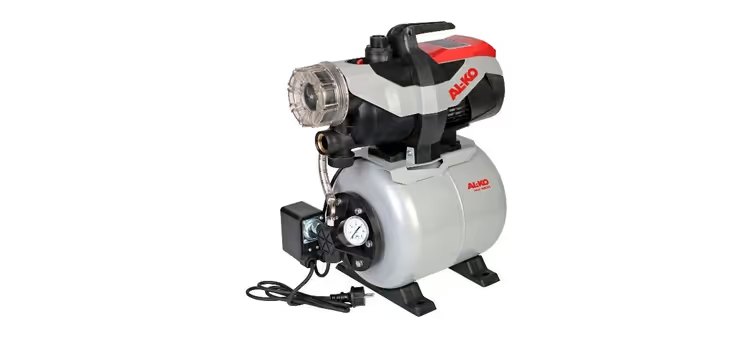
Any domestic pump station is four key assemblies. Understanding each one eliminates half the questions when choosing.
Motor. Almost always electric, power from 400 to 1,500 W. For summer irrigation 400-500 W is enough. A cottage with two bathrooms and a washing machine needs at least 800-1,100 W. If your area has frequent power outages, plan backup power in advance: without electricity the station does not pump.
Pump section. Draws water from the source and feeds it into the pipes. By mechanism type it divides into vortex (cheaper, higher head at modest power, but noisier and more sensitive to particles) and centrifugal (quieter, more reliable with "dirtier" water, holds flow more steadily). Catalogs offer dozens of pumps for pump stations with different specs, from budget vortex to professional centrifugal. For clean well water a vortex type will do. For continuous family water supply choose centrifugal.
Pressure tank. A tank that smooths out pressure spikes and stores a water reserve. A small 2-liter tank is an option for irrigation and a seasonal dacha. A 20-24 liter tank saves motor life and provides 15-20 liters of water during a power outage. The price difference between these options is small, but the comfort gain is noticeable.
Controls. A pressure switch starts the pump when system pressure drops and stops it when the upper threshold is reached. Advanced models add dry-run protection (critical for wells with unstable flow rate), soft start, and performance adjustment. Check upon delivery: the control unit can get dented during shipping, and the station will stop shutting off by pressure.
How to choose a pump station: 5 parameters that actually matter
1. Suction depth
A surface station physically cannot lift water deeper than 8-9 meters. If the water table in the borehole is lower, you need a model with an external ejector capable of drawing water from 15-20 meters. Measure the actual depth to water BEFORE buying. This is not a parameter you can "guess."
2. Head
Head in meters is the height to which the station will lift water, plus losses in the pipes. For a single-story dacha most mid-range stations will suffice. A two-story cottage with several bathrooms will require a model with headroom to spare; aim for the upper half of the ranking. The formula is simple: actual depth to water + lift height inside the house + allowance for pipe bends and fitting losses.
3. Flow rate
Shows how many taps the station can supply simultaneously. A family of 3-4 people: 40-60 liters per minute. A house with irrigation, a washing machine, and a dishwasher: from 70 l/min. Do not chase power "for future growth": a 1,500 W motor for a dacha with a single tap means extra noise, wasted electricity, and load on the wiring.
4. Pump housing material
Cast iron is heavier, dampens vibration and noise better, and withstands water hammer. Plastic is cheaper and lighter, but less resistant to pressure fluctuations. With hard water and year-round operation, metal is the clear winner. A nuance: inside cast iron pumps, infrequent starts can produce a yellowish film; use the station regularly.
5. Dry-run protection
If the well runs dry and the pump keeps working, the motor overheats and burns out within minutes. A dry-run relay cuts power automatically. For boreholes with inconsistent flow rate and dachas where water is pumped seasonally, this is not an option, it is a mandatory requirement.
Pump station ranking 2026: 10 models for different tasks
Below, models that consistently hold their ranking on marketplaces and collect positive owner reviews. Prices and ratings are current as of July 2026.
Model | Type | Tank, l | Head, m | For whom | Price, ₽ |
|---|---|---|---|---|---|
DGM BP-1100 | Centrifugal | 24 | 45 | House / dacha | from 10,000 |
Denzel PS500C | Centrifugal | 24 | 45 | House, controls | from 11,500 |
Vikhr ASV-1200/24 | Centrifugal | 24 | 42 | House, family | from 11,000 |
Metabo HWW 4000/25 G | Centrifugal | 25 | 48 | Cottage | from 18,000 |
Quattro Elementi Automatico 801 | Centrifugal | 20 | 40 | Dacha / house | from 10,000 |
Aquario AUTO ADB-60-H | Centrifugal | 24 | 46 | House, protection | from 27,000 |
GRAMEX JET 150 L-24 | Centrifugal | 24 | 55 | Large house | from 12,000 |
Oasis S 70/50P-24 | Centrifugal | 24 | 50 | Family, reliability | from 13,500 |
Huter APS 45-30 | Centrifugal | 2 | 30 | Irrigation, dacha | from 5,500 |
Wilo HiMulti 5-45 iPQ | Centrifugal | - | 45 | Premium, silence | from 96,000 |
1. DGM BP-1100, the people's favorite for house and dacha
The best-selling mid-range station. Cast iron pump, 24-liter tank, and 45-meter head: this is enough for a two-story house with two bathrooms. 1,100 W motor with overheat protection.
- Pros: reliability proven by hundreds of buyers, cast iron housing, fair price for a 24 l tank, quiet operation per reviews.
- Cons: the stock pressure gauge is not always accurate; better to replace it right away.
- Price: from 10,000 ₽.
- Where to buy: available on marketplaces and in building supply hypermarkets.
2. Denzel PS500C, smart controls out of the box
Stands out from competitors with an advanced control unit: soft start, dry-run protection, and performance adjustment. 3-year warranty.
- Pros: controls that genuinely protect the motor; steady pressure without surges; built-in dry-run protection.
- Cons: price slightly higher than analogs without controls; the control unit is sensitive to voltage fluctuations.
- Price: from 11,500 ₽.
- Where to buy: marketplaces, official Denzel dealers.
3. Vikhr ASV-1200/24, a reliable mid-ranger for the family
A domestic brand with a 24-liter metal pressure tank and 1,200 W power. The station is simple, repairable, and spare parts are available.
- Pros: metal tank body, high repairability, spare parts in any region.
- Cons: noisier than imported analogs; advisable to install on vibration isolation.
- Price: from 11,000 ₽.
- Where to buy: construction markets, marketplaces, retail chains.
4. Metabo HWW 4000/25 G, German build quality for the demanding
Power 1,100 W, head 48 meters, tank 25 liters. Stainless steel housing. Designed for year-round operation in a cottage with high water consumption.
- Pros: build quality, stainless steel housing, stable performance under frequent starts.
- Cons: pricier than analogs with the same specs; weight ~ 18 kg, mount it securely.
- Price: from 18,000 ₽.
- Where to buy: specialized tool stores, marketplaces.
5. Quattro Elementi Automatico 801, ready to work with no fuss
Centrifugal station with a 20-liter tank and 40-meter head. Prime the pump section, switch it on, it works. Minimum setup, maximum predictability.
- Pros: simple setup, stable pressure switch, quiet start.
- Cons: plastic impeller, not for sandy water; the included hoses are a bit short.
- Price: from 10,000 ₽.
- Where to buy: marketplaces, online garden equipment stores.
6. Aquario AUTO ADB-60-H, stainless steel and Hydroprotector protection
Stainless steel shaft, brass inserts in the hydraulics, Hydroprotector protection system. For homes where water is hard and the station must run non-stop.
- Pros: corrosion-resistant materials, reliable three-parameter protection, steady head.
- Cons: price is high for the domestic segment; fewer service centers than mass-market brands.
- Price: from 27,000 ₽.
- Where to buy: official dealers, specialized online stores.
7. GRAMEX JET 150 L-24, for a large house with active water draw
Flow rate of 70 liters per minute and head up to 55 meters. Draws water from depths up to 9 meters. Three taps running simultaneously is not a problem.
- Pros: high flow rate, large headroom, cast iron housing.
- Cons: somewhat noisy at peak RPM; sensitive to water cleanliness.
- Price: from 12,000 ₽.
- Where to buy: marketplaces, building supply hypermarkets.
8. Oasis S 70/50P-24, consistently high customer rating
24-liter tank, 50-meter head, flow rate 70 l/min. Buyers note smooth operation without surges and a quiet start.
- Pros: high user rating, stainless steel housing, steady pressure.
- Cons: 2-year warranty, less than Denzel; requires insulation at sub-zero temperatures.
- Price: from 13,500 ₽.
- Where to buy: marketplaces, online pump equipment stores.
9. Huter APS 45-30, a budget option for irrigation and a seasonal dacha
Lightweight, compact, with a 2-liter tank. For lifting water to the second floor of a dacha or watering the garden. Not for a year-round house: the tank is too small, and the motor will start every time a tap is opened.
- Pros: price, low weight (easy to transport), quiet operation at standard RPM.
- Cons: 2 l tank, frequent motor starts; actual suction depth up to 4 meters.
- Price: from 5,500 ₽.
- Where to buy: construction markets, marketplaces.
10. Wilo HiMulti 5-45 iPQ, premium with variable speed control
The German flagship: a variable speed drive maintains exactly the pressure needed at any given moment. Noise level 50 dB, quieter than a conversation. Does not require a pressure tank.
- Pros: silent operation, intelligent control, energy savings, compact housing.
- Cons: price comparable to a budget turnkey borehole; repairs only at a service center.
- Price: from 96,000 ₽.
- Where to buy: official Wilo dealers, specialized stores.
Video: how to install a pump station with your own hands
A short video in English: water pump installation, pressure tank connection, and pressure switch adjustment. All steps are shown on a real installation, with no gaps:
⁉️🤔 Frequent questions
The station starts and stops frequently, what is the cause?
Nine out of ten cases, incorrect pressure in the pressure tank. Disconnect the station from the mains, drain the water, and check the tank pressure with a tire gauge via the valve. For a 20-24 liter tank the norm is 1.5-2 bar. If the diaphragm is torn (water comes out of the valve), the tank needs replacing.
Can a pump station be installed in a residential basement?
Yes, but noise and vibration will be audible on the ground floor. Place it on a vibration-isolating pad and do not rigidly anchor it to walls. The ideal option is a separate annex or an insulated caisson. At sub-zero temperatures the station must be insulated: a cast iron housing can crack if water freezes inside.
How often does a pump station need servicing?
Every six months check the pressure in the tank and clean the inlet filter. Once a year inspect the pressure switch; contacts can burn and the station starts to "chatter" on startup. Keep a set of gaskets and a check valve handy: they are the first to fail.
Pump station or submersible pump, which is better for a borehole?
If the water table is deeper than 9 meters, definitely a submersible pump. A pump station with an external ejector can also draw water from 15-20 meters, but it is more complex to install, noisier, and more expensive. For a well up to 8 meters a station is more convenient: all equipment is at the surface, easier to service.
Which station to get for a house with three taps?
Look for a flow rate of 60 liters per minute or more and a head of 45 meters or more. Choose a 24-liter tank. From the ranking above, DGM BP-1100, Denzel PS500C, or GRAMEX JET 150 L-24 will work. For a shower, kitchen, and washing machine running simultaneously, this reserve is sufficient.
💎 Summary: which pump station to choose for your task
The choice comes down to three scenarios. Identify yours and pick the model designed for it:
If you need a station for a year-round house with a family of 3-4, choose DGM BP-1100 or Denzel PS500C. 24-liter tank, 45-meter head, hundreds of positive reviews. Denzel is pricier, but the controls pay off through motor life savings.
If you have a seasonal dacha or garden irrigation, Huter APS 45-30. Compact, lightweight, priced from 5,500 ₽. Enough to lift water to the second floor of a dacha and handle irrigation with room to spare.
If the house is large, there are many taps, and the budget is not limited, Wilo HiMulti 5-45 iPQ. Variable speed control, 50 dB silence, energy savings. This is a station for a decade, not a season.
Before buying, measure the depth to water in your well or borehole and count the number of taps. These are the two numbers that instantly eliminate half the catalog and save you from a "didn't fit" return.
Which station are you considering for your home? Write in the comments, and we will help compare it with alternatives.

A professional team of writers and editors specializing in creating quality content.