













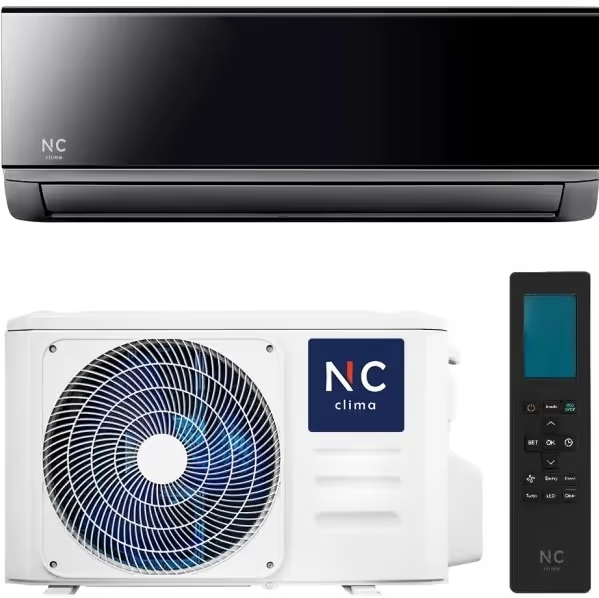
🌀 Black air conditioners: how to choose, install and style in the interior
White boxes under the ceiling: the standard everyone is used to. But an air conditioner can work as a design element, not just cool the air.
Black split systems have long since left the "expensive and exotic" niche. Today, models in a dark housing are available from all major brands, from budget to premium. Interior designers increasingly specify a black unit in a project as a deliberate accent, not a compromise of "whatever was in stock."
Below, an honest breakdown: how a black air conditioner differs from a white one in practice, how to choose a model for your square footage, and what installation and design nuances to consider before buying.
💡 Quick overview:
- Appearance: a black housing looks visually more compact than a white one and collects less dust and fingerprints. But it requires thoughtful placement, otherwise it looks out of place.
- Selection: capacity is chosen based on area (5 kBTU/h for 15-18 m², 7 kBTU/h for 20-25 m², 9-12 kBTU/h for 30-40 m²). A split system is optimal for an apartment; a portable monoblock works for a rental.
- Installation: the rules are the same as for white models. Height 2.5-3 m from the floor, outdoor unit in the shade, line set no longer than 5-7 meters without additional refrigerant charge.
- Operation: clean filters once a month, check refrigerant once a year, cooling temperature 24-26 °C to save electricity.
🎨 Why a black housing is not just a color
Manufacturers do not simply paint the same models black "for looks." A dark housing changes the perception of the device in an interior on three levels.
First: visual compactness. A black object on a light wall appears smaller than a white equivalent of the same dimensions. In a room up to 20 m², this is noticeable: the air conditioner does not "press" on the space. Especially evident in kitchens and bedrooms.
Second: practicality. On a dark surface, dust, fingerprints, and light residue after damp cleaning are far less visible than on glossy white plastic. Over a season, a white housing needs wiping every two weeks. A black one gets by with a monthly interval.
Third: compatibility with electronics. Televisions, soundbars, monitors, kitchen panels, most electronics are produced in black. An air conditioner of the same shade gathers disparate devices into a single visual group. The interior looks cohesive, not assembled from multicolored boxes.
🛠 How to choose a black air conditioner: 5 parameters
The choice comes down to five characteristics. Color is the sixth item: hardware first, then aesthetics.
Device type
For an apartment and a house, the standard is a wall-mounted split system. The indoor unit is hung under the ceiling, the outdoor unit is placed on the facade or balcony.
Portable monoblocks with a duct to the window are a compromise for rented housing. They are noisier, weaker in cooling, and take up floor space. Cassette and ducted systems are an option for commercial spaces with a suspended ceiling.
Among black models, split systems dominate. Portable units in a dark housing are rare: manufacturers see no demand for design in the "plug in and leave" segment.
Cooling capacity
The basic rule: for every 10 m² you need 2.5-3 kBTU/h (British Thermal Units). For a 20 m² room, take 5-7 kBTU/h. For 30 m², 9 kBTU/h. For a spacious 40 m² living room, 12 kBTU/h.
Upward adjustments: south-facing side, panoramic windows, ceilings above 2.7 m, top floor. Downward adjustment: ground floor, north-facing side, blackout curtains.
An overly powerful air conditioner in a small room cools the air in minutes and shuts off before dehumidifying it. Result: cold and damp. An underpowered one in a large room runs nonstop and overheats the compressor.
Operating modes
Cooling is present in all. Heating, in most split systems (operate down to -7 °C outdoors; some inverter models hold down to -15 °C and below). Dehumidification, a mode for humid climates: fan at minimum speed, compressor cycling. Air purification, fine filters, carbon, photocatalytic, plasma. Each brand has its own technology and marketing name.
A useful feature often overlooked: night mode. When activated, minimum fan speed and a gradual increase of the target temperature by a degree or two over the night. Comfortable sleep without excessive electricity consumption.
Energy efficiency class
Modern inverter models have class A, A+ or A++ on the European scale. An inverter compressor smoothly varies speed instead of on-off cycles: lower starting currents, quieter operation, longer service life. The difference in the monthly bill between classes A and A++ is noticeable with daily operation of 6-8 hours.
A basic on/off model of class B or C is cheaper to buy, but the difference is spent on electricity within one and a half to two seasons. For an apartment, an inverter pays off. For a dacha with occasional use, an on/off unit is sufficient.
Where to look for models
A selection of black air conditioners with filters by price, capacity, and brand is convenient to view in one place, for example, in the category https://allo.ua/ru/products/kondicionery/color_kondicionery-chernij/. This eliminates the task of visiting different store websites and comparing manually.
🧾 Comparison of popular models
For reference, seven black split systems from different brands and price categories. Prices are not fixed: they update every season; check the exact figure on the seller's website.
Model | Type | Capacity | Class | Price category |
|---|---|---|---|---|
Leberg LS-07FRA2/LU-07FRA2 | Split system | 7 kBTU/h | A | Budget |
Cooper&Hunter CH-S09FTXF2-NG | Split system | 9 kBTU/h | A+ | Mid-range |
Samsung AR09TXHQASINUA Basic | Split system | 9 kBTU/h | A+ | Mid-range |
Osaka STV-09 HH DC | Split system | 9 kBTU/h | A++ | Mid-range |
NC Clima NCI12EHMIw1eu | Split system | 12 kBTU/h | A+ | Mid-range |
Midea MSAB-09HRFN8-I | Split system | 9 kBTU/h | A++ | Upper mid-range |
Cooper&Hunter CH-S12FTXD2-SC | Split system | 12 kBTU/h | A++ | Premium |
The inverter models from the table (Cooper&Hunter, Midea, Osaka) run quieter and more efficiently than on/off equivalents. For a bedroom, this is critical: the difference between 22 dB and 32 dB is the difference between "inaudible" and "disrupts falling asleep."
🔧 Installation and maintenance: what to know before buying
A black air conditioner is mounted exactly the same way as a white one. No special brackets, cables, or housing color allowances. But there are placement nuances that affect both efficiency and appearance.
Installation: height and location
The indoor unit is hung at a height of 2.5-3 meters from the floor. Lower, and the cold airflow hits a seated person directly in the head. Higher, and the air does not have time to mix with the room air and stays near the ceiling.
Do not hang the unit opposite a bed, sofa, or desk. The ideal position: on a side wall, so the airflow runs parallel to the relaxation zone. In a narrow room, the best option is above the doorway: there, the air conditioner is least noticeable and not directed at people.
Place the outdoor unit in the shade (north or east side). Direct sunlight heats the housing and noticeably reduces heat exchange efficiency. If there is no shade, arrange a canopy with a 15-20 cm gap to the radiator grille.
Maintenance
Wash the indoor unit filters once a month with warm water without detergents. A clogged filter increases energy consumption: the airflow meets resistance, the compressor runs longer. Dry the filter before reinstalling it; a damp one gives off a musty smell.
Check the refrigerant level once a year before the season starts. Even a small freon leak increases the time to reach the target temperature and overloads the compressor. Signs of a problem: the air conditioner blows but does not cool; the outdoor unit ices up at above-freezing temperatures; a hissing sound is heard at the pipe connection point.
Once a year, call a technician for a full service: cleaning the drain from mold, checking electrical connections, topping up freon. You can only wash the filters yourself. The rest requires tools and skills.
🖼 Design: how to fit a black unit into an interior
A black unit on the wall is an accent. An accent works only when it is singular and intentional. Let's examine three scenarios.
Loft and high-tech
Brickwork, concrete, exposed utilities, metal, and glass. A black air conditioner here looks like an industrial element, not alien household appliance. In a loft, it supports the industrial palette. In high-tech, it reinforces the technological image.
Bonus: a dark housing does not clash with black light fixtures, switches, and outlets in the "techno" style.

Minimalism and Scandinavian style
Against white walls, a black air conditioner creates a contrast that structures the space. In minimalism, where every detail counts, a dark unit works as a graphic element, almost like a black frame on a white gallery wall.
In a Scandinavian interior, it echoes the black legs of furniture, door handles, and light fixture housings. The rule is simple: if the room has more than three black items (electronics, furniture, decor), an air conditioner of the same color unifies them. If there are none, it stands out. Check before buying: is there anything else black, matte or glossy, in the room?
Classic interior
A black air conditioner in a classic setting is an unexpected but workable solution under two conditions.
First: the housing is matte, not glossy. Gloss in a classic interior looks plasticky and cheap. Second: the room already has dark elements, wrought-iron chandeliers, picture frames, furniture hardware, marble with dark veining. Then the air conditioner completes the composition rather than clashing with the surroundings.
A visual video on choosing a split system: key parameters in 10 minutes.
⁉️🤔 Frequent questions
Does a black air conditioner heat up more than a white one in the sun?
The indoor unit is inside the room and is not exposed to direct sunlight. The housing color does not affect cooling efficiency. The outdoor unit on all models is standard gray or beige, regardless of the indoor unit's shade.
Do the filters of a black air conditioner get dirty faster?
No. The housing color is not related to the volume of air passing through the filters. Cleaning frequency depends on room dust levels and the presence of pets, not on the color of the plastic.
Can a black air conditioner be installed in a small bedroom?
Yes, and this is one of the best scenarios. In a room up to 15 m², a black unit visually shrinks on a light wall and does not dominate the interior. Choose a model with night mode and a noise level up to 25 dB.
Which energy consumption class pays off faster?
Inverter models of A+ and higher recoup the price difference within one and a half to two seasons of daily operation for 6-8 hours. If the air conditioner is used occasionally (dacha, guest house), take an on/off unit of class B or C; the premium for an inverter will not pay back.
Does a black air conditioner require special brackets for installation?
No. Installation is identical to a white one: brackets, line set, cable, drain, everything is standard. The only nuance: a black housing is more noticeable during marking, so it is easier for the installer to level the unit horizontally.
How often should a dark-housing air conditioner be serviced?
The schedule is the same as for any air conditioner: filters once a month, full service with refrigerant check and drain cleaning once a year before the season. Dust is less visible on a black housing, but this does not cancel cleaning: clogged filters seriously reduce cooling capacity.
Is it worth paying extra for a black housing?
A black air conditioner is not a marketing markup, but a genuinely different perception of the device in an interior. The price premium for color relative to an equivalent white model is insignificant. Essentially, it is the price for visual compactness and compatibility with other electronics.
If you have an apartment in a minimalist, loft, or high-tech style with black electronics, the dark housing pays off aesthetically from day one. If the interior is entirely light, without dark accents, take white: a black unit without support from other dark elements looks lonely.
Before buying, open the black air conditioners category on the store's website, filter by capacity and budget. Then look at the noise level, energy consumption class, and the presence of night mode. Color is the last item on the checklist. But it is precisely what determines whether the air conditioner will please the eye or irritate for the next five years.
In short: a black housing is the choice of those who view a renovation as a holistic picture, not as a set of individual purchases. Choose for the interior, not for the neighbors.

A professional team of writers and editors specializing in creating quality content.