













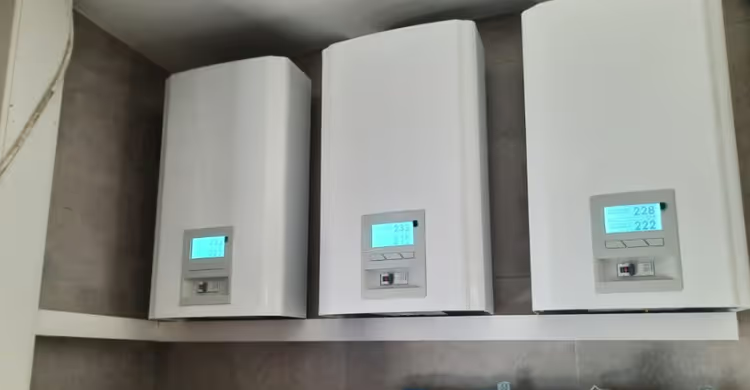
🔌 Home voltage stabilizer: protecting appliances without delay
A power surge hits the grid, the refrigerator falls silent, and the expensive TV won't turn on anymore. A familiar situation for anyone living in a private house or a neighborhood with old wiring. And while you can still put up with power outages, fried electronics are always unexpected and costly.
A voltage stabilizer for home is a device that takes the hit from an unstable grid and delivers a steady 220 V (or 380 V for a three-phase input) at the output. Without it, any modern electronics, from a heating boiler to a home server, operate on a "lucky or not" basis.
Below is a breakdown: why you actually need a stabilizer, which parameters matter when choosing one, how much it costs, and how to avoid overpaying for features you don't need.
💡 Quick overview:
- First, determine the total power of all the devices you will protect; the stabilizer's rating depends on this
- Then choose the type: wall-mounted for an apartment or floor-standing for a whole house
- Assess the grid condition in your area: the stronger the fluctuations, the wider the operating range should be
- Check the manufacturers' table and pick a model that fits your budget
Why get a stabilizer if appliances already "handle" fluctuations?

Formally, yes, most modern devices have built-in protection. But it is short-term and designed for minor deviations. When voltage drops to 160 V or spikes to 280 V (and in rural areas this is not uncommon), the built-in fuse simply does not save the device.
A TV or computer switching power supply can survive one or two such surges. But regular fluctuations wear out capacitors and power switches many times faster. The result: the equipment fails not at the moment of an accident, but "suddenly" six months to a year later. Repairing a refrigerator's motherboard costs about half the price of a new unit.
Gas heating boilers are a separate story. The control board is so sensitive to power quality that manufacturers explicitly state in the warranty card: "the warranty is void without a stabilizer." Leaving a house without heat in winter because of a burnt-out board is a scenario you want to avoid at any cost.
How to choose a stabilizer: 4 parameters that matter in practice
When you open a catalog, your eyes glaze over: kilowatts, volt-amperes, accuracy in percentages. In practice, however, it all comes down to four characteristics. The rest is marketing or clarifications for specific cases.
1. Power: not the sum of nameplate watts, but a realistic reserve
The first thing a consultant asks is, "how many devices will you connect?" You take the equipment the stabilizer must protect and sum up the power.
Add up the ratings of all devices and include a reserve for the inrush currents of compressors and motors. For a home with a set of "refrigerator + boiler + TV + a couple of laptops + lighting," the total is usually several kilowatts.
2. Form factor: wall-mounted or floor-standing
Wall-mounted models attach to the wall and take up minimal space. They are suitable for an apartment or protecting a dedicated line (boiler + refrigerator). Floor-standing units are bulkier, with a wider power range, and often have forced cooling. They are installed at the input to a private house when you need to protect absolutely everything.
The price difference between a wall-mounted and a floor-standing stabilizer of the same power favors the wall-mounted unit: it is structurally simpler and more compact. But a floor-standing model is generally more reliable for 24/7 operation: better heat dissipation, easier maintenance.
3. Operating range: the wider, the more peace of mind
The datasheet specifies two thresholds: the lower limit (down to how many volts the stabilizer can still "pull up") and the upper limit (above which it disconnects). For a city with a relatively stable grid, a range of 140-260 V is sufficient. For suburbs and rural areas, look for a model with a lower limit of 100-120 V: dips below 140 V occur regularly there, especially in winter during peak load.
Note: when the limits are exceeded, a good stabilizer does not burn out but disconnects with a fault indication. Cheap models may simply fail.
4. Output voltage accuracy
This parameter distinguishes a stabilizer for household appliances from an industrial one. For home use, the standard accuracy of household models is sufficient, a corridor of 209-231 V at the output. Any modern device operates normally within these limits. Chasing ultra-high accuracy only makes sense for specific equipment: medical devices, measuring instruments, audio studios. Overpaying for precision stabilization at home is not justified.
Manufacturers: who to consider in 2026
The stabilizer market in the CIS is split between local manufacturers and Chinese OEM brands. The former offer a warranty and local service, the latter a noticeably lower price with comparable specifications. The choice depends on your budget and willingness to deal with warranty issues in case of a breakdown.
Manufacturer | Country of assembly | Type | Price range (5 kW), $ | Feature |
|---|---|---|---|---|
Ukrtechnology | Ukraine | Wall-mounted | 180-300 | Local service, spare parts in stock |
Eleks | Ukraine | Floor-standing | 250-450 | Industrial line, three-phase models |
Volter | Ukraine | Wall-mounted | 160-280 | Good price/accuracy ratio |
LogicPower | China | Wall-mounted | 100-200 | Budget segment, basic functionality |
Rucelf | Russia | Wall-mounted/floor-standing | 140-320 | Wide product line, quiet operation |
Prices are approximate; check the current ones on the manufacturer's or dealer's website. For a whole house with a three-phase input (380 V), take a three-phase model of the same brand; power is calculated the same way, but for each phase separately.
Video: how a voltage stabilizer works, visually
If you want to understand the physics of the process in 5 minutes, watch the clip below. It shows the operating principle of a servo-driven autotransformer and how the stabilizer handles real grid surges.
⁉️🤔 Frequent questions
Do I need a stabilizer if I have a voltage relay?
A voltage relay is protection based on the principle of "turn off when dangerous," not stabilization. It will cut off power when a threshold is exceeded, but it will not correct it. If the voltage in your area does not go beyond critical limits but "floats" in the 190-250 V range, the relay will just click back and forth, while the equipment still runs on suboptimal power. A stabilizer, on the other hand, continuously corrects the voltage to the norm.
How long does a stabilizer last in a private house?
The service life of a quality stabilizer is 7-10 years, provided it does not constantly operate at its power limit. The weak point is the servo drive and autotransformer brushes: they wear out mechanically. Thyristor (electronic) models have a longer lifespan, 12-15 years, but they also cost 2-3 times more. Every 2-3 years, it is worth calling an electrician for preventive maintenance: cleaning contacts, checking terminal tightness, monitoring brush wear.
Does a stabilizer make noise when operating?
Mechanical (servo-driven) units produce the sound of a working transformer, a low-frequency hum of 35-45 dB. This is comparable to a quiet conversation or a refrigerator running. It is audible in a living room, but almost not in a hallway or basement. Thyristor and relay models operate silently. If you are placing the stabilizer in a bedroom, get an electronic one, but prepare a budget of $500+ for a 5 kW model.
Can I connect a stabilizer myself?
A single-phase wall-mounted model on a dedicated line (boiler, refrigerator), yes, if you have basic skills: turn off the input breaker, strip the cable, tighten the terminals with the correct torque. For a floor-standing model for the whole house or a three-phase stabilizer, it is better to call an electrician. An incorrect choice of cable cross-section or a weak contact on a terminal is the cause of half of all burnt-out stabilizers, according to service center statistics.
What is the difference between kVA and kW and why does it matter?
Manufacturers often specify power in kVA (kilovolt-amperes), which is apparent power. But consumers (refrigerator, kettle) are measured in kW (kilowatts), active power. The ratio between them, the power factor, for household appliances averages 0.7-0.8. To convert kVA to kW, multiply by 0.7. Example: a 10 kVA stabilizer will actually handle about 7 kW of household load. Do not confuse these when calculating; this is a common reason for buying an underpowered device.
Home stabilizer: to buy or not to buy?
If you live in a new building with underground wiring and stable voltage, a stabilizer most likely will not pay for itself. But if you are outside the city, in an old building, or in a region with worn-out grids, this is not "just in case" insurance, but as essential an element of the input as an RCD and circuit breakers.
If you live in an apartment and protect a couple of expensive devices, take a closer look at wall-mounted models. For a private house with a gas boiler and a three-phase input, look towards floor-standing models with a power reserve. And if the budget allows, a thyristor stabilizer with silent operation and extended lifespan.
The main thing is, do not delay. A burnt-out boiler control board in the middle of winter costs far more than any stabilizer.

A professional team of writers and editors specializing in creating quality content.