













🛠 How to budget-renovate a small apartment in Kyiv
A Kyiv micro-apartment: 32 square meters, a cramped kitchen-hallway, and the eternal question "How can anyone actually live here?". And when it comes to renovation, the budget is tight, the walls are cracking, and a 90s-era sofa eats up half the room.
The good news: you don't need a $15,000 budget to turn a cramped apartment into a cozy and visually spacious home. Five targeted solutions are enough, from wall color to storage organization. And yes, you can renovate an apartment without demolishing load-bearing walls and a floor plan redo that costs three months' salary.
Every step described below has been tested in practice in Kyiv Khrushchev-era apartments and studios up to 40 m². The result: a space that feels easier to breathe in, where guests ask "Did you expand the room?".
💡 Quick overview:
- Paint the walls a light color to visually expand the space.
- Replace bulky furniture with compact and multifunctional pieces.
- Hang a large mirror opposite the window to double the daylight.
- Add 2-3 low-maintenance plants to bring the interior to life.
- Organize vertical storage from floor to ceiling.
Step 1: Walls and why color decides everything
The first thing to start a budget renovation with is repainting the walls. The cheapest and fastest way to change the perception of space. Light shades reflect most of the daylight and make the room visually more spacious, especially if the windows face north or a narrow inner courtyard.
Optimal colors for a Kyiv micro-apartment: matte white, light gray with a cool undertone, cream, or very pale beige. It's better to steer clear of glossy paint: it highlights wall unevenness, which old housing stock has plenty of.
If you're not ready to repaint the entire apartment, do one accent wall. Paint it a shade darker than the rest: this creates depth without eating up the space. Matte water-based paint for 30 m² will cost 800-1200 UAH, which is comparable to one trip to a home improvement hypermarket for decor that still won't solve the problem.
Step 2: Furniture and the "less is more" rule
The main enemy of a small apartment is not the square footage, but bulky furniture. A heavy fold-out sofa, a massive wooden table, and grandma's china cabinet take up a significant portion of the usable floor area, leaving narrow passage-corridors between zones.
What works in a small space:
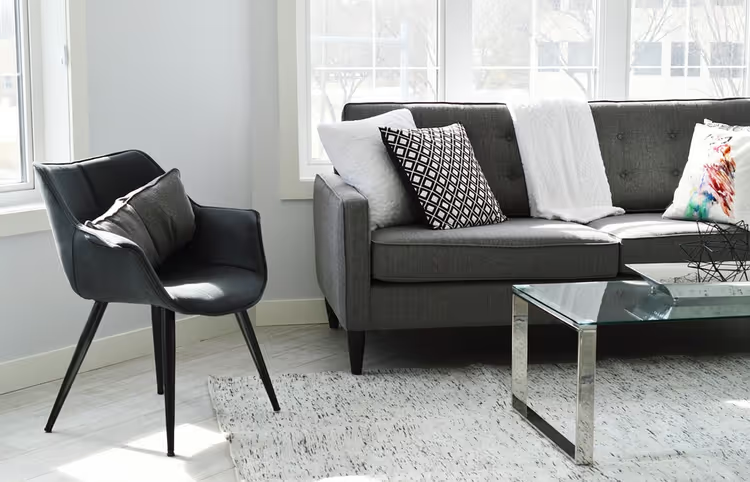
Glass and transparent surfaces. A tempered glass coffee table visually "disappears": the eye doesn't catch on it, the room feels freer. The same logic applies to acrylic chairs and shelves.
Furniture on legs. A sofa or bed on high, thin legs provides a gap between the floor and the body, and the space reads as deeper. Solid "to-the-floor" models cut off the perspective.
Folding and modular solutions. A transformable dining table for 2-4 people, folding chairs that hang on the wall, a pouf with a lift-up lid for storage. Every item performs two functions.
You don't have to change everything at once. Start with the largest item in the room, usually the sofa or wardrobe. Replacing one bulky element already gives a noticeable effect of spaciousness.

Step 3: Mirrors and visual expansion without a floor plan redo
A mirror opposite the window is one of the oldest design tricks, and it works flawlessly. Daylight hits the mirror surface, reflects back into the room, and literally doubles the amount of light. A small room with one window immediately stops resembling a pencil case.
Placement rules:
- One large mirror, at least half a meter in height, works better than several small ones. Hang it on a wall perpendicular to the window or directly opposite.
- Don't place a mirror opposite the entrance door: the first thing a guest will see is their own reflection, not the interior.
- Mirrored sliding wardrobe doors: a controversial solution. In a small bedroom, they work for expansion, but in an 18 m² living room, they can create a "hall of mirrors" effect and visually press down.
Budget option: a framed floor mirror for 600-900 UAH, leaned against the wall. It's mobile, requires no drilling, and easily moves when the layout changes.
Step 4: Plants and greenery without extra hassle
A few potted plants solve two tasks at once: they enliven a minimalist interior (purely visually) and improve air quality. In a closed 30-35 m² space, the CO₂ level by evening can exceed the outdoor level by 2-3 times, and a couple of plants with large leaves partially compensate for this.
For a micro-apartment, choose low-maintenance species that don't need direct sunlight:
- Sansevieria ("snake plant"): survives with infrequent watering, grows vertically upwards without taking up usable space.
- Zamioculcas: the ZZ plant with glossy leaves, tolerates shade and watering interruptions.
- Chlorophytum: a record-holder for cleaning air from formaldehyde, cascades down from a shelf or hanging planter.
The main rule: plants should not stand on the floor in passageways. Use hanging planters, narrow floor stands, or wall shelves, because greenery at eye level works better than a pot in the corner behind the sofa.
Step 5: Order, vertical storage, and decluttering
A small apartment does not forgive mess. Even a designer renovation gets cluttered over months if there is no well-thought-out storage system. The visual noise from scattered items noticeably "eats up" the perceived volume of the room, especially in studios where the bedroom, living room, and workspace share one area.
A basic set of budget solutions for order:
- Floor-to-ceiling shelves. Open shelving from floor to ceiling along one wall. The bottom 2-3 rows for frequent access, the top ones for seasonal items in matching boxes. This is cheaper than a built-in wardrobe and visually lighter.
- Over-door organizers. The space above the entrance and interior doors, a "dead zone", which fits 4-6 pairs of shoes or spare bed linen.
- Stackable containers. Transparent plastic boxes of the same size for clothes, tools, and small items. A uniform format creates visual order, and transparent walls eliminate the need to label each one manually.
Before organizing storage, mandatory decluttering is needed. Go through each room with three boxes: "keep", "give away/sell", "throw away". Items that haven't been used for over a year will almost certainly not be needed going forward.
Step 6: Light and layers instead of a single chandelier
Lighting is often overlooked during a budget renovation, and that's a mistake. One central chandelier gives a flat picture and "collapses" the room's corners into darkness. Three to four light sources at different levels create depth and zoning better than any partition.
A scheme for a 16-18 m² room:
- General light: a ceiling fixture of neutral white (4000K), basic lighting for cleaning and work.
- Local: a floor lamp by the sofa or a desk lamp on the work table (2700-3000K, warm), the relaxation zone.
- Accent: an LED strip under the top shelves of the bookcase or behind the mirror; it highlights texture and deepens the space in the evening.
No complex wiring: accent and local lights plug into a regular outlet. A 2-meter LED strip costs 150-200 UAH, a floor lamp from an IKEA-analogue will cost 500-800 UAH. The effect on the room's perception in the evening is comparable to a floor plan redo.
⁉️🤔 Frequent questions
Where to start a renovation if the budget is minimal, 10,000-15,000 UAH per room?
Start with the walls and ceiling; this is the cheapest operation with the maximum visual effect. Light paint on the ceiling and walls (2,000-3,000 UAH with labor), removal of old carpet or worn linoleum, replacement of baseboards. Then, on a residual basis: one mirror, two light sources, a minimum of furniture. It's better to remove a bulky sofa immediately, even if a replacement isn't affordable yet, because an empty room looks more spacious than a cluttered one.
What wall color is best for an apartment with north-facing windows?
Cool white with a slight blue undertone. It compensates for the yellowness from the lack of sunlight that beige and cream shades produce on the north side. Avoid gray with a purple undertone: in cloudy weather, it makes the room gloomy. If white seems "clinical", add one wall in a light oak or alder color, because warm wood warms visually without darkening the space.
Mirror or mirrored wardrobe doors, which is better for a small bedroom?
A separate large mirror. A mirrored sliding wardrobe in a 12 m² bedroom creates a "funhouse mirror" effect: you see the reflection of the bed in the wardrobe's reflection, and so on. Besides, mirrored wardrobe doors collect fingerprints along the tracks, and this looks untidy. A solid front in a light shade and one wall mirror on the wall opposite the window is better.
Which plants will definitely survive if I forget to water?
Sansevieria and Zamioculcas, two practically unkillable options. Both store water in their leaves and rhizomes, forgiving watering breaks of up to 3-4 weeks. Chlorophytum is slightly more demanding of water, but grows in any soil and under any lighting, so it's ideal for a hanging planter in a corner where direct light doesn't reach.
How much does a budget renovation of a one-bedroom apartment in Kyiv really cost in 2026?
A cosmetic renovation (painting walls, replacing baseboards, basic lighting, without replacing plumbing and wiring) costs approximately from 25,000 to 40,000 UAH doing it yourself or with partial hiring of a specialist for complex sections. With replacement of flooring and basic furniture (sofa, table, shelving unit), the budget will be 60,000-80,000 UAH. These are average market figures for Kyiv as of mid-2026. In old housing stock (Khrushchev-era, Stalin-era buildings), always budget a reserve for wall leveling and unforeseen nuances.
What to do first: a step-by-step plan for renovating a micro-apartment
The sequence of actions is more important than individual techniques. The wrong order leads to you painting the walls before replacing the windows, and then construction dust settles on the fresh paint.
Here is a proven sequence for a budget refresh of a small apartment:
- Decluttering. Removal of everything not used for a year. An empty apartment already seems larger.
- Walls and ceiling. Paint, baseboards, outlets. The cheapest and visually most powerful transformation.
- Lighting. Three levels: ceiling, local, accent. Wired after the walls are finished.
- Furniture. Start by replacing the most bulky item in each room. Buy the rest as the budget allows.
- Mirror. One, but large and correctly positioned.
- Plants and decor. The final touch that makes the space lived-in and homey.
Don't try to do everything at once. Stretch the process over 2-3 months, completing one step per week. The result will be of higher quality, and the budget won't burst on the very first day.
Before you pick up paint and a drill, look at a real example of a small apartment transformation. The video below is a step-by-step breakdown of a studio refresh up to 35 m² with specific techniques that work in any old housing stock.
Whatever approach you choose, minimalist Scandinavian or cozy boho with live greenery, stick to three rules: a light base, compact furniture, and vertical storage. They work in any geometry, from a narrow Khrushchev-era "vest" layout to a square studio in a new building. And don't wait for the "perfect moment" with a full budget; start with the walls this weekend. The rest will follow.

A professional team of writers and editors specializing in creating quality content.