













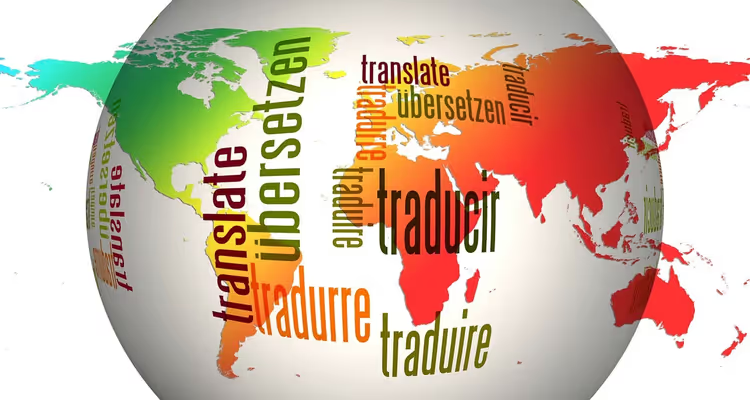
⚖️ Legal translation: the key to successful international interaction
International contract on the table. Deadlines are burning. Lawyers on both sides have agreed on the final version. All that's left is to translate, and it's ready to sign. But who will do the translation: a professional agency or an online translator in two minutes?
A mistake in a single contract clause can wipe out months of negotiations. The legal translation services market is valued at $7.46 billion according to Business Research Insights for 2026. Demand is growing at 4.7% annually: businesses are entering new markets, deals are becoming cross-border, and compliance requirements are getting stricter.
By the end of this article, you will know exactly how legal translation differs from general translation, which documents cannot be entrusted to a machine, and how to choose an agency that won't let you down.
💡 Quick overview:
- Understand how legal translation differs from general translation
- Identify which documents require a professional approach
- Evaluate translation agencies against four criteria
- Compare service costs and learn what drives pricing
Why business needs accurate legal translation
Legal translation is not about swapping words from one language to another. It is about transferring legal concepts between jurisdictions. The term "consideration" in Anglo-American law has no direct equivalent in the civil law system. Translate it literally, and the contract loses one of the key elements of enforceability.
In practice, companies come to us after they have already been burned. A freelancer translated a commercial lease agreement, and the landlord interpreted the penalty clause differently than intended. The amount in dispute exceeded the cost of the translation itself by two orders of magnitude. A professional agency would have cost dozens of times less.
There are three growth drivers. First: companies entering Asian and Middle Eastern markets, where language pairs are complex and legal systems are dissimilar. Second: the rise in M&A deals with foreign participation, where due diligence requires translating hundreds of pages. Third: tightening compliance requirements, where the regulator requests documentation in the language of the country of presence.
Which documents require professional translation
Not every text with a legal flavor needs agency services. But there are five categories where the stakes are too high.
Contracts and agreements. International sale and purchase agreements, license agreements, NDAs, distribution contracts. Every clause has binding force in a specific jurisdiction. An error in the governing law provision can render a contract unenforceable in principle.
Court and arbitration documents. Statements of claim, court decisions, motions. Here, not only terms are critical, but also procedural nuances: the names of instances, procedures, and types of judicial acts do not match across countries.
Constitutional and corporate documents. Charters, minutes of meetings, resolutions of the sole participant. Needed when registering subsidiaries abroad and opening accounts with foreign banks.
Notarial acts and personal documents. Powers of attorney, certificates, wills. For use abroad, notarized translation is almost always required, and the agency helps organize this procedure.
Tender and compliance documentation. Bids for international tenders, anti-corruption policies, reports to regulators. The cost of an error here is disqualification from the tender or a fine.
Why machine translation of legal texts is dangerous

GPT models handle news and blog posts perfectly. But legal text is territory where they still malfunction. And the cost of such a malfunction is disproportionate to the savings on a translator.
False equivalence. A machine translator sees the word "assignment" and outputs a generic term. In contract law, it is a "transfer of a right of claim." And "consideration" the model either skips or translates literally. The output is text that looks legal but essentially is not.
Context blindness. The same word in different sections of a contract means different things. "Party" is a contracting party, not a social gathering. But in the force majeure section, where a third party is mentioned, the model mixes up the meanings.
No jurisdiction check. Terms are tied to the legal system. Does "term" translate as a time period or a condition? It depends on whether it is English or American law. The model does not analyze the jurisdictional context.
A case from practice: AI translation of immigration documents in the US confused names with months and pronouns with numbers. Judges denied asylum based on incoherent translation. Reuters materials from 2025 confirm: this is not a hypothetical scenario.
Video: five types of legal translation in four minutes
A quick overview from practitioners explains the difference between the main types of legal translation and shows why a one-size-fits-all approach does not work here.
How to choose a translation agency: four criteria
The market is flooded with offers. Here is what to look at to avoid making a mistake.
Specialization. A generalist agency translates both a restaurant menu and a service contract. Look for a team with a dedicated legal department. Ask whether the translators have specialized education or experience in law. The answer "all our translators have linguistics degrees" is insufficient for a major international contract.
Quality control. Find out how many people work on one document. The minimum industry standard: translator plus editor. For complex texts, a proofreader who is a native speaker of the target country is added. Three pairs of eyes see what one misses.
Notarization and legalization. For many documents, the translation needs to be certified by a notary or go through the apostille procedure. The agency must either provide these services or clearly know how to organize them. Clarify in advance: rules differ across countries and even across authorities within one country.
Confidentiality. Legal documents contain deal amounts, commercial terms, personal data. The agency must have a confidentiality policy and be ready to sign an NDA with your side. The absence of these documents is a red flag.
Separately, evaluate speed. The standard volume for a translator is 8-10 pages per day. If they promise 50 pages in a day, either the team is really large or the quality is questionable.
⁉️🤔 Frequent questions
How much does legal translation of one page cost?
The price depends on the language pair, text complexity, and urgency. A standard page (1800 characters with spaces) for European languages costs in the range of several tens of dollars. Rare and Asian pairs are noticeably more expensive: the difference can be twofold or more. Notarization is paid separately; its cost varies by country and document type.
How does legal translation differ from general translation?
General translation conveys meaning. Legal translation conveys legal consequences. Every word in a contract can become the subject of judicial interpretation, and the translator must understand how a court in another jurisdiction will interpret that word. An error in general translation is a stylistic flaw. An error in legal translation is grounds for declaring a transaction void.
Can I use ChatGPT or Google Translate for contracts?
Only for preliminary review. For signing, filing with a court, or submitting to government authorities: no. Models do not distinguish jurisdictions, do not recognize the legal consequences of wording, and bear no responsibility for the result. A signed machine translation of a contract is consent to terms you may not have fully understood.
Which language pairs are most in demand?
English-Russian, English-Chinese, and English-Arabic are the three leaders by order volume. In the corporate segment, demand for German and French is growing for deals within the EU. For Asian markets, pairs with Vietnamese and Indonesian are gaining popularity.
Is notarization of the translation mandatory?
For courts and government authorities, almost always yes. For commercial contracts between private companies, usually not, unless the parties have agreed otherwise. Clarify the requirements with the receiving party in advance.
What business loses on inaccurate translation: the bottom line
Saving on translation is one of the most expensive items of unforeseen expenses. Professional translation of a contract costs a few hundred dollars. Arbitration due to discrepancies in wording costs an order of magnitude more. A full-scale international proceeding costs yet another order of magnitude more.
If a business regularly works with foreign partners, build a relationship with a specialized agency rather than chasing one-off orders on freelance marketplaces. The latter are suitable for letters and presentations. Not for documents where every word can become a point of dispute.
Choose an agency with confirmed legal specialization, ask about quality control procedures, and request an NDA. A good translation does not guarantee the success of a deal. But a bad one guarantees problems.

A professional team of writers and editors specializing in creating quality content.