













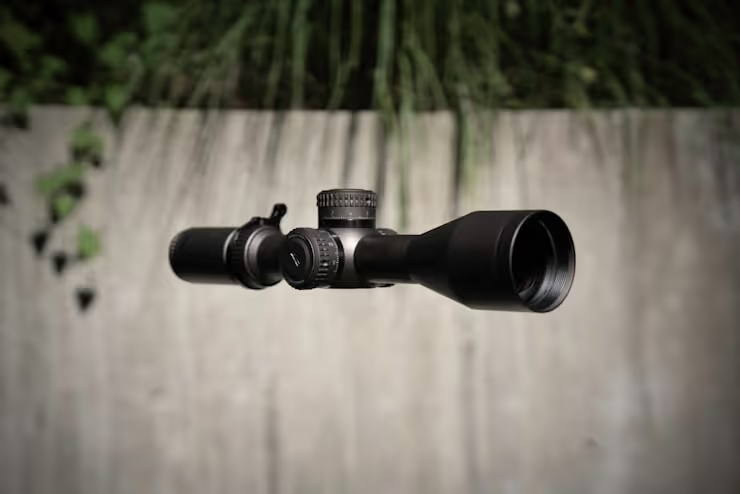
🎯 How to choose a riflescope: a guide for hunting and sport
Sighted in the rifle, and at a hundred yards the group is half a palm wide? A familiar story for anyone who has picked up a weapon with a factory sight or no optic at all. A good scope doesn't just bring the target closer. It holds zero after a dozen shots, doesn't fog up in the rain, and gives a clear picture when the sun has already dropped behind the forest.
Below, no fluff: what really matters in a riflescope, how reticles and magnifications differ, and how not to overpay for features you'll never use.
💡 Quick overview:
- Decide on your shooting type (hunting, sport, or tactical) and match the magnification to the distance
- Compare reticle types and pick the one that makes dialing corrections easier for you
- Check mount compatibility and order rings for your rail
Riflescope types: magnification and categories
All scopes fall into two broad groups: fixed magnification and variable (zoom). The former are mechanically simpler, with fewer lenses, less light loss, and less weight. But you're locked into one magnification. For driven hunts in the woods, where an animal can burst out from under your feet, a fixed 4x or 6x is a workable option.
Variable magnification is more versatile. The classic standard, 3-9x40: a three-to-nine zoom with a 40 mm objective. At the low end of 3x you scan the area with a wide field of view; at 9x you examine the target at distance. This range covers 90% of hunting tasks. For sport and precision shooting, people look higher, 5-25x and beyond, but there every millimeter of optical travel matters (Rocky Mountain Optics magnification guide).

Fixed or variable: what to choose when
For stalking at short range (up to 100 m), 1-4x or a fixed 4x is enough. For a blind or a stand, where a shot might be at 200-300 meters, take 4-12x or 4-16x. Sport and benchrest, 16x and above, often fixed magnification for maximum clarity. Don't chase maximum magnification: at 25x any hand tremor turns into a jumping picture, and without a rest you simply won't hit anything (recommendations for matching magnification to distance).
What to look at inside: objective, reticle, and mechanics
Objective diameter and light transmission
The objective gathers light. The rule is simple: larger diameter means a brighter, more contrasty picture at dusk. But also more weight and a higher price. 32 mm goes on lightweight mountain carbines where every gram counts. 40-42 mm is the sweet spot for most hunting. 50 mm is justified in a blind, when you're waiting for a boar until the last minutes of daylight. 56 mm is the domain of long-range optics: at maximum magnification an objective this size still holds light.
Keep in mind: a cheaply made 50 mm with cloudy glass will lose to a quality 40 mm in actual light transmission. Fully multi-coated lenses are what you want to see in the spec.
Reticles: what all those dots and hash marks mean

The most common reticle types:
- Duplex, a thin crosshair with thicker posts toward the edges. Simple, doesn't clutter the picture. For hunting at medium distances, it's exactly what you need.
- Mil-Dot, dots on the crosshairs at regular intervals. One Mil = 10 cm at 100 meters. Convenient for holding corrections on the fly without dialing turrets. The standard for tactical shooting and some sport disciplines.
- BDC (Ballistic Drop Compensator), additional horizontal hash marks below the main crosshair, each mark corresponding to a specific distance. Tied to a particular caliber and cartridge, so check the description.
- "Christmas Tree", a reticle with markings both vertically and horizontally below the center. Lets you dial windage and elevation corrections without taking your eye off the picture. The choice of precision shooters.
A separate question is the focal plane. In FFP (First Focal Plane) the reticle scales with the image: the subtensions are true at any magnification. In SFP (Second Focal Plane) the reticle is a fixed size, and holdover corrections work correctly only at one magnification, usually the maximum. FFP is more expensive, but for shooting with variable zoom it works more reliably. For hunting at standard distances, SFP is more than enough.
Turrets and adjustments: MOA vs MRAD
Two scales, two philosophies. MOA (Minute of Angle), roughly an inch at 100 yards, is more familiar to American shooters. MRAD (milliradian), 10 cm at 100 meters, follows metric logic. There is no fundamental difference in precision. The key point: the reticle and turrets must be in the same system. Don't buy a scope with a Mil-Dot reticle and MOA turrets; you'll get confused on your very first outing.
Pay attention to the click value. Budget scopes offer 1/4 MOA (7 mm at 100 m); more precise ones offer 1/8 MOA. For hunting, 1/4 MOA is sufficient. For benchrest, people look for 1/8. And check for a zero stop, a mechanism that prevents you from dialing the turret below zero after sighting in. In the field at night, you'll understand why it's needed.
How to choose a scope for a specific task
For hunting
Key requirements: low weight, a wide field of view at minimum magnification, resistance to rain and fogging. The scope must live in a range from -20°C to +40°C without a shift in the point of impact. An aircraft-grade aluminum body with anodizing, nitrogen or argon purging, sealed O-rings on the turrets: this isn't marketing, it's the minimum for working in the field.
For driven hunts, look at 1-4x or 1-6x models with an illuminated reticle. For mountain hunts, the lightest possible 3-9x with a 32-36 mm objective. For a blind, 3-12x or 4-16x on a 50 mm objective (recommendations on optics for different hunting types).
For sport shooting
Here the priorities are different: maximum optical resolution, click repeatability, parallax capability. Parallax is the apparent movement of the reticle when you move your eye. On hunting scopes it's fixed at the factory (usually 100 yards); on sport scopes a side focus is installed, a dial that eliminates the effect at a specific distance.
For varminting and benchrest, people choose 6-24x or 8-32x with a fine reticle and parallax adjustment from 10 meters to infinity. Turrets are open tactical style, so you can dial corrections at every distance without a screwdriver (precision scope guide).
Mounts and installation: so the scope doesn't walk after the third shot
There are three mount types: Weaver, Picatinny (MIL-STD-1913), and dovetail. Weaver and Picatinny look similar externally, but the slot spacing is different; the rings must match the rail. Dovetail is common on European rifles and airguns.
What matters during installation:
- Choose rings to match the scope tube diameter. Standards: 1 inch (25.4 mm), 30 mm, 34 mm. The larger the diameter, the wider the adjustment range.
- Ring height must provide a gap between the objective and the barrel of at least 2-3 mm, accounting for a protective cap.
- Tighten the ring screws with a torque wrench. Overtighten and you'll deform the tube and the reticle will drift. Undertighten and the scope will walk from recoil.
- Set the eye relief, the distance from the ocular lens to your eye at which the picture fills the entire field without a dark ring around the edges. Usually 80-100 mm. Too close and you'll get "scope bite" on your eyebrow from the shot.
Where to buy and how to avoid a counterfeit
The market is flooded with replicas: externally like the original, internally plastic lenses without coating that fall apart after a dozen shots. You should buy optics only from trusted suppliers with an official warranty. The catalog of riflescopes in Ukraine features certified models, and competent advice helps filter out what doesn't suit a specific caliber and task.
Before paying, check three things: whether it's nitrogen-filled (Nitrogen-filled or Argon-purged marking on the box), whether the click value in the spec matches what's stated, and whether the seller has a physical pickup point. In a warranty case, you won't want to ship optics by mail to another city.

Video: how experienced shooters choose a scope
A short but substantive video on the topic, a live breakdown of the characteristics you've just read about:
⁉️🤔 Frequent questions
How does a riflescope differ from a red dot sight?
A red dot provides no magnification; it projects a dot or reticle onto the glass, and you see the target with both eyes. It's about speed up close: driven hunts, practical shooting. Optics give you magnification, for distances of 50 meters and beyond.
What magnification should I get for a first scope?
3-9x40, the safest starting point. At three you see a wide picture and quickly find the target; at nine you comfortably shoot out to 250-300 meters. You won't want to replace it for years, even when a second barrel comes along.
Do I need an illuminated reticle?
It depends on the scenario. For a blind at dusk, yes, a red dot against a dark animal saves the day. For daytime hunting and paper targets, people live fine without it. Note that cheap illumination washes out half the picture: before buying, look through the scope at minimum brightness.
MOA or MRAD, which is easier for a beginner?
MOA is intuitively clearer: "a click, an inch at a hundred yards." But if you're used to the metric system and think in centimeters, MRAD fits more naturally. The deciding factor isn't the scale, it's that the reticle and turrets are in the same system.
Can I mount a scope myself, or do I need a gunsmith?
A basic mount takes half an hour with a torque wrench and a level. But if the rifle is expensive and you're unsure about ring alignment, one visit to a gunsmith will save you ammo when sighting in. A crookedly mounted scope at 200 meters will throw the bullet by tens of centimeters.
Riflescope: the bottom line
A scope is not chosen by price or by the maximum magnification on the box. There are three main criteria: at what distance, in what weather, and with what type of shooting you'll be working. The rest are derivatives. Get glass with full multi-coating, don't skimp on rings, and properly sight in from a rest once. After that, the optic will simply do its job, shot after shot.

A professional team of writers and editors specializing in creating quality content.