













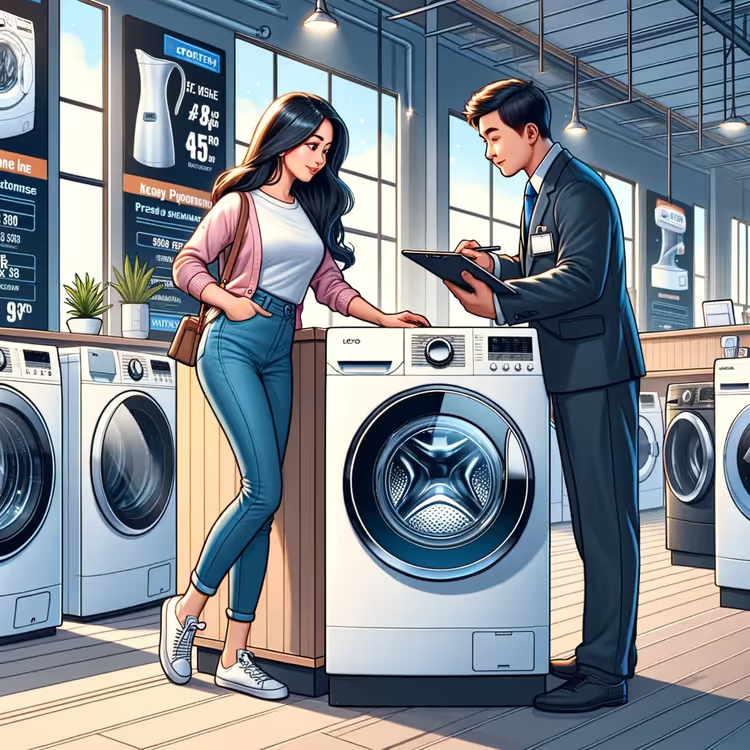
🧺 How to choose a washing machine: complete guide 2026
Choosing a washing machine is a purchase for 7-10 years. Getting the loading type or dimensions wrong means either returning it to the store or years of daily inconvenience. And overpaying for features you never use only warms the seller’s heart.
Below is a clear selection sequence: from machine type to specific noise and energy consumption figures. No marketing fluff, with a focus on what actually affects wash quality.
💡 Quick overview:
Decide on the type: automatic or semi-automatic, depending on whether you have running water and a drain connection
Choose the loading style: front-load or top-load, which determines dimensions and whether it can be built in
Pick the drum capacity based on household size: from 5 kg for one or two people to 8+ kg for a family with children
Check the wash, spin, and energy efficiency classes according to the new European standard (scale from A to G)
Verify the noise level in decibels, critical for studio apartments and nighttime washes
Washing machine types: where to start
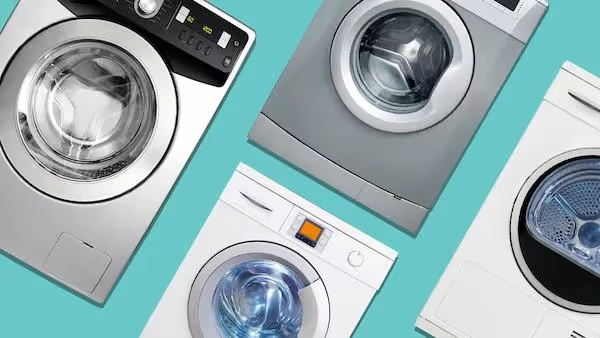
Automatic or semi-automatic, that’s the first fork in the road. Semi-automatic machines do not require a connection to water supply or drainage: you fill the water manually, and it drains into a bucket or sink. Washing is done by an activator, a rotating disc at the bottom of the tub.
This is an option for a dacha, rented accommodation without utility hookups, or temporary living. The upside is reliability: minimal electronics, nothing much to break. The downside is full human involvement in the process and higher water consumption (no automatic dosing).
Automatic machines are the standard for an apartment or house. They connect to water supply and drainage, and the entire cycle runs without human intervention. These are the automatics we’ll analyze further by criteria.
A separate category is washer-dryers. A washer-dryer combo saves space (one appliance instead of two), but drying consumes more energy and shortens the heating element’s lifespan. For a small apartment without a balcony, it’s a justified compromise.
A visual comparison of machine types and key characteristics, in this English-language review. Even without translation, the tables and footage give a clear picture of the differences between front-loaders, top-loaders, and combined models.
Key characteristics: what affects wash quality
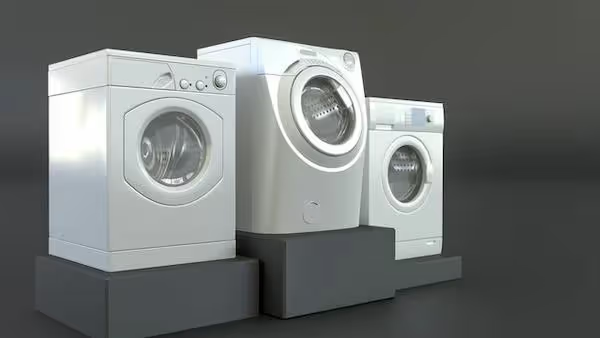
Loading: front-load or top-load. Front-loaders are versatile: they can be built into a kitchen unit, placed under a countertop, and you can stack a dryer or shelf on top. Top-loaders are narrower (standard width 40-45 cm) and don’t require clearance to open a door, a plus for a cramped bathroom. The downside of top-loaders: they can’t be built into cabinetry, and you can’t place anything on top.
Drum capacity. For 1-2 people, 5-6 kg is enough. A family of 3-4, 7-8 kg. With children, 8-9 kg: bed linen, towels, clothes with some margin. The figure in the specs is for cotton; for synthetics and wool, the actual load is noticeably lower. Don’t chase the "10 kg" number; in most households, such a drum gets filled once a week, but you pay for it every day.
Wash class. Almost all modern automatics are class A; differences between them are minimal. What to look at: the spin class. Class A means laundry comes out almost dry to the touch. Class C means noticeably damp laundry (takes twice as long to dry). For an apartment without a balcony, spin class A or B is a necessity, not a luxury.
Energy consumption. Since 2021, an updated scale has been in effect in Europe: A (most efficient) to G. No more A+++. A class A machine consumes about 0.13 kWh per kilogram of laundry. Class B, roughly 0.17 kWh. The difference in money over a year is noticeable, and over 10 years of service, it adds up to the cost of another budget machine.
Noise level. During washing: 47-55 dB. During spinning: up to 72 dB on budget models (audible through the wall to neighbors). For an open-plan kitchen/living room or nighttime washes, both figures are critical. Pay attention to the "night mode": the machine reduces spin speed to a quiet 60-65 dB.
Motor type. An inverter motor (Inverter Direct Drive) is quieter, more efficient, and more durable than a brushed motor. Manufacturers offer a 10-year warranty on it, versus 2-3 years on a conventional one. The price premium at purchase is noticeable, but over its service life it pays for itself through lower electricity consumption and no brush replacement.
Installation and dimensions: three scenarios
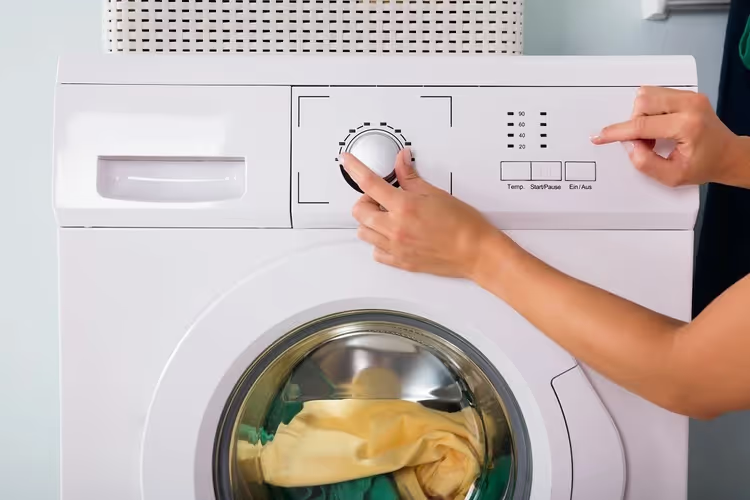
Freestanding. The simplest and most common option. Standard: height 85 cm, width 60 cm, depth from 32 to 65 cm. Slim models (32-40 cm deep) are a lifesaver in narrow hallways and compact bathrooms. Before buying, measure doorways; the machine must fit into the room with at least 3-5 cm clearance on the sides.
Built-in. The machine hides behind a kitchen unit front panel. Requires precise niche measurement: width 60 cm, height 82-85 cm, depth from 55 cm. The hinged door adds 2-3 cm to the front panel depth. And don’t forget the ventilation gap between the body and the niche walls.
Under a sink. Special models 67-70 cm high with a mounting for a countertop sink. Depth up to 45 cm, load up to 3-4 kg. A rare but life-saving option for a tiny bathroom where every centimeter counts.
Additional features: what’s worth paying extra for
Steam treatment. Smooths out wrinkles, refreshes clothes without washing, and eliminates most bacteria and allergens. Useful for families with children and allergy sufferers. Adds 15-30 minutes to the cycle but saves time on ironing.
Automatic detergent dosing. The machine measures out powder or liquid detergent itself based on load size and soiling level. It saves detergent and prevents overdosing, which causes residue on laundry, mold in the tub, and extra water consumption for rinsing.
Leak protection. Partial protection: an inlet hose with a mechanical blocker. Full protection (AquaStop): a double hose with an electromagnetic valve plus a tray with a float. For an apartment above the ground floor, only get full protection: a flood from a burst hose costs tens of thousands of hryvnias in repairs for the neighbors below.
Wi-Fi and smart features. Remote start, end-of-cycle notification to your phone, error diagnostics via an app. Not a must-have, but noticeably convenient if the machine is in a basement, on a lower ground floor, or in a separate laundry area.
⁉️🤔 Frequent questions
Is it worth overpaying for a brand?
A name is not a guarantee of quality. Pay attention to the country of assembly: European factories (Poland, Italy, Germany) consistently deliver quality plastics and bearings. Chinese assembly of the same brand often cuts corners on these components. Read reviews for the specific model, not the brand as a whole.
Inverter motor: marketing or real benefit?
Real. An inverter runs quieter (no brush friction), controls speed more precisely, and consumes less energy. LG and Samsung offer a 10-year warranty specifically on the inverter motor, which is an indicator of its designed lifespan. A conventional brushed motor lasts 5-7 years and is 5-8 dB louder.
Is it true that washer-dryers are unreliable?
Service center statistics confirm: washer-dryer combos are called in for repair noticeably more often than separate appliances. The reason is simple: more components (two heaters, a fan, an additional control board). But for an apartment without space for a separate dryer, the compromise is justified.
Can you put a washing machine on an unheated balcony?
No. At sub-zero temperatures, water in the valves and hoses will freeze and rupture them from the inside. Even a glazed but unheated balcony is a risk. The minimum operating temperature for most models is +5 °C.
How long does a washing machine actually last?
The average lifespan is 8-10 years with regular use. Machines with an inverter motor can last up to 12-15 years. The main longevity factors: water hardness (scale on the heating element is the number one killer), overloading the drum, and failing to remove the transit bolts after installation.
Which machine to get: the final rundown
The universal choice for a family of 3-4 in an apartment: a front-load 7 kg machine with spin class A or B, an inverter motor, and full leak protection. This set will cover most needs for the next 8-10 years.
- If the bathroom is cramped, get a top-loader for 6-7 kg, 40 cm wide.
- If the kitchen has built-in appliances, a built-in front-loader, niche depth from 55 cm.
- If it’s a dacha or a house without running water, a semi-automatic with an activator, requiring no hookup.
- If there’s no balcony and no space for a separate dryer, a washer-dryer combo, and budget extra for it.
Before buying, measure doorways and the niche itself with a 2-3 cm margin on the sides and in depth. And most importantly, remove the transit bolts after delivery: technicians from washing machine repair Odesa and other cities regularly encounter machines killed by the very first wash with the bolts still in place.
Which criterion was the deciding factor in your choice: loading type, dimensions, or something else? Tell us in the comments.

A professional team of writers and editors specializing in creating quality content.