














💰 How to make money online: a beginner's guide 2026
A bank account doesn't grow on its own, and a salary no longer looks like the only option. 73 million Americans freelance, and collectively they generated $1.5 trillion in 2024, Upwork data. The internet long ago stopped being just a place for memes: it's a full-fledged labor market where a beginner with no portfolio can earn their first money within a couple of weeks.
The problem isn't a lack of opportunities. The problem is the noise: thousands of "experts" promise mountains of gold in three clicks, but reality works differently. The median side-hustle income is around $200 a month, and only 4% of content creators cross the $100,000-a-year mark, EarnifyHub and Demandsage data. The numbers are sobering, but they also provide a map: it becomes clear where to go and where the real money is.
Below, without fluff or inspirational quotes: which earning methods work right now, how much you can realistically make with them, and where to start if you have zero experience and zero followers.
💡 Quick overview:
- Sign up on Upwork and land your first freelance order without a portfolio
- Pick a niche for affiliate marketing and find offers through aggregators
- Launch a blog or YouTube channel and publish content that brings in clients
- Try dropshipping through a marketplace with minimal investment
- Package your knowledge into an info product and sell it without an existing audience
What actually works: 5 ways to earn without startup capital
You don't need to invest millions. Most of the methods below can be launched with a zero budget; all you need is time, a good head on your shoulders, and a willingness to figure out the details.
Freelancing: your first earnings in 2 weeks
The most direct path to money: sell a skill. Upwork, Fiverr, and Freelancer connect clients with freelancers directly. The platform takes a commission (from 5 to 20 percent depending on volume), but it provides the main thing: access to clients that a beginner doesn't have.
How to enter the market in 2026? AI-adjacent skills are growing explosively: generative AI job posts increased by 300% year over year. Freelancers who use AI tools earn roughly 40% more per hour, Upwork data for 2025. At the same time, classic niches are still alive: web development holds 34% of all activity on Upwork, copywriting 18%, design 9%.
The average hourly rate for a US freelancer is $47. Beginners in the Russian-speaking market start at $5-15 per hour, but after 3-6 months of regular work they reach $20-30. Five and a half million independent workers in the US crossed the $100,000 annual income mark in 2025, a record figure, according to MBO Partners.
Where to start: sign up on Upwork, complete your profile (photo, description, 2-3 relevant skills), take 2-3 small orders at the minimum rate to get your first rating. Then raise your prices.
Affiliate marketing: earning on other people's products
The concept is simple: you recommend a product or service, someone buys through your link, you get a commission. It's convenient to search for offers through affiliate program aggregators; for example, Affmoment collects programs across various niches.
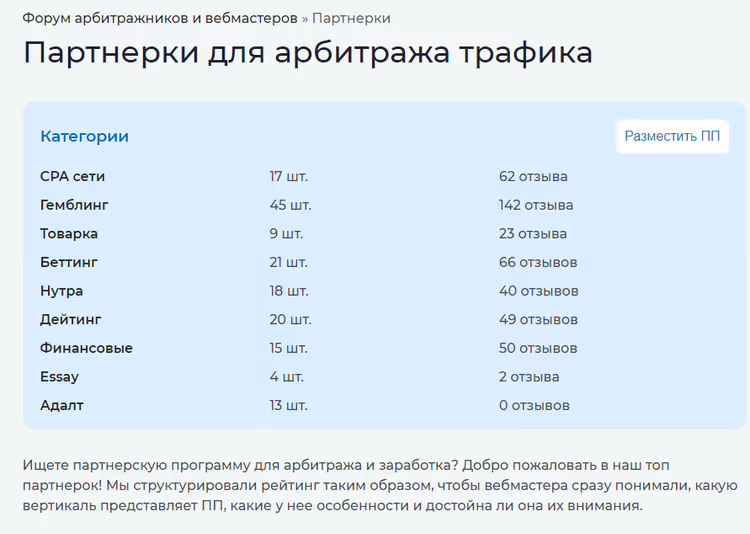
Affiliate marketing doesn't require your own product, warehouse, or customer support. But it does require traffic. Without visitors to your site or subscribers in your channel, commissions won't appear. That's exactly why most beginners burn out: they sign up for ten programs and wait for sales that never come.
A working model looks different. Pick one narrow niche. Create a platform: a blog, Telegram channel, YouTube channel, or social media page. Publish reviews, comparisons, and how-to guides, content that helps a person make a purchasing decision. Embed affiliate links where they feel natural. One quality review can generate commissions for years.
Commissions vary dramatically: info products and SaaS services can pay up to half the order value, while marketplace goods yield just a few percent. One sales post with modest traffic can bring in $50-200 a month. A well-developed blog with 10,000 visitors can bring in $500-2,000.
Blog or YouTube channel: content as an asset
Content creation is not "record a video and get rich." Out of 50 million content creators worldwide, only 4% earn more than $100,000 a year, Demandsage data on the creator economy. Almost three quarters earn less than $30,000. This is a market with a harsh power-law distribution: the winner takes almost everything.
But content has a property that distinguishes it from hourly work: it accumulates. An article written a year ago continues to bring in visitors. A video from three years ago still circulates in recommendations. You aren't selling your time; you are building an asset.
Monetization for blogs and channels is multi-layered:
- Advertising (Google AdSense, display networks, direct advertisers), from a couple of dollars to thousands per month, depending on traffic and niche;
- Affiliate links, the most predictable source for review and educational content;
- Sponsored integrations, which appear once you have a stable audience of 1,000-5,000 subscribers;
- Your own products: ebooks, courses, templates, consultations.
A starting recommendation: don't spread yourself thin across everything at once. Pick one platform and one niche. Publish 10 pieces of content before drawing conclusions. The first six months are an investment, not income.

Online stores and dropshipping: from marketplace to your own brand
Three formats with different barriers to entry. Marketplaces (Ozon, Wildberries, AliExpress): you register as a seller, upload product listings, and pay for logistics and commission. A quick start, but margins are eaten up by competition. Dropshipping: you create a storefront website and find a supplier who ships the product directly to the customer. You don't hold inventory, but you also don't control packaging quality or delivery times. Your own brand: you buy a batch, create packaging, and build marketing. Maximum margin, and maximum risk.
For a beginner, the logical path is to start with a marketplace: it gives you an understanding of demand, pricing, and logistics without investing in a website and advertising.
Info products: sell knowledge, not time
If you understand something better than the average person, that's already a product. A checklist for setting up an ad account. A video course on Excel for managers. A contract template for freelancers. The packaging doesn't have to be complex: a 15-page PDF recorded in an evening can bring in $200-500 a month with the right presentation.
The main barrier isn't recording, but attracting buyers. However, the same logic applies here as in affiliate marketing: you create free content on the topic, build an audience, and offer a paid product to those who need to go deeper.
Where 90% of beginners stumble
There are hundreds of platforms and even more opportunities. But there are three recurring reasons why people burn out after a month:
- Blurred focus. Trying to do freelancing, YouTube, and dropshipping simultaneously leads to zero results in each. Pick one direction and push it to the first money, then expand.
- Expecting fast money. Affiliate marketing doesn't generate commissions in the first week. A blog doesn't hit the top of Google in a month. The median time to the first stable $500 a month is 4-7 months of consistent work.
- Ignoring AI. 54% of freelancers already use AI at an advanced level, and they save about 8 hours a week (Upwork data). Not using AI today is like refusing to use the internet in 2005.
Watch before you start: a breakdown of the topic in 15 minutes
A good English-language video that breaks the topic down clearly. 15 minutes, and you'll have a framework in your head instead of a mess of scraps from other people's advice. Turn on auto-translated subtitles if your English isn't great yet.
⁉️🤔 Frequent questions
How much can a beginner realistically earn in the first month?
Zero is the most honest answer for most people. The first month is spent learning, setting up profiles, and understanding the niche. A realistic scenario: $50-200 in the second or third month of consistent work. The exception is freelancing with an existing skill (design, coding, translation): there, the first money can come within the very first week.
Which earning method is the fastest to start?
Freelancing on platforms like Upwork. Registration takes an hour. If you have at least one applied skill, writing a text, laying out a page, translating a document, you can get your first order within a few days. The downside: income is tied to your time; it doesn't scale.
Do I need to pay taxes on online income?
It depends on your jurisdiction. In most countries, yes. Register as self-employed or as a sole proprietor before you start receiving regular payments. The fine for non-payment can exceed your earnings.
Is it worth buying courses on making money online?
Almost never. All the information sold in courses for $200-500 is available for free: platform documentation, YouTube, forums. The exception is highly specialized technical courses (for example, on Google Ads or programming), where paid access provides practice and homework review, not just video recordings.
What's more profitable: affiliate marketing or your own product?
Your own product is more profitable in the long run; the margin approaches the full price minus payment processing fees. But affiliate marketing is easier to start: you don't need to create or maintain anything. A sensible strategy: start with affiliate marketing in your niche, build an audience, and in 6-12 months launch your own info product or service.
Where you specifically should start: a sober plan
Don't try to guess the "most lucrative" method; it doesn't exist. There is a method that suits your skills, time, and temperament.
If you already have an applied skill, go into freelancing. It's the shortest path to your first thousand. If you don't have a skill but your head works and you have free time, launch a content platform and build affiliate income. If you are a subject-matter expert in a narrow field, package your knowledge into an info product. And if you're drawn to entrepreneurship, try a marketplace with a minimal product range.
The main thing is to start with one direction. 68% of companies regularly hire freelancers, according to an Upwork estimate; the market is still hungry for competent professionals. 53% of Americans already have a side hustle, and their number grows every year, EarnifyHub 2026 report. The internet hasn't ended; it has simply stopped being a free ride. And for those willing to work with their heads, it's still the best market in history.

A professional team of writers and editors specializing in creating quality content.