













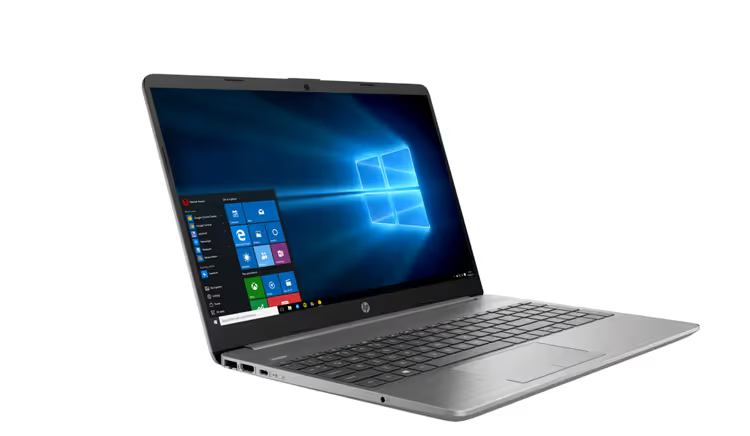
💻 HP laptops in 2026: brand overview and current lineups
Choosing a laptop but your head is spinning from OmniBook, Omen, and EliteBook? Over the past two years, HP has shaken up its catalog so much that you can't figure it out without a guide. Spectre, Envy, Pavilion, those names are gone from the official HP website. In their place, the OmniBook family, where a $550 budget model sits alongside a $2000 premium convertible.
We combed through HP's current lineup as of mid-2026: which series fits which scenarios, where the compromise is hidden, and where you're genuinely paying extra for quality. No press-release jargon, just a real-world breakdown of hardware, battery, and money.
💡 Quick overview:
- OmniBook Ultra Flip, premium convertible, Spectre successor: 2.8K 120 Hz OLED, Intel Core Ultra 7, 1.34 kg
- OmniBook 5 and 7, mainstream segment replacing Pavilion and Envy: reasonable price, 9-10 hours of battery, Copilot+ AI
- Omen 16 and 17, gaming machines with RTX 50-series, QHD 240 Hz, vapor chamber on the CPU
- EliteBook, business class with up to 22 hours of battery life, vPro, MIL-STD-810H, self-healing BIOS
- ZBook, mobile workstations for engineers: ECC, certified drivers, up to 128 GB RAM
How HP reinvented its catalog
Before 2024, everything was predictable. Spectre, the flagship, Envy, the mid-range with a premium touch, Pavilion, the budget option, Omen, gaming, EliteBook, the corporate sector. Then HP pulled off the largest lineup restructuring in a decade. The consumer segment now lives under a single brand, OmniBook. This banner covers devices from $500 to $2500: OmniBook 3 (entry-level), OmniBook 5 (basic), OmniBook 7 (mid-range+), OmniBook Ultra Flip (premium convertible), OmniBook X Flip (large 16″ screen), HP data.

Gaming laptops are still called Omen, but the lineup was also shaken up internally: a sub-line called Omen Max appeared with an RTX 5090 and a Mini-LED screen, while the base Omen 16 was updated to the RTX 50-series Blackwell. The EliteBook business line received Intel Core Ultra Series 2 and AMD Ryzen AI processors in 2025-2026, with a focus on battery life (20+ hours) and corporate security. Dragonfly disappeared as a separate brand; the ultra-light 13.3″ chassis now ship under the EliteBook X G1a name.
You can no longer find the old Spectre, Envy, and Pavilion on HP's website. Remaining stock still pops up in retail, but buying them in 2026 makes no sense: these are leftovers with processors that are two or three years old, lacking an NPU block and with worse energy efficiency. Your reference point is only the current lineup.
OmniBook Ultra Flip, the flagship convertible
At the top of HP's consumer pyramid sits the OmniBook Ultra Flip 14. This is the model that took the place of the Spectre x360, and judging by tests, it didn't just take its place, it outgrew its predecessor. The chassis is all-aluminum, 1.34 kg, 14.9 mm thick. The hinges hold the screen in four modes without play: laptop, tablet, presentation, tent.
The heart is an Intel Core Ultra 7 258V (Lunar Lake) with integrated Intel Arc 140V graphics. This is enough not only for office work and browsing but also for Lightroom, Figma, and light editing in DaVinci Resolve. The screen is a 14″ OLED, 2.8K, 120 Hz, 100% DCI-P3, according to manufacturer specifications. For a designer or photographer, this is almost a reference standard: color gamut on par with professional monitors, brightness up to 500 nits in HDR. A stylus is included (in some configurations), with instant response.
The 68 Wh battery lasts 12-14 hours under mixed load; Intel Lunar Lake has seriously improved energy efficiency. Ports: two Thunderbolt 4 (USB-C), one USB-A 10 Gbps, HDMI 2.1, 3.5 mm jack. No dongles needed for daily work.
Downsides: RAM is soldered (16 or 32 GB at purchase, no upgrade). The SSD is replaceable, but accessing it requires removing the bottom cover with its clips. Starting price: from $1450 for the base configuration, top-tier builds with 32 GB/2 TB go for $2200, current HP prices.
Who it's for: designers, photographers, executives, anyone who needs a premium screen and chassis, and gaming is not a priority.
OmniBook 5 and 7, the mainstream segment
HP's mainstream laptops are now divided into two clear tiers: OmniBook 5 (all-rounder, formerly Pavilion) and OmniBook 7 (mid-range+, formerly Envy). Both are available in 14- and 16-inch versions.
OmniBook 5 (14″), the base model on Intel Core Ultra 5 225U or AMD Ryzen 5 240. 1920×1200 IPS screen (16:10), 8 or 16 GB RAM, SSD from 256 GB to 1 TB. The chassis is plastic but assembled without creaks; HP has learned to make budget laptops decently. The 51 Wh battery provides 9-10 hours of office work. Price, from $550 to $800 depending on configuration, HP catalog. The main difference from the old Pavilion: Intel Core Ultra Series 1/2 processors with an NPU block for AI features (Copilot+, Windows Studio Effects) are included even in the base model.
The 16-inch version adds a numeric keypad and a 59 Wh battery, the same 9-10 hours, but the screen is noticeably larger. For home use, where the laptop rarely leaves the desk, this is the optimal choice in terms of price-to-screen-size ratio.
OmniBook 7 Aero, an ultrabook weighing 980 grams in a 13.3-inch chassis. Qualcomm Snapdragon X Plus (ARM) processor with up to 20 hours of battery life, 16 GB RAM, 512 GB SSD. HP's answer to the MacBook Air: silent, cool, with an LTE modem in some configurations. The downside is the ARM architecture: not all Windows software runs natively. x86 emulation exists but hits performance. Price, around $900 for the base model, HP data.
Both lines are workhorses without premium frills. The screen is not OLED, the chassis is not made of "space-grade" aluminum. But the price is reasonable, and the battery lasts a full day.
Omen, the gaming series
HP's gaming laptops remain under the Omen brand. In 2025-2026, the lineup received its most significant update in several years.
Omen 16 (2025), the base gaming model. Choice of Intel Core Ultra 7 265H (Arrow Lake) or AMD Ryzen 7 7840HS processors. Graphics cards: NVIDIA GeForce RTX 5050, 5060, or 5070 (50-series Blackwell, a serious leap in ray tracing over the 40-series). Screen: 16″ IPS, QHD 240 Hz, 3 ms response. Cooling: OMEN Tempest Cooling, two fans and a vapor chamber on the CPU. Under an hour-long load in Cyberpunk 2077, throttling is minimal. 83 Wh battery, 4-5 hours in office mode, normal for a gaming laptop. Price from $1300, Omen 16 specifications.
Omen 17, the higher-end model. 17.3″ QHD 240 Hz display, Intel Core Ultra 9 285H, RTX 5080. A full-fledged desktop replacement: handles 4K gaming on an external monitor, VR headsets, streaming with NVENC encoding. Cooling uses three fans with enlarged radiators. Weight is 3.2 kg, not for a backpack, but for a stationary spot "on the go."
Omen Max 16, a new sub-line for 2026. RTX 5090, Intel Core Ultra 9 285HX (a desktop die in a BGA package), 64 GB DDR5, 16″ Mini-LED screen with 1000 local dimming zones. Price, from $3500, Omen Max specifications. For those who need a no-compromise "beast." But keep in mind: the RTX 5090 in a laptop is NOT the desktop chip. TGP is 120-175 W versus 575 W for the desktop version. Real-world performance is on par with a desktop RTX 4080, not higher. For a laptop, that's the ceiling in 2026.
EliteBook, business class
HP addresses corporate users with the EliteBook line. What matters here is not gigahertz, but security, battery life, and certification for corporate standards.
EliteBook Ultra G1i (14″), the flagship of the business line. Intel Core Ultra 7 268V processor (Lunar Lake, vPro), 14″ OLED 2.8K 120 Hz, weight 1.18 kg. Magnesium alloy chassis, MIL-STD-810H certification (drops, vibration, dust, humidity). Battery life, up to 22 hours in "office + Wi-Fi" mode. Corporate features include: TPM 2.0 on a dedicated chip, self-healing BIOS (HP Sure Start), physical webcam shutter, smart card reader. Price, from $1600, HP EliteBook catalog.
EliteBook 8 G1i, a 16-inch entry-level workstation. Core Ultra 7 266H, up to 64 GB RAM (two SODIMM slots, not soldered), two M.2 slots for SSDs, NVIDIA RTX A500 for CAD. QHD+ IPS 120 Hz screen. Weight 1.75 kg with a 76 Wh battery, 14-16 hours of battery life. Price, from $1800, EliteBook 8 specifications. Both models come with Windows 11 Pro and a three-year HP Care Pack warranty as standard. These are tools for making money, not toys; the premium over OmniBook is justified if the laptop generates income.
What remains of the old lines: ZBook
ZBook, mobile workstations for engineers and scientists. The current generation: ZBook Studio G11 and ZBook Fury G11 (2025). Intel Core Ultra 9 285HX, up to 128 GB ECC RAM, NVIDIA RTX 5000 Ada (professional GPU), 16″ 4K OLED. Price, from $3000 to $8000 depending on configuration, HP ZBook specifications. They are produced and updated, but the mass user doesn't need them: this is a niche tool for AutoCAD, SolidWorks, and MATLAB with certified drivers and ECC memory. If you don't know why you need ISV certification (Autodesk, Dassault, Siemens), you don't need a ZBook. The EliteBook 8 G1i with RTX A500 will cover an engineer's CAD needs almost completely.
Which HP laptop to choose: the matrix
Summary table of HP's current lineups. Prices in USD, mid-2026, base configuration:
Lineup | Who it's for | Screen | Processor | Weight | Battery life | Price from |
|---|---|---|---|---|---|---|
OmniBook 5 (14″) | All-rounder, student | 14″ IPS, 1920×1200 | Core Ultra 5 / Ryzen 5 | 1.5 kg | 9-10 h | $550 |
OmniBook 7 Aero | Mobility, business travel | 13.3″ IPS, 1920×1200 | Snapdragon X Plus | 0.98 kg | up to 20 h | $900 |
OmniBook Ultra Flip 14 | Premium, design | 14″ OLED, 2.8K, 120 Hz | Core Ultra 7 258V | 1.34 kg | 12-14 h | $1450 |
Omen 16 (2025) | Gaming, streaming | 16″ IPS, QHD, 240 Hz | Core Ultra 7 265H / Ryzen 7 | 2.4 kg | 4-5 h | $1300 |
Omen 17 | Gaming, desktop replacement | 17.3″ IPS, QHD, 240 Hz | Core Ultra 9 285H | 3.2 kg | 3-4 h | $2000 |
EliteBook Ultra G1i | Business, work | 14″ OLED, 2.8K, 120 Hz | Core Ultra 7 268V vPro | 1.18 kg | up to 22 h | $1600 |
EliteBook 8 G1i | Engineering, CAD | 16″ IPS, 2560×1600 | Core Ultra 7 266H | 1.75 kg | 14-16 h | $1800 |
The bottom line. Student or office worker, get the OmniBook 5 and don't overthink it: this is the new Pavilion, only better on battery and with an NPU on board. Mobility above all else, the OmniBook 7 Aero on ARM, 20 hours away from an outlet at under a kilogram. Need a premium screen and chassis, the OmniBook Ultra Flip 14, the direct successor to the Spectre. Gaming, Omen 16 or 17 depending on your budget: the first is a sensible compromise, the second is a desktop replacement. Corporate work, EliteBook Ultra G1i (mobility) or 8 G1i (16″ screen and CAD). Engineering software at full throttle, ZBook.
The only thing you shouldn't do in 2026 is buy an HP with the old Spectre, Envy, or Pavilion name. Those are machines from 2023-2024 with processors that were already obsolete yesterday. The current HP is OmniBook, Omen, EliteBook. There are no others.
HP's entire current lineup is available in Ukrainian retail, from the budget OmniBook 5 to the top-tier Omen 17. You can compare prices, availability, and configurations in the catalog: https://comfy.ua/notebook/brand__hp/. If you need maximum customization, the official HP website lets you configure RAM, SSD, screen, and warranty at the order stage. Check the specific model page for direct shipping to Ukraine.

⁉️🤔 Frequently asked questions
How is OmniBook different from Spectre and Envy?
This is not a rebranding. Spectre and Envy have been discontinued. OmniBook uses new Intel Core Ultra (Series 2) and AMD Ryzen AI with a dedicated NPU block, as well as Qualcomm Snapdragon X Plus in the Aero version. Old Spectre models (pre-2024) run on Intel Core 13th/14th generation without an NPU and with worse energy efficiency. The difference in battery life between them and an OmniBook on Lunar Lake reaches 4-6 hours with the same battery capacity. If you're buying a laptop in 2026, only look at OmniBook.
Is the OmniBook 7 Aero on Snapdragon suitable for work?
It depends on the software. Microsoft 365 (Word, Excel, Teams, Outlook) has native ARM versions as of December 2024. Browsers (Edge, Chrome, Firefox) are native. Adobe Photoshop and Lightroom have been native since February 2025. Problems arise with specialized software (AutoCAD, SolidWorks, 1C) and old peripheral drivers. x86 emulation works, but performance drops noticeably. For most office tasks, the ARM version is sufficient: 20 hours of battery life and complete silence (no fan) are worth it. Before buying, check the compatibility list at worksonwoa.com.
Is it worth getting an Omen instead of a desktop?
Depends on how often you move. The Omen 17 with RTX 5080 delivers FPS on par with a desktop RTX 4070 Ti, which is enough for 1440p gaming. But a desktop for the same money will be noticeably faster, quieter, cooler, and allows for incremental upgrades. The laptop RTX 5090 in the Omen Max is marketing: real performance is limited by the 175 W thermal envelope. A gaming laptop is justified if you need mobility (student, frequent moves, LAN parties). If it sits on a desk almost always, build a desktop.
Does it make sense to pay extra for OLED in an EliteBook?
If you work with text, there's no big difference from IPS. If you work with graphics (design, photo, client presentations), OLED gives you true black, DCI-P3 coverage, and HDR. Plus, less eye strain during an 8-hour day: HP uses DC Dimming on 2025-2026 OLED models, so there's no flicker. The price difference between the OLED and IPS versions is a few hundred dollars.
Is ZBook still relevant, or can you get by with an EliteBook?
ZBook means certified NVIDIA RTX/Quadro drivers, ECC memory, and guaranteed compatibility with industrial software (Autodesk, Dassault, Siemens). If you don't know whether you need ECC and ISV certification, you don't need a ZBook. The EliteBook 8 G1i with RTX A500 will cover 95% of engineering tasks in CAD, HP lineup comparison.
So which HP laptop should you buy in 2026?
A quick algorithm: limited budget, OmniBook 5, the best $550-800 in HP's catalog, current prices. Need maximum mobility, OmniBook 7 Aero on Snapdragon (check your software against worksonwoa.com first). Want a premium screen and a chassis that "feels the part," OmniBook Ultra Flip 14, the direct successor to the Spectre and HP's best consumer laptop today. Gaming, Omen 16 as a sensible compromise, Omen 17 as a desktop replacement. Business and work with confidential data, EliteBook Ultra G1i or 8 G1i. Engineering CAD with calculations, ZBook.
There's just one main rule: in 2026, HP is OmniBook, Omen, and EliteBook. Everything else is history.

A professional team of writers and editors specializing in creating quality content.