













🔌 Inverter generators: how to choose, connect and not overpay
Power went out for the third time this week and the fridge is starting to defrost? Or you're heading out camping and don't want to leave your laptop and coffee maker behind? In both cases you need a generator. But not just any generator.
A conventional generator produces "dirty" power with high total harmonic distortion. For an angle grinder or a water pump that's no big deal. But a laptop, router, or phone charger won't forgive it: voltage spikes slowly kill sensitive electronics. That's exactly why inverter generators have become the standard for home, cottage, and outdoor use over the past five years: they deliver a clean sine wave signal with THD below 3%, comparable to grid power quality.
Below, no fluff and no marketing promises: how an inverter works, which specs actually matter when choosing one, a comparison table of three popular models from different price brackets, and the rules without which a generator won't last long.
💡 Quick overview:
- Understand how an inverter generator differs from a conventional one and why THD is critical for electronics.
- Determine the power you need: add up the wattage of all devices that will run simultaneously and include a small reserve for starting surges.
- Choose the fuel type (gasoline, dual fuel gas-gasoline, or diesel), starter type, and evaluate the noise level in decibels.
- Check the comparison table of three models: from the compact Ducati to the versatile Könner & Söhnen.
- Memorize three safety rules and the maintenance schedule; without them even an expensive generator will fail within a season.
What an inverter generator is and how it differs from a conventional one
A conventional generator is simple: the engine spins an alternator, and you get AC power at the output. But the frequency and voltage of that power "float" depending on engine speed. Total harmonic distortion (THD) in such models reaches 10-25%, which is enough to gradually damage laptop power supplies, gas boiler control boards, or charging stations.
An inverter generator works differently. First it rectifies the AC from the alternator into DC, then a dedicated electronic module synthesizes it back into AC, but now with a perfectly smooth sine wave. Output THD is under 3%, and on quality models like the Honda EU2200i, under 1.5%. For comparison: a household wall outlet typically has 2-5% THD.
Three practical advantages follow from this:
- Safe for electronics. You can plug in a laptop, monitor, router, or CPAP machine without the risk of burning out power supplies.
- Fuel efficiency. The inverter can adjust engine speed to match the current load, rather than running flat out at a constant 3600 rpm like a conventional generator. In practice this yields 20-40% fuel savings.
- Quiet operation. At idle and under low load, inverter models run at reduced rpm. Noise levels on the best models are 48-58 dB, roughly like a quiet conversation. A conventional generator under the same conditions puts out 68-75 dB.
There is one downside: price. A 2 kW inverter generator costs 1.5 to 2 times more than a conventional one of the same power.
How to choose an inverter generator: 5 parameters
Choosing comes down to five specs. Go through them in order and your chance of making a mistake is minimal.
1. Power: rated and maximum
Maximum (starting) power is the short-term peak the generator can handle for a few seconds when motors or compressors start up. Rated power is what the generator sustains continuously. Rated power is what you should base your decision on.
Add up the power of all devices that will be on at the same time. A fridge, laptop, a few LED bulbs, router, and phone chargers rarely exceed 1.5-2.2 kW of rated power combined. Add a reserve for starting surges and you get the required maximum generator power.
For a cottage with a well pump or a welding inverter, look at models from 4 kW and up.
2. Fuel type
Three options:
- Gasoline. The most common. Available everywhere, but shelf life in the tank is typically 3-6 months without a stabilizer.
- Dual fuel (gas-gasoline). You can fill it with either gasoline or LPG from a cylinder. Gas is cheaper and stores for years, but power drops roughly 10% on LPG. Convenient for a cottage that already has a gas cylinder for the stove.
- Diesel. A rarity in the inverter segment. Economical under constant load, but the generators themselves are heavier, more expensive, and noisier.
For occasional home backup and trips, gasoline or dual fuel is optimal.
3. Starter: recoil, electric, or auto-start
Recoil starter (pull cord): cheap and reliable, but yanking the cord in freezing weather is no fun. Electric starter: starts with a button or key, convenient, but adds weight and requires battery maintenance. Auto-start (ATS): the generator turns itself on when grid power fails and shuts off when it returns. Installed on stationary home standby models.
4. Noise level
Measured in dB(A) at a distance of 7 meters under 25-50% load. Models up to 60 dB are suitable for camping and cottages with close neighbors. 60-70 dB is noticeable but tolerable for a construction site or emergency backup at a private house.
Pay attention: manufacturers sometimes list noise at idle (eco-throttle), but the figure rises noticeably under load. Look for measurements at half load; they are closer to real-world operating conditions.
5. Weight and portability
Portable 2 kW models weigh 18-22 kg; one person can carry one to the trunk. Dual fuel and models from 3.5 kW with an electric starter are already 35-45 kg and need wheels and a handle. Stationary 5+ kW units require a wheeled frame or permanent installation.
Comparison table of three models
Model | Rated power | Fuel type | Weight, kg | Noise, dB | Starter | Approximate price |
|---|---|---|---|---|---|---|
Honda EU2200i | 1.8 kW | Gasoline | 21 | 48-57 | Recoil | from $1,100 |
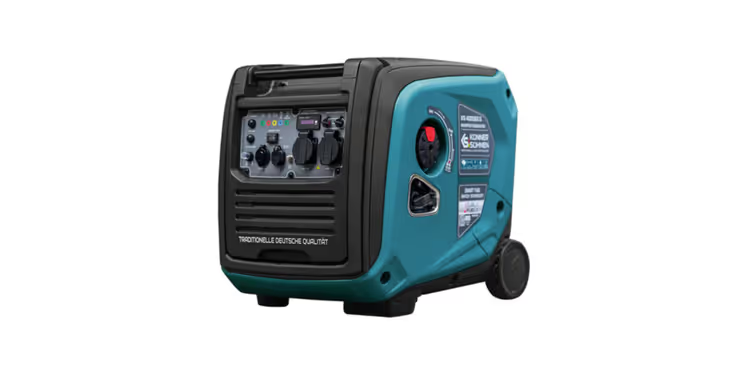
Könner & Söhnen KS 4000iEG S | 3.5 kW | Dual fuel | 40 | 67 | Electric + recoil | from €750 |
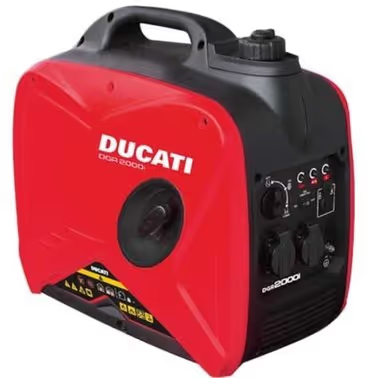
Ducati DGR2000IS | 1.6 kW | Gasoline | 22 | 65 | Recoil | from $350 |
Data sourced from official manufacturer pages and catalogs as of 2026. Prices are approximate and depend on region and dealer.
Safety and maintenance: three rules
An inverter generator is an internal combustion engine that produces carbon monoxide (CO). The rules are simple, but violating them costs lives:
Generator outdoors only. At least 6 meters from windows, doors, and ventilation intakes. CO is odorless and colorless. A carbon monoxide detector in the room where the generator is running is not protection; it's a delay of tragedy.
Dry conditions and grounding. The generator must sit on a dry surface. In rain or snow, place it under a canopy with open sides (exhaust must vent freely). Grounding is mandatory, especially for models from 3 kW and up.
Maintenance by engine hours, not "when you remember." Oil change every 50-100 hours (see your specific model's manual). First oil change after just 5-10 hours of break-in. Air filter every 100 hours or more often in dusty conditions. Spark plug once a season. For winter storage, drain fuel or add stabilizer.
For long-term storage (3 months or more): drain fuel from the tank and carburetor, fill with fresh oil, disconnect the battery if equipped. Store in a dry, ventilated space at above-freezing temperatures.
⁉️🤔 Frequently asked questions
Can I connect an inverter generator to my home wiring through a wall outlet?
Absolutely not. Connecting a generator directly to an outlet without isolation via a transfer switch creates backfeed voltage on the line; this is deadly for utility workers on the poles and is illegal. Use either a three-position transfer switch (line-off-generator) or separate extension cords to your appliances.
Proper connection is through a transfer switch installed by a certified electrician. It physically breaks the connection to the utility grid before the generator is connected. Budget several hundred dollars for the installation with labor. This is not a place to save money; it's a matter of safety.
What noise level is considered comfortable for camping?
Models with noise up to 55 dB(A) at 25% load are practically inaudible from 10-15 meters away. The Honda EU2200i in eco mode produces 48 dB, on par with a quiet conversation. For campgrounds with noise restrictions, look for models marked "super quiet" with a rating no higher than 57 dB. Note: decibels are a logarithmic scale; a 10 dB difference means a tenfold difference in sound pressure.
Gasoline or gas: which is cheaper and more convenient?
Gas is cheaper per kilowatt-hour and doesn't degrade in storage. But power drops roughly 10% on LPG, and the cylinder takes up space. Gasoline delivers full power and is available at any gas station, but requires a stabilizer for storage longer than 3 months. The optimal compromise is a dual fuel model: day to day you run it on gas from a cylinder, and when the cylinder runs out you switch to gasoline.
Does a portable inverter generator need to be grounded?
For models up to 2 kW, if you power devices through the generator's built-in outlets (without connecting to the house), grounding is not required; the housing is already insulated. But if the generator is connected to the home's distribution panel, grounding is mandatory per electrical code requirements. In any case, check the manufacturer's manual: if it says "ground the generator," do it.
How often should I change the oil in a new generator?
First oil change after 5-10 engine hours of break-in (usually the first tank of fuel). Then every 50-100 hours depending on the model. Use oil with the viscosity specified in the manual (most often 10W-30 for four-stroke engines). Do not use automotive oil with additives for wet clutches; they are not designed for the generator's air cooling.
Inverter generator: which one to get for your needs
The choice comes down to three scenarios:
Backup for an apartment or cottage during outages. Get a compact gasoline inverter in the 1.8-2.2 kW range: Honda EU2200i (expensive, reliable, very quiet) or the more affordable Ducati DGR2000IS (1.6 kW, 22 kg, recoil starter). Enough for a fridge, lights, chargers, and a laptop.
Cottage with gas heating and a well. You need a dual fuel unit from 3.5 kW with an electric starter, such as the Könner & Söhnen KS 4000iEG S. Runs on both gasoline and a gas cylinder, starts with a button.
Camping and outdoor trips. Priority: low weight and quietness. Look at models up to 22 kg with noise no higher than 57 dB. The Honda EU2200i is unrivaled here for noise, but there are also affordable alternatives from Champion and Westinghouse in the mid-price segment.
The cardinal rule: don't buy a generator "for future growth." Overpaying for extra kilowatts means not just more money, but more weight and higher fuel consumption at idle. An inverter generator is most efficient when operating in the middle of its load range, not at maximum output.
Before buying, check current prices and availability with dealers; selection and pricing vary by region. Browse models in the catalog: https://stylus.ua/generatory/tip-alternatora:invertornyy/.

A professional team of writers and editors specializing in creating quality content.