













IPhone 14: review of features and key Apple innovations
Every September Apple refreshes its flagship lineup, and every time insiders and analysts race to predict exactly what will change. The iPhone 14 turned out to be especially interesting: some leaks were spot on, others missed the mark.
The new iPhone 14 brought Dynamic Island, satellite SOS, and the first megapixel jump in the camera in years. But not everything Mark Gurman and Ming-Chi Kuo wrote about made it into the final product. Let's unpack what Apple actually changed in the iPhone 14, and where the insiders got it wrong.
💡 Quick overview:
- Dynamic Island replaced the notch on Pro models and became a signature interface feature
- iPhone 14 Plus replaced the mini: a large screen without the Pro premium
- Satellite SOS debuted in this lineup and has since saved dozens of lives
- A 48 MP camera arrived on Pro versions: the first resolution bump in seven years
- The A16 Bionic chip went only to Pro models; the base model runs on the A15
- 8K video and vapor chamber cooling stayed rumors: reality turned out more modest
Design: Dynamic Island instead of the notch
 AIIllustrative image: AI-generated
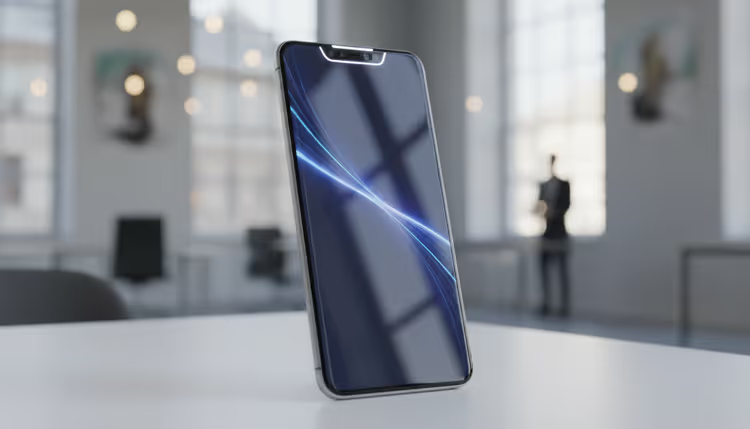
Before the launch, analysts from Bloomberg's Mark Gurman to Ming-Chi Kuo agreed that Apple would remove the rectangular notch and replace it with two separate cutouts: a pill for the camera and a circle for Face ID.
Reality proved more interesting. Apple engineers turned two physical cutouts into a single interface element, Dynamic Island. The system animates the area around the sensors, making it part of the UI: it shows music, timers, navigation, AirPods battery indicators. The base iPhone 14 kept the notch; Dynamic Island went only to the Pro and Pro Max.
The move worked. Dynamic Island became a recognizable signature and migrated to the entire iPhone 15 lineup, and later to the iPhone 16.
IPhone 14 Plus instead of the mini
The iPhone 12 mini and 13 mini sold noticeably worse than their larger siblings. According to Consumer Intelligence Research Partners, the mini versions accounted for just 3% of iPhone 13 lineup sales in the first quarter. Apple drew a conclusion: there would be no fourth mini.
In its place came the iPhone 14 Plus, a 6.7-inch screen without the Pro markup. The entry pair: iPhone 14 (6.1″) and iPhone 14 Plus (6.7″). The premium pair: iPhone 14 Pro (6.1″) and iPhone 14 Pro Max (6.7″). Same dimensions, different internals; the Pro models got Dynamic Island, 48 MP, and the A16.
For those who want a large screen for reading and video but don't need pro cameras, the Plus became a compromise. In 2026 the same logic holds: Plus versions launch every year.
Emergency SOS via satellite
Satellite connectivity for emergencies is one of those features that get plenty of pre-announcement buzz and rarely make it to release. In the iPhone 14's case, it made it.
Emergency SOS via satellite went live in the US and Canada in November 2022. When no cellular network is available, the phone helps you point the antenna at a satellite and sends a short message with your coordinates to emergency services. Text compression technology cuts transmission to 15 seconds under a clear sky.
Since launch the feature has saved dozens of people, from hikers in the California mountains to a driver stranded in snow in Alaska. In 2023-2024 Apple expanded coverage to more than 20 countries, and in the iPhone 15 and 16 satellite functionality added roadside assistance.
48-Megapixel camera on Pro models
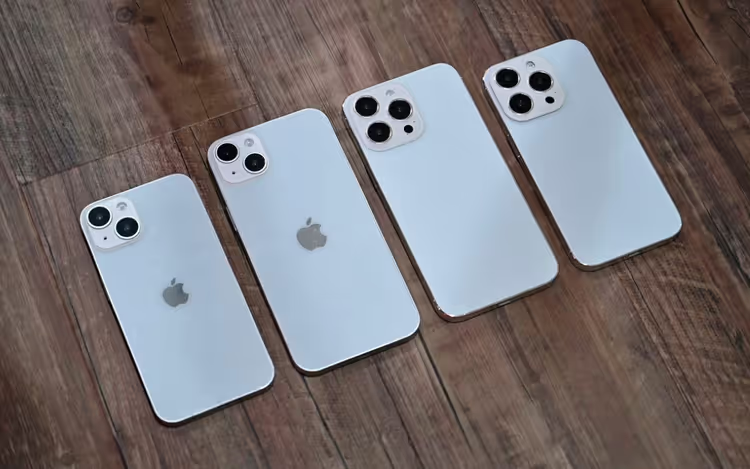
Since the iPhone 6s (2015) the main camera had stayed at 12 MP. The iPhone 14 Pro delivered the first jump to 48 MP in seven years. Resolution quadrupled, but it doesn't work the way competitors do it.
The sensor shoots in binning mode: four adjacent pixels merge into one, yielding a 12-megapixel photo with better light sensitivity and less noise. Full 48 MP is available only in ProRAW, for those who need headroom for cropping or print.
The ultrawide and telephoto stayed at 12 MP. On the software side Apple added Action Mode, stabilization for video in motion, and Photonic Engine, improved processing in medium and low light.
One more change: the rear camera bump got larger. The square protrusion familiar since the iPhone 11 didn't go away; on the contrary, it grew because of the larger sensor.
A16 Bionic processor, Pro only
For the first time in iPhone history Apple split processors between the base and Pro lines. The iPhone 14 and iPhone 14 Plus got the previous year's A15 Bionic (the same chip as the iPhone 13 Pro). The iPhone 14 Pro and Pro Max got the new A16 Bionic on a 4nm process.
The performance gap between the chips was noticeable in synthetic benchmarks, but in practice the A15 in the base model still covered all needs: gaming, video recording, multitasking worked without compromise. Yet the split itself became a marketing irritant. Apple continued this practice in the iPhone 15 and 16: new chips go only to Pro models.
What didn't pan out: 8K video and vapor chamber cooling
 AIIllustrative image: AI-generated
Two high-profile predictions didn't materialize.
8K video. Ming-Chi Kuo and several outlets expected the 48-megapixel sensor to support 8K recording. That didn't happen; the ceiling remained at 4K 60 fps with Dolby Vision. Even the iPhone 15 Pro and 16 Pro lack 8K recording: Apple emphasizes color and dynamic range over resolution.
Vapor chamber. Rumors of a vapor chamber for the iPhone 14 circulated a year before the launch. The technology is indeed used in Android flagships to draw heat away from the chip, but Apple implemented it only in the iPhone 17 Pro, three generations later. The iPhone 14 uses a conventional system with graphite pads.
Both cases are a good illustration of how the insider cycle works: a source sees a prototype or a patent, extrapolates to the next release, while Apple meanwhile tests the technology for years before actual deployment.
Before buying it's worth checking a current review: the video below shows real-world iPhone 14 performance on the latest iOS in 2025.
⁉️🤔 Frequently asked questions
Is the iPhone 14 still relevant in 2026?
Depends on the tasks. Hardware-wise it handles iOS 20, everyday apps, and video recording without lag. But Dynamic Island and 48 MP are only on Pro versions, and the base model runs on a 2021 chip. If you're buying today, it makes more sense to look at the iPhone 15 with Dynamic Island and USB-C, which costs only slightly more on the secondary market.
How does the iPhone 14 differ from the iPhone 13?
There are three main differences: satellite SOS, Action Mode for video, and a slightly brighter screen (800 nits vs. 625 nits). Externally the phones are nearly identical; the chip is the same (A15). Upgrading from the 13 to the 14 is the most modest jump in iPhone history, if you ignore the Pro versions.
Does satellite SOS work in Russia and Ukraine?
As of 2026, no. The feature is available in the US, Canada, Australia, the UK, and most Western European countries. In Eastern Europe, including Russia and Ukraine, satellite SOS is not live. Apple is gradually expanding coverage but has not given timelines for these regions.
Is the iPhone 14 Pro worth buying in 2026?
As a camera phone, yes, if you can find a solid unit with a healthy battery. 48 MP in ProRAW, Dynamic Island, and the A16 are still competitive. The only compromise is Lightning instead of USB-C. For those who want a single connector across all their gadgets, the iPhone 15 Pro is more practical.
Will the iPhone 14 keep getting iOS updates?
Yes. Apple historically supports iPhones with updates for 6-7 years. For the iPhone 14 (released 2022) the last version will roughly be iOS 21 or iOS 22, meaning support will last until 2028-2029.
The bottom line: was the iPhone 14 worth the hype
The iPhone 14 became a transitional generation. On one hand, satellite SOS, Dynamic Island on Pro models, the first megapixel leap in seven years. On the other, minimal differences between the base model and the iPhone 13, and a frankly marketing-driven chip split between the lines.
The main lesson from the iPhone 14: not all insider reports come true, and that's normal. 8K and vapor chamber arrived later, or not at all. But what Apple actually shipped in 2022 set the template for several generations ahead.
If you're shopping for a device right now, get the iPhone 14 Pro for the camera and Dynamic Island, or look at the iPhone 15 for USB-C and a more universal Dynamic Island across the entire lineup.

A professional team of writers and editors specializing in creating quality content.