













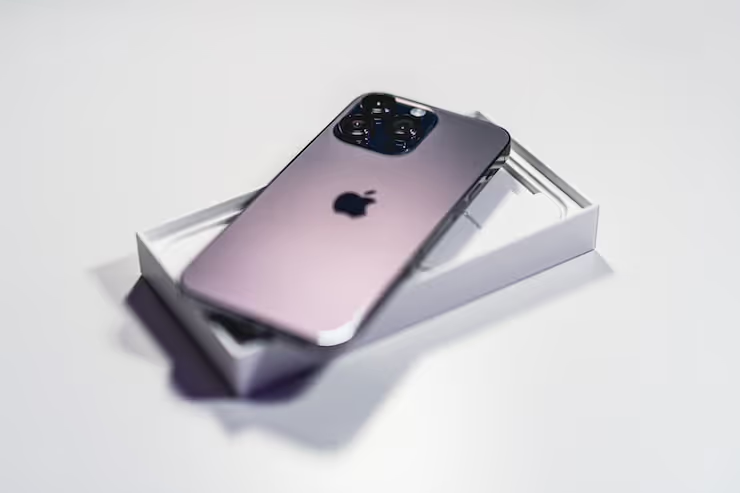
📱 IPhone 14 Pro Max or Google Pixel 7 Pro: detailed flagship comparison
iPhone 14 Pro Max and Pixel 7 Pro launched a month apart in fall 2022. Apple and Google, the two dominant players in the US smartphone market, each took a different approach to their flagship: a bet on raw power versus a bet on software-driven camera magic.
By 2026, both phones have received several major OS updates and have become noticeably cheaper on the secondary market. In a direct comparison, the difference in user experience boils down to a few specific areas: display, battery life, cameras, and ecosystem. Here is a breakdown of each point without the marketing fluff.
💡 Quick overview:
- Display: Pixel has higher pixel density (512 ppi), iPhone has much higher peak brightness (2000 nits vs 1500) and a wider adaptive refresh rate range (1-120 Hz vs 10-120 Hz).
- Performance: A16 Bionic beats Tensor G2 in Geekbench 6 single-core by 83%, a massive gap.
- Cameras: Pixel wins on zoom (5× optical vs 3× on Apple), but iPhone consistently leads in video recording.
- Battery life: iPhone 14 Pro Max lasts about 30 hours in testing, 63% longer than Pixel 7 Pro (18.5 hours).
- Software: Pixel gets Google features first; iPhone gets five to six years of updates and seamless integration with the Apple ecosystem.
Design and build: steel vs aluminum
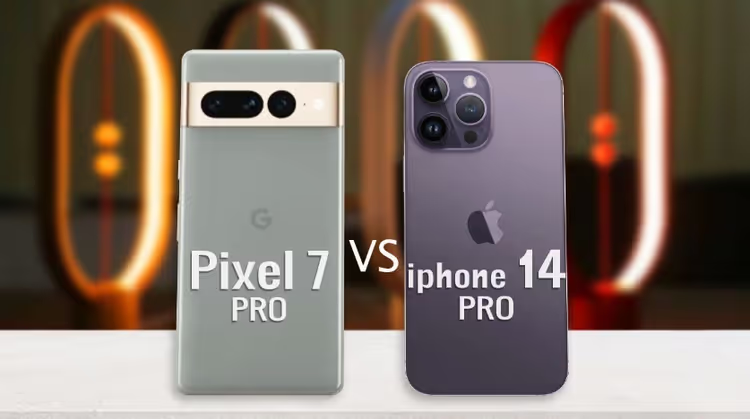
The first thing you notice when comparing them is the difference in materials. The iPhone 14 Pro Max is built with surgical-grade stainless steel, a matte glass back, and Ceramic Shield protection on the front glass. The Pixel 7 Pro uses an aluminum frame and Gorilla Glass Victus, also premium, but tactility is simpler.
In hand, the iPhone weighs 240 grams, noticeably heavier than the 212-gram Pixel. However, the steel frame delivers a sense of solidity that aluminum cannot replicate. The Pixel is lighter and slightly taller (162.9 mm vs 160.7 mm) but narrower (76.6 mm vs 77.6 mm). Both phones are IP68 rated, so rain, dust, and brief submersion in water are not a concern.
Overall ergonomics come down to a simple choice: if lightness and grip comfort matter to you, the Pixel wins. If you prefer a premium heft and confidence in the body's durability, go with the iPhone. Neither device supports microSD card expansion, and there is no 3.5 mm jack, both manufacturers dropped it long ago.
Displays: brightness is the deciding factor
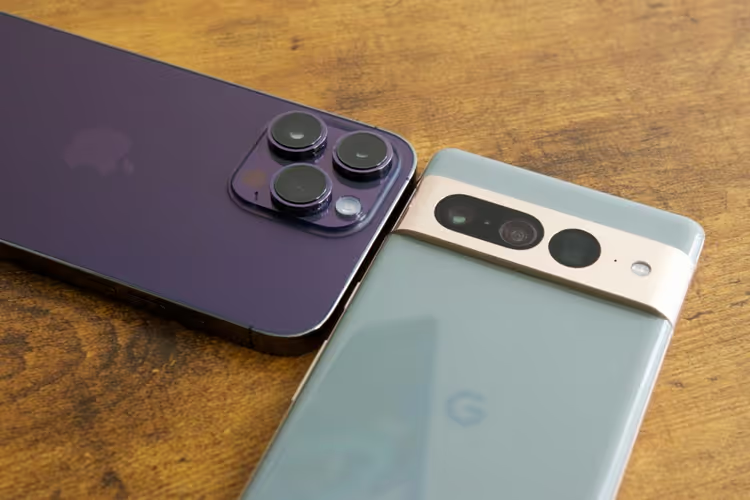
Both smartphones feature 6.7-inch OLED panels with adaptive refresh rates up to 120 Hz. That is where the similarities end.
The Pixel 7 Pro has a higher resolution: 1440×3120 versus 1290×2796 on the iPhone, resulting in a density of 512 ppi versus 460 ppi (GSMArena data). The difference is not radical; in practice, text and icons look equally sharp on both screens. The Pixel's adaptive refresh rate operates in a 10 to 120 Hz range, while the iPhone can drop to 1 Hz on static content, which saves battery with the Always-On Display.
The key difference is brightness. The iPhone 14 Pro Max delivers up to 2000 nits peak brightness outdoors, versus 1500 nits on the Pixel in HDR mode. According to NotebookCheck measurements, the iPhone's real-world peak brightness reaches 1753 nits, while the Pixel hits 1089 nits. A 61% difference means the iPhone screen is readable under direct sunlight without straining, whereas you often need to shade the Pixel with your hand.
Dynamic Island, Apple's signature pill-shaped cutout, became a convenient compromise between functionality and aesthetics. It displays timers, music tracks, navigation, and calls without switching to a full-screen mode. The Pixel has a classic centered hole-punch cutout, less intrusive but also less functional.
In short: both displays are excellent in terms of color accuracy (DCI-P3, infinite contrast). But for sunlight readability and animation smoothness, the iPhone is noticeably ahead.
Performance: A16 Bionic vs Tensor G2
The Apple A16 Bionic processor (4 nm, TSMC) is built on two high-performance Everest cores clocked at 3.46 GHz and four energy-efficient Sawtooth cores at 2.02 GHz. Google's Tensor G2 (5 nm, Samsung) uses a 2+2+4 layout: two Cortex-X1 at 2.85 GHz, two Cortex-A78 at 2.35 GHz, and four Cortex-A55 at 1.8 GHz.
In synthetic benchmarks, the gap is huge. According to NanoReview, in Geekbench 6 Single-Core, the iPhone scores 2669 points versus 1462 for the Pixel, an 83% advantage. In AnTuTu 10, the gap is slightly smaller but still decisive: 1,512,000 versus 1,122,000 (a 35% difference).
In practice, both phones handle everyday tasks without lag. The difference shows up in heavy scenarios: video rendering, 3D gaming at max settings, and working with RAW photos. There, the A16 Bionic pulls far ahead, thanks to its 5-core GPU clocked at 1398 MHz and 1.79 TFLOPS of compute power versus 0.76 TFLOPS on the Mali-G710 in the Pixel.
The Tensor G2 takes a different approach: its NPU (Next-gen Tensor Processing Unit) is optimized for on-device machine learning tasks, speech recognition, real-time translation, and photo processing. This is not about benchmark numbers but about scenarios where the Pixel truly excels: dictation, smart frame selection, and noise removal on calls.
Cameras: zoom vs video
The Pixel 7 Pro has three cameras: a 50 MP main (f/1.9), a 12 MP ultrawide (f/2.2), and a 48 MP telephoto with 5× optical zoom (f/3.5). The iPhone 14 Pro Max has a 48 MP main module (f/1.8), a 12 MP ultrawide (f/2.2), and a 12 MP telephoto with 3× optical zoom (f/2.8).
In terms of photo quality, both phones are in the top tier. The Pixel is traditionally strong in color rendering and HDR: shots come out contrasty and vibrant straight away, with no additional processing needed. The iPhone tends toward a more neutral color profile, which is convenient for later editing in post-processing apps.
Zoom is where the difference becomes obvious. The Pixel's 5× optical zoom versus the iPhone's 3× means that at long distances, the Pixel captures details the iPhone simply cannot resolve. For concerts, sports events, and urban architecture, this is a decisive argument.
But as soon as video comes into play, the iPhone pulls ahead. Stabilization, color balance when switching scenes, ProRes recording, and Cinematic mode with automatic focus pulls, taken together, iPhone video recording is still the best among smartphones. The Pixel shoots decent video, but it does not reach the iPhone's level.
Both devices received significant camera improvements through OS updates: iOS 17/18 and Android 14/15 brought new processing algorithms. By 2026, both shoot noticeably better than they did at launch.
Battery and charging

The most clear-cut point of comparison. The iPhone 14 Pro Max with its 4323 mAh battery shows in NanoReview tests 30 hours and 6 minutes of battery life. The Pixel 7 Pro with a 5000 mAh battery lasts 18 hours and 28 minutes. The difference is 63% in favor of the iPhone, despite the physically smaller battery.
The reason is the energy efficiency of the A16 Bionic chip (TSMC's 4 nm process versus Samsung's 5 nm) and the more aggressive adaptive display refresh rate (1 Hz at idle versus 10 Hz on the Pixel).
For charging, the Pixel is slightly faster: 30 W wired and 23 W wireless. The iPhone charges at 20 W wired and 15 W via MagSafe. Both support reverse wireless charging for earbuds and accessories.
If battery life is critical, the iPhone 14 Pro Max wins by a wide margin. It handles a full day of active use with room to spare, whereas the Pixel is looking for a charger by evening.
For those who need an iPhone 14 Pro, estore.ua has models in stock. Note: the Pro and Pro Max differ in screen size (6.1 vs 6.7 inches) and battery, but the cameras and processor are identical.
Verdict: which one to buy in 2026?
Four years after release, the difference between the iPhone 14 Pro Max and Pixel 7 Pro has only become clearer. Each has its own audience.
The iPhone 14 Pro Max is the choice for those who need maximum performance, the best battery life, and high-quality video recording. It is heavier and more expensive, but the Apple ecosystem and five to six years of iOS updates make it a long-term investment. If you already use a Mac, iPad, or Apple Watch, the integration works seamlessly.
The Pixel 7 Pro is the choice for geeks and purists who value the camera above all. 5× zoom, a light body, instant Android updates, and unique software tricks like Call Screening and Now Playing. On the secondary market, it is noticeably cheaper than the iPhone.
In short: buy it for video and battery life, get the iPhone. Buy it for zoom and lightness, get the Pixel. Both phones are still relevant in 2026 and handle everyday tasks without compromise.
A visual comparison of the two flagships in action, in the video review below.
⁉️🤔 Frequent questions
Which phone shoots better at night?
Both shoot excellently thanks to their night modes. The Pixel produces a more contrasty, ready-to-publish image straight away. The iPhone requires a bit more manual correction but retains more detail in the shadows. When shooting with optical zoom at night, the Pixel wins thanks to its 5× lens.
Is there a difference in OS updates by 2026?
Yes. The iPhone 14 Pro Max received iOS 17, iOS 18, and is guaranteed updates until 2027-2028. The Pixel 7 Pro was updated to Android 15 and will get security patches until October 2027, but there will be no more major Android version updates, Google promises three years of OS updates and five years of patches.
Which phone is a better value on the secondary market?
The Pixel 7 Pro is noticeably cheaper: by 2026, the price difference between them on the secondary market is $200-300 in favor of the Pixel. If your budget is tight and camera and pure Android are priorities, the Pixel gives you more for less money.
Does Dynamic Island work with third-party apps?
Yes, Apple opened the API to developers in iOS 17. By 2026, Dynamic Island is supported by dozens of apps: from Uber and Flighty to sports trackers and delivery apps. The Pixel has no equivalent to this feature.
Is it worth switching from a Pixel 7 Pro to an iPhone 14 Pro Max or vice versa?
Only if you critically lack a specific feature: battery life (switch to iPhone), optical zoom (switch to Pixel), or video recording (switch to iPhone). Otherwise, both phones are still good, and an upgrade makes more sense to a 2025-2026 model.

A professional team of writers and editors specializing in creating quality content.