













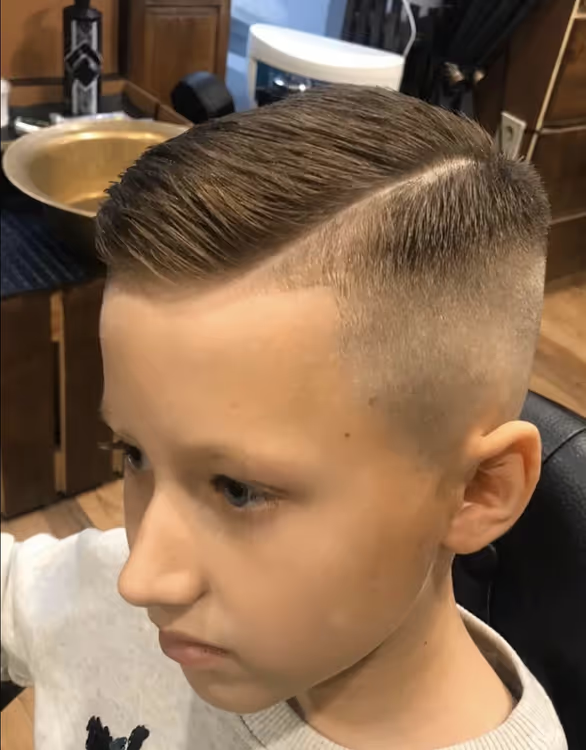
✂️ Kids' haircuts for boys: 5 stylish looks for young gentlemen
A boy’s first barbershop haircut is the moment he goes from being "just a kid" to a young gentleman. The chair, the mirror, the barber’s confident moves, and suddenly the reflection shows not a tousled little boy but a person with character.
But parents know: a children’s haircut is always a compromise. You want it to be stylish, but not look too grown-up. Fashionable, but still school-appropriate. And most importantly, you want the child to sit still in the chair and the barber to get the brief right away.
The good news: the trending boys’ haircuts for 2026 are exactly that, neat but with personality; modern but without going overboard. And boys’ haircuts at Barberking Kyiv are done exactly that way: with attention to the parents’ wishes and respect for the child’s individuality. Let’s break down five key options to see which one suits your young gentleman.
💡 Quick overview:
- Pick the haircut type: undercut for contrast, fade for versatility, Canadian for a classic look, crop for active boys, designs for individuality.
- Consider face shape and hair texture, they determine how the haircut will sit.
- Find a barber with specific experience in children’s cuts, this determines whether the child sits through it and wants to come back.
Classic undercut
An undercut is when the sides and back are clipped short while the top stays long, up to 5-8 centimeters. The contrast between the zones is the main feature: the sharper the transition, the bolder the look.
For an older boy (8-9 and up) the top can be styled back or to the side with gel or wax, giving an edgy, grown-up result. For younger boys the top is left shorter so no styling is needed, yet the cut still reads clearly. Pros: works for straight and curly hair, holds its shape for a long time, easy to refresh, just buzz the sides and the cut looks new again. The only downside: the outline needs refreshing every 2-3 weeks, otherwise it loses its sharpness.
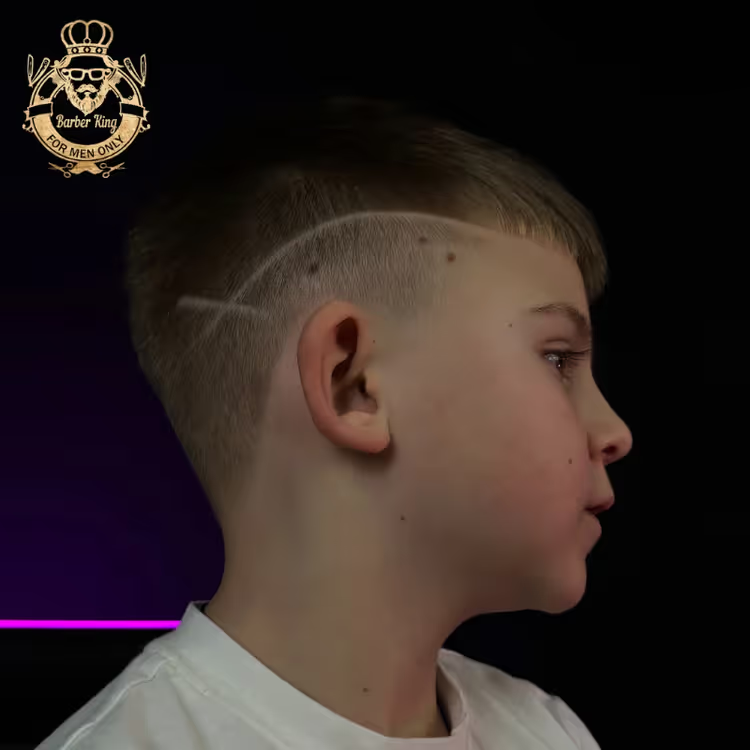
Fade
A fade is a smooth, almost imperceptible transition from short hair at the hairline to longer hair on the crown. No harsh lines, the hair "dissolves" into the skin. This smoothness is exactly what makes the fade the most versatile option: it suits any age, any head shape, and any dress code.
Barbers distinguish between low, mid, and high fades based on how high the transition starts. Low is the most conservative (the boundary sits at the temples), high is the boldest (the transition starts near the eyebrows). Mid is the golden mean. Kids usually get a mid or low fade: stylish but not overly aggressive. Maintenance is minimal: washing and a quick blow-dry if you want to add some volume.
Canadian cut
The Canadian cut is a haircut that hasn’t gone out of style for the last ten years or so, and it works just as reliably for kids as it does for adults. The formula is simple: the top and fringe are longer (3-6 cm), the sides and back are shorter but not down to zero, leaving 3-6 mm. The transition is smooth, without a harsh contrast.
Why the Canadian cut is a hit for boys: it "gets along" with any hair texture (thick, fine, curly, everything works) and doesn’t require daily styling. Just comb the hair to the side or back and the look is done. It looks good both at school and at a celebration. One limitation: on a very round face the longer top can visually pull the proportions the wrong way, here the barber will advise whether to shorten the fringe.
Crop
The crop is a find for active boys who aren’t willing to stand in front of the mirror every morning. It’s a short, textured cut with a straight or slightly jagged fringe. The length is short all over, from 1 to 3 cm, and through thinning the barber creates a "choppy" texture: the hair lies not as a solid layer but in individual strands.
The result: the head looks neat even without styling, and if you add a bit of matte paste you get a fashionable, effortless look. The crop is especially good for fine hair: the texture adds volume where nature didn’t provide enough. The only nuance is that the cut is quite short, so it grows out fast: it’s worth refreshing every 3-4 weeks.
Shaved parting line and designs
Once the base haircut is chosen, the barber can add an accent, a narrow line (parting line) buzzed in on the side or a geometric design on the back. This isn’t a standalone haircut but an element added on top of an undercut, fade, or Canadian cut.
A parting line is a thin shaved line along the part. A design can be a zigzag, stripes, a triangle, or even a favorite team’s logo (yes, some barbers can do that). For a boy it’s a way to stand out without radical experiments: the design grows out in 1-2 weeks, and if he doesn’t like it, they simply don’t refresh it at the next haircut. A note for parents: schools have varying attitudes toward such things, so it’s better not to get a design right before September 1.
How to choose a haircut based on face shape and hair type
Even the most fashionable haircut "won’t sit right" if it goes against what nature gave you. Here’s a quick cheat sheet.
For a round face, an undercut and a fade with volume on top work well, they elongate the silhouette. A Canadian cut with a long fringe on a round face can, on the contrary, emphasize roundness. For an oval face almost everything works, it’s the most flexible shape. For a square face (wide cheekbones, defined jaw) a crop is good: the short texture softens the angles.
Hair type also dictates the choice. Thick and coarse hair: undercut and Canadian cut sit perfectly (the long top holds its shape on its own). Fine and soft hair: crop and textured fade add visual density. Curly hair: a fade with a smooth transition looks gorgeous, while a Canadian cut might start to "puff up" without proper styling. A good barber will assess both in two minutes during a consultation and suggest an option that won’t disappoint.
Why the barber makes all the difference
Any barber-school graduate knows the "undercut" technique. But sitting a six-year-old in front of you who squirms, gets distracted, and tenses up at the word "clippers" is a whole different skill level.
A children’s barber works differently. They start not with the clippers but with a conversation: they show the tools, let the child touch the guard, explain that it will buzz but won’t hurt. They don’t pressure or rush; if a pause is needed, they take it. The pace of a children’s haircut is one and a half times slower than an adult’s, and that’s normal.
At Barberking the barbers work with children constantly, not once a month. They know that a child who calmly gets out of the chair and wants to come back is the main quality indicator. And yes, they keep up with trends: a fade with crop texture, an undercut with a design, a Canadian cut with modern styling, all of that is in their arsenal.
If you want to see what a modern children’s haircut process looks like from start to finish, the video above shows a barber’s work in real time. From the shampoo to the final styling: all the stages, techniques, and the result.
⁉️🤔 Common questions
At what age can a boy go to a barbershop?
From 3-4 years old, when the child can already sit in the chair for 20-30 minutes and understands the barber’s requests. Many barbershops take children even younger, but it’s all individual: one child at 2 sits as if spellbound, another at 5 refuses the clippers. Before the first visit it’s helpful to show the child a video of the process so the chair and tools don’t come as a surprise.
From 3-4 years old a child can sit for 20-30 minutes and understands the barber’s requests. It’s helpful to show a video of the process beforehand so the chair and clippers aren’t a shock. At Barberking the barber starts with a conversation and an introduction to the tools, which reduces anxiety.
How often should a child’s haircut be refreshed?
Every 3-4 weeks for short cuts (fade, crop, undercut) and every 5-6 weeks for a Canadian cut. Children’s hair grows faster than adults’, and the outline of short cuts loses its sharpness after just 2 weeks.
Short cuts (fade, crop, undercut) lose their shape after 2-3 weeks, refresh once a month. A Canadian cut lasts up to 5-6 weeks. Children’s hair grows faster than adults’, so the interval between visits is shorter.
Which haircut is the lowest maintenance?
The crop is the undisputed leader in minimal effort. The short length and thinning mean the hair lies as it should even without a comb. A fade also just needs washing, the shape holds thanks to the smooth transition rather than styling.
The crop is the leader: short length and thinning hold the shape without a comb or styling products. A fade also requires no styling, the shape reads because of the smooth transition. Both options are great for active boys who don’t have time to stand at the mirror.
What if the child is afraid of the clippers?
Don’t pressure or shame them, fear of a buzzing tool near the temple is completely normal. A good barber will let the child hold the clippers, turn them on at a distance, and demonstrate on their own hand. Sometimes the first haircut is done with scissors, it’s quieter and calmer. The key is to choose a barber who works with children regularly, not just occasionally.
Don’t pressure, don’t shame, the fear is normal. The barber will let the child hold the clippers, demonstrate on themselves, and turn them on at a distance. The first haircut can be done with scissors, quieter and calmer. Choose a barber with a steady stream of children clients.
Does a haircut with a design last long?
No, a parting line or design grows out in 7-10 days. That’s a plus: if the child or parents don’t like it, everything returns to the base cut in a week and a half. If they do like it, the design is simply refreshed at the next visit.
A design or parting line grows out in 7-10 days. If you don’t like it, the base cut returns in a week and a half. If you do like it, it gets refreshed at the next visit. No long-term risk.
Which haircut will suit your young gentleman?
For a five-year-old fidget who lives in "woke up and ran" mode, a crop: finger-comb it and he’s ready. For a schoolboy who wants to look "like dad," a Canadian cut: a classic that doesn’t clash with the uniform. For a teenager searching for his own style, an undercut with a fade: bold, graphic, modern.
And a shaved parting line or design can be added to any of these cuts, like a cherry on top, once the base look is found.
The main thing is to find a barber in front of whom the child doesn’t tense up but relaxes. Because a fashionable haircut on a boy trembling with fear is not style, it’s an ordeal. But that same haircut on a confident boy who knows he’s in safe hands, that’s already character. Book a consultation at Barberking: the first visit will decide a lot.

A professional team of writers and editors specializing in creating quality content.