














🔑 Opening an online casino in 2026: a complete guide
Launching your own online casino is an idea that crosses many entrepreneurs' minds. The global online gambling market's annual turnover surpassed $100 billion in 2025, and the curve keeps climbing. High ticket size, growing demand, digital nature of the business: it looks like a dream. But between "I want to open a casino" and the first real player's bet lies a path where 7 out of 10 startups stumble.
The problem isn't money or technology. The problem is that the market is regulated in a fragmented way: every country has its own rules, and a license obtained in one jurisdiction may mean nothing in another. Add to that the choice of software, payment systems, game content, and marketing in a niche where Google and Facebook restrict advertising, and you get a tangle you can't unravel without a roadmap.
Below is a step-by-step guide to launching an online casino in 2026: from choosing a jurisdiction to retaining players. No slogans, just real numbers and scenarios for different budgets.
💡 Quick overview:
- Choose a jurisdiction based on your target market: Curacao, fast and cheap; Malta, EU access; Gibraltar, a balance of speed and reputation. The jurisdiction determines timelines, budget, and access to payment systems.
- Obtain a license or sublicense: independent licensing takes 2 to 12 months; White Label, 4 weeks to launch. The second path is cheaper at the start but gives up part of the margin to the vendor.
- Deploy the technical platform: software from SoftSwiss, EveryMatrix, or Pragmatic Solutions; games from Evolution and Pragmatic Play; payment gateways from Skrill to cryptocurrencies. A minimum set of providers: 5-10 studios plus a live casino.
- Set up payment methods: cards, e-wallets, direct bank transfers, and cryptocurrencies. The wider the choice, the higher the visitor-to-deposit conversion.
- Launch marketing: SEO and content, streamers, affiliate programs, email reactivation. Google Ads and Facebook restrict gambling advertising in most regions, so plan alternative channels in advance.
- Maintain compliance: KYC verification, AML monitoring, sanctions list screening. This is not a one-time procedure but an ongoing process for the entire term of the license.
Licensing: which jurisdiction to choose in 2026
A license is the foundation on which any legal online casino is built. Without it, you won't connect a proper payment gateway, run advertising, or sign a contract with top-tier game providers. The choice of jurisdiction determines the budget, launch timeline, and player geography.
Malta (MGA)
Malta is the gold standard for those targeting the European Union market. A Malta Gaming Authority license opens access to 420 million European consumers and is accepted by first-tier payment systems.
Processing time: 8-11 months (officially 6, but reality is tougher).
First-year budget: from €120,000. This includes €25,000 for the application fee, €15,000-20,000 for local service providers, €100,000 demonstration of capital adequacy, audit, and compliance infrastructure. Figures are taken from LicenseWay's 2025 jurisdiction comparison.
Malta is not a choice for a startup on a modest budget. This is a jurisdiction for projects that have already raised investment and are being built to institutional requirements. On the other hand, an MGA license is accepted by any payment provider, any game aggregator, and any ad account: this asset pays for itself when scaling to a European audience.
Curacao
The fastest and most affordable entry point into the industry. In 2024, Curacao completed the consolidation of master licenses, eliminating the reputational gap of "four disparate operators" and now operates through a single regulator, the Curacao Gaming Control Board.
Timeline: 45-90 days.
First-year budget: €15,000-30,000 (sublicense through a master licensee such as Antillephone N.V.). According to LicenseWay, this is the minimum entry threshold into the industry.
Limitations: major payment providers charge commissions 2-3 times higher than for Maltese licenses, and Google Ads does not allow Curacao-licensed casinos in most regions. However, for a start in Latin America, Southeast Asia, or a cryptocurrency casino, this is the optimal option.
Gibraltar
An intermediate option: 4-6 months to obtain, first-year budget €50,000-80,000, reputation on par with Malta, but greater flexibility in working with cryptocurrencies. According to LicenseWay, Gibraltar is chosen by operators who need a balance between regulatory reputation and freedom of maneuver.
Other options
Kahnawake (Canada), 4-8 weeks, of interest to operators from North America. Isle of Man, Maltese-level trust with slightly lower costs. Costa Rica does not formally issue a gambling license but provides a "data processing license" for a few thousand euros per year. This is cheap, but payment systems and ad accounts are practically inaccessible.
Jurisdiction | Timeline | First-year budget | EU market access | Cryptocurrencies |
|---|---|---|---|---|
Malta | 8-11 mo. | €120,000+ | Full | Limited |
Curacao | 1.5-3 mo. | €15,000-30,000 | No | Yes |
Gibraltar | 4-6 mo. | €50,000-80,000 | Partial | Yes |
Kahnawake | 1-2 mo. | €25,000-40,000 | No | Yes |
Isle of Man | 4-6 mo. | €120,000-150,000 | Partial | Limited |
Costa Rica | 1 mo. | €5,000-10,000 | No | Yes |
Experienced operators often follow a "Curacao first, Malta later" path: they launch quickly and cheaply, test the product, and when they reach the European consumer, they add a Maltese license. This is called a multi-license strategy, and it is being used by an increasing number of venture-funded projects.
White Label: a turnkey casino
Don't want to wait six months and invest six-figure sums in licensing bureaucracy? White Label is a casino "out of the box": the license, software, games, payment systems, and hosting are provided by a single vendor. You get a ready-made product under your own brand and focus on marketing and player acquisition.
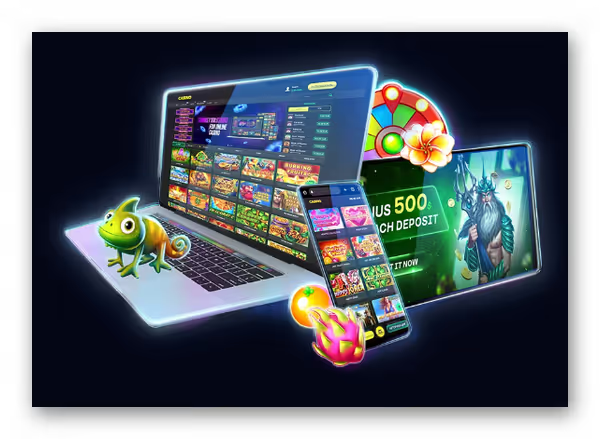
Inbet is one of the providers in this market. It offers a ready-made online casino with a choice of interface design, flexible settings, and reliable hosting. The service integrates over 50 payment systems with different currencies, including cryptocurrencies.
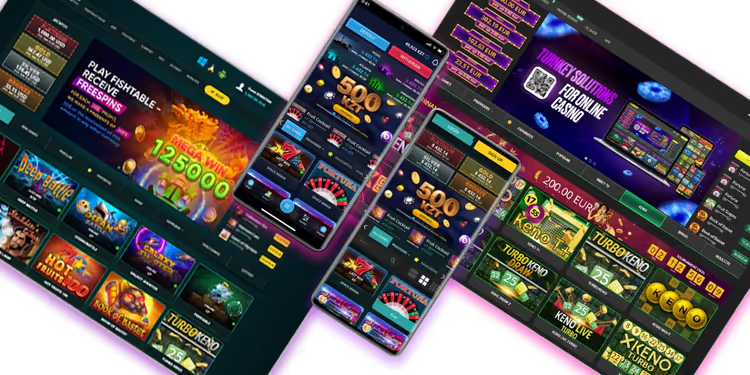
The budget for a White Label solution ranges from $15,000 to $60,000, which is several times lower than an independent turnkey launch. Time to market: from 4 weeks. This is a practical path for a first casino: you test the niche and build an audience without getting bogged down in regulatory procedures.
Market growth: why online gambling keeps taking off
The online casino industry has been growing at double-digit rates for years running. According to Grand View Research, the global online casino market was valued at $19.1 billion in 2024 and is projected to reach $23.9 billion in 2026, with a CAGR of 12.2%.
What is fueling this growth:- Cryptocurrencies and blockchain. Bitcoin, Ethereum, and stablecoins have given players fast and anonymous transactions. Provably fair algorithms on the blockchain allow verification of the fairness of every round: a strong argument for those who don't trust casinos. Crypto deposits are growing exponentially: while a few years ago their share was symbolic, now every third new casino launches with support for at least three cryptocurrencies.
Expansion of payment methods. Traditional Visa and Mastercard have been joined by e-wallets (Skrill, Neteller), direct bank transfers (Trustly), crypto wallets, and even Apple Pay and Google Pay. The easier it is to top up an account, the more often a player does it.
Live casino and gamification. Live dealers, tournaments, story-driven slots, and VR experiments are turning gambling from mechanically spinning reels into entertainment people spend hours on.
Europe holds nearly half of the global market (48% of revenue in 2024 according to Grand View Research), and this is where operators planning to scale after launch are looking.
Marketing: how to attract players when advertising is restricted
The operator's biggest headache, not software and not payments, is player acquisition in a niche where Google and Facebook cut ad campaigns. Working channels in 2026:
SEO and content marketing: slot reviews, strategy guides, industry news. Organic traffic, the only channel that won't get shut down or banned. Takes a long time to ramp up, but delivers the lowest CAC over the long run.
Streamers and bloggers: Twitch, YouTube, TikTok. A single stream with real gameplay brings in hundreds of sign-ups if the streamer is relevant to the audience. Important: platforms are tightening rules, check whether gambling content is allowed in the specific region.
Affiliate marketing: you pay webmasters and media buyers for referred players (RevShare or CPA). The primary channel for most new casinos. Downside: high competition for top affiliates.
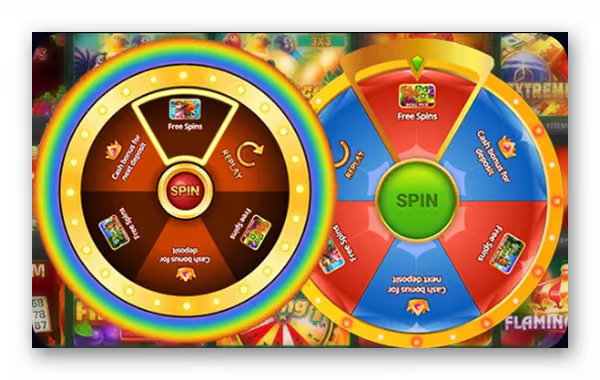
Bonuses and promotions: welcome package (deposit bonus + free spins), cashback, weekend reload bonuses. A bonus is not a gift, it's a retention tool: properly configured wagering requirements and playthrough conditions protect the casino from bonus hunters.
Email reactivation: emails to players who haven't logged in for 7-14-30 days. Triggered sequences bring back a noticeable share of dormant accounts at zero acquisition cost.
Technical platform: software, games and payments
The core of an online casino is the iGaming platform. This is not WordPress or a custom-built website, but specialized software that manages game content, balances, bonuses and reporting. The main vendors on the market: SoftSwiss, EveryMatrix, Pragmatic Solutions.
What the platform must include:
Game aggregator: connection to thousands of slots, roulettes, card games and live games through a single API. Minimum provider set: Evolution (live casino), Pragmatic Play (slots), NetEnt (classics), plus 5-10 niche studios for variety. The aggregator solves the integration problem: instead of signing a contract with each provider individually, you get access to hundreds of games through one contract and one API.
Payment module: Visa, Mastercard, Skrill, Neteller, Trustly, Bitcoin, Ethereum, Tether at a minimum. The more methods, the higher the deposit conversion. Cryptocurrencies are mandatory: in 2026, without them you lose a significant share of the audience. Think through withdrawals separately: payout speed is one of the main loyalty factors. Players forgive a casino anything except delayed withdrawal of winnings.
KYC and AML: automatic identity verification, sanctions list screening, suspicious transaction monitoring. This is not an option, it's a requirement of any licensing jurisdiction.
Bonus engine: configuration of welcome packages, free spins, cashback, tournaments, loyalty tiers. The flexibility of the bonus system directly affects player LTV.
Analytics and reporting: dashboards for NGR (net gaming revenue), GGR (gross gaming revenue), CPA, LTV, Churn Rate. Without them you're flying blind.
A separate point: RTP (Return to Player). This is the percentage of wagers that a slot machine returns to players over the long run. The typical range for slots is 94 to 97 percent. The higher the RTP, the more attractive the slot is to the player, but the lower the casino's margin. Balancing these two forces is the art of managing a game lobby. In practice, most successful casinos keep the average RTP of their game lobby around 96 percent: players see frequent wins and stay in the game longer, while the casino earns on turnover.
Economics: how much it costs to launch and when it pays off
Startup costs depend heavily on the launch model. Here's the breakdown for 2026:
Item | Standalone launch (Malta) | White Label (Curaçao) |
|---|---|---|
License and compliance | €120,000+ | Included in package |
Platform and software | €30,000-50,000 | Included |
Game content (royalties) | 15-25% of GGR | Per contract |
Payment systems | €5,000-10,000 integration | Included |
Marketing (first 6 months) | €50,000-100,000 | €50,000-100,000 |
Team (3-5 people) | €60,000-100,000/year | Minimal |
Total first year | €300,000-500,000 | €100,000-200,000 |
The White Label path saves hundreds of thousands of euros at the start, but gives up a share of GGR to the vendor. A standalone launch requires more investment, but the operator keeps the entire margin.
Key metrics of a healthy casino project:
- Average deposit size: from a couple dozen euros for mass market to several hundred for VIP players. Geography and the audience's payment habits determine everything here.
- Visitor to registration conversion: depends heavily on the traffic source and the attractiveness of the welcome bonus. Cold traffic converts many times worse than a streamer's audience.
- Registration to deposit conversion: the main lever here is the speed and convenience of the payment gateway. The fewer fields in the form and the more deposit methods, the higher the conversion.
- GGR per player per month: varies from tens to hundreds of euros depending on geography, game type and engagement. The VIP segment contributes a disproportionately large share of revenue.
- Payback period: with smart marketing, projects break even a year to a year and a half after launch.
The numbers are approximate. The real economics of a project depend on geography, funnel, bonus policy and a dozen other factors. To avoid guessing, most experienced operators launch a pilot on a small ad budget, look at the actual metrics and only then scale the channels that showed positive unit economics.
⁉️🤔 FAQ
How much money do you actually need to launch an online casino?
A self-launch with a Malta license will cost several hundred thousand euros in the first year: the lion's share goes to the license, compliance infrastructure, and mandatory local providers. A White Label setup through Curaçao is an order of magnitude cheaper at the start, and a vendor package costs between 15 and 60 thousand dollars. The difference lies in speed, margin control, and access to payment systems. See the detailed breakdown in the table above.
Can you open a casino without a license?
Technically, yes, if you register a company in Costa Rica (formally, the license there is for "data processing," not gambling). But without a full license, you won't be able to connect top payment gateways, run ads on Google and Facebook, and game providers like Evolution and NetEnt simply won't grant access to their content. You cannot build a legal business without a license.
Which jurisdiction is best for a startup on a limited budget?
Curaçao. A sublicense will cost a few tens of thousands of euros, with a processing time of up to three months. The remaining budget will be enough for basic marketing and the first months of operations. When the project reaches breakeven and targets the EU market, add Malta or Gibraltar as a second license.
**What is RTP and why is it important?**What is the biggest risk when launching an online casino?
Not the license or the software, but marketing. You can get a license and deploy a platform in 2-4 months. But achieving a steady flow of players with an acceptable CAC (cost per acquisition) in a niche where ad accounts are restricted is a task requiring 6-12 months of hard work. Three out of four failed projects shut down because they couldn't attract an audience, not because of technical or regulatory issues. So here's the advice: budget for marketing at least six months ahead and test channels with small amounts. If Google Ads doesn't work, go into SEO and YouTube. If YouTube doesn't deliver results, bring in affiliates. Channel diversification is your insurance against a cash gap at the start.
Do you need to hire a team or can you manage alone?
At the start of a White Label project, the minimum team is the founder plus freelancers for content, design, and tech support. For a self-launch, you need at least: a compliance officer (a requirement of any license), a platform technical specialist, a marketer, and support. That makes 3-5 people total. Trying to do everything alone means spreading yourself thin and wasting time on tasks where you are not competent. It's better to hire specialized experts and focus on strategy and product.
What you really need to open a casino in 2026
Launching an online casino is not magic or a lottery. It's a business with clear economics, where success comes down to three components: the right jurisdiction for your market, a reliable platform with quality game content, and disciplined marketing.
If you have a modest budget and want to launch in 2-3 months, go with White Label in Curaçao. It's fast, relatively inexpensive, and gives you a chance to test the niche without multi-million-dollar investments.
If the budget allows and the goal is the European market with a long-term perspective, build your project in Malta. An MGA license opens doors that are closed to others and pays for itself as you scale.
If you're in the middle, consider Gibraltar: faster than Malta, more reputable than Curaçao, with cryptocurrency flexibility.
And remember: regulations change every year. What worked in 2024 may not pass in 2026. Keep a compliance specialist on staff or outsourced; it's cheaper than losing your license.
Which launch option is closer to your situation, self-launch or White Label? Share in the comments.

A professional team of writers and editors specializing in creating quality content.