













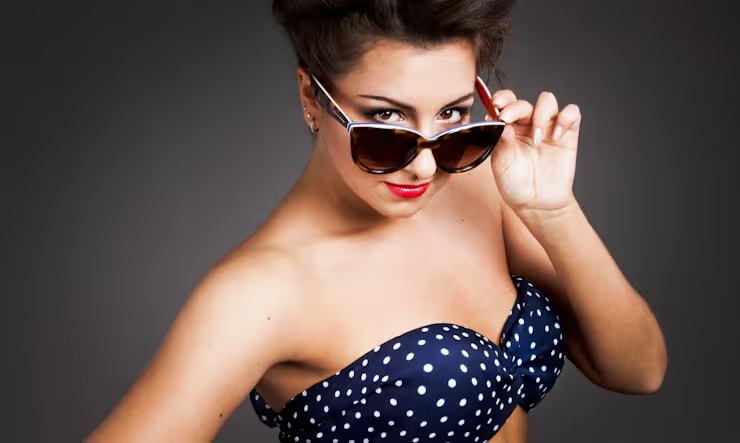
🎨 Pin-up art: the iconic style that outlasted decades
Red lipstick, curled locks and a glance over the shoulder. Pin-up needs no introduction; its images are recognized at first sight even by those who know nothing about 1940s calendars. A style born as magazine illustration has survived a hundred years, two world wars and the digital revolution, and today its DNA is visible in fashion shoots, tattoos and advertising. But behind the bright picture stands an entire artistic school with its own masters and canons.
The paradox of pin-up is that it was simultaneously adored and banned, called both a "low genre" and "art for the people." By 2026, debates about its artistic value have long since faded: original Vargas works sell for tens of thousands of dollars at Heritage auctions, and museum retrospectives draw full houses from London to Tokyo. Let's take this phenomenon apart piece by piece: from the newspaper page of the 1900s to the lens of a modern photographer.
💡 Quick overview:
- Where the term "pin-up" came from and how magazine illustration turned into a national phenomenon of the 1940s
- Who created the visual canon: Vargas, Elvgren, Petty and why their techniques are still studied in art schools
- What the look consists of: hair, makeup, clothing, pose and the meaning each element carries
- How pin-up lives today in fashion, tattoos, interiors and photoshoots
- Where to dive deeper into the subject and try the style on yourself
🎭 From the newspaper page to the barracks wall: the history of pin-up
The term "pin-up," from "to pin up," did not enter common usage right away. At first there were simply "pictures of pretty girls" in calendars, on the covers of cheap magazines and in advertising. Publishers quickly realized: an issue with a pretty girl on the cover sold many times better. By the 1920s, a recognizable type had formed: a coquettish smile, a direct gaze into the camera and light flirtation without vulgarity.
The real explosion happened in the 1940s. World War II, millions of soldiers far from home. A picture of a smiling girl pinned to a locker wall became an anchor: a symbol of home, peaceful life and what it was all for. The command not only did not forbid it, they encouraged it: drawn beauties decorated the noses of bombers as "nose art," and magazines with pin-up spreads were supplied to the troops centrally. That is how utilitarian illustration became a national phenomenon.
In the 1950s, with the soldiers returning, pin-up migrated into civilian life: calendars in auto repair shops, Coca-Cola ads, paperback novel covers. And then came the decline: the 1960s and 1970s, with their sexual revolution, made pin-up's coy flirtation seem "old-fashioned." The genre went into the shadows for three decades, only to return in the 1990s as a conscious retro aesthetic.
Key milestones
Period | Years | What happened | Key figures |
|---|---|---|---|
Early period | 1900-1930s | Magazine illustration, calendars, postcards; formation of the visual type | George Petty, Charles Dana Gibson |
Golden age | 1940-1950s | Army nose art, mass print runs, flourishing of the illustration school | Alberto Vargas, Gil Elvgren, Zoë Mozert |
Oblivion | 1960-1980s | Decline of interest; genre displaced by photography and the new sexual culture | - |
Revival | 1990s - present | Museum exhibitions, auctions, fashion, tattoos, digital art | Dita Von Teese, contemporary illustrators and brands |
🖌 The masters who created the canon
Pin-up is not "just pretty pictures." Behind it stands a school of illustration with a rigorous technical foundation. Three names define its face.
Alberto Vargas (1896-1982), the Peruvian artist whose "Vargas Girls" for Esquire and Playboy became the gold standard of the genre. His technique: watercolor and airbrush, producing translucent, "glowing" skin. Vargas's girls are long-legged, with wasp waists and an invariably direct, confident gaze. It was he who shifted the emphasis from the "trophy girl" to the "girl as a person": each Vargas Girl is the heroine of her own story, not a faceless object.
Gil Elvgren (1914-1980), the main "director" of the pin-up scene. His trademark was comical everyday situations: a girl's heel caught in a grate, a skirt snagged on a car door, a puppy pulling the string of a corset. Technically, Elvgren was a virtuoso of oil: his works are photographically detailed in the folds of fabric and highlights on skin. Over his lifetime he created more than 500 works for Brown & Bigelow; collectors consider Elvgren's pin-up the "pinnacle of the genre."
George Petty (1894-1975), Vargas's predecessor, whose "Petty Girls" for Esquire set the format a decade before the term "Vargas Girl" itself appeared. His style is more graphic, almost poster-like, with elongated proportions that would later be called the "Petty aesthetic."
What unites all three is one thing: an academic foundation. Vargas and Elvgren studied at the Art Institute of Chicago, Petty at the Académie Julian in Paris. Pin-up grew not out of kitsch but out of the classical school of painting; this is important to understand when looking at these "light" pictures.
Watch a short documentary breakdown of the psychology of pin-up: why these images work on the viewer decades later and what lies behind the "simplicity" of the genre.
💄 Anatomy of the look: what pin-up consists of
The pin-up look is not accidental. Every element, from the arch of the eyebrow to the height of the heel, performs a specific task: to balance between innocence and seduction, to be bright but not vulgar.
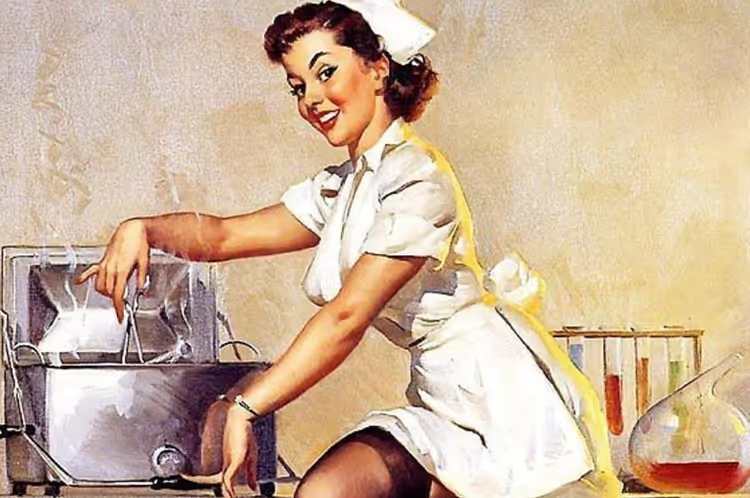
Makeup. Red lipstick, non-negotiable. It is the anchor of the entire look: matte or with a slight sheen, in a cool cherry or warm coral shade. Eyeliner on the lid, thin, with a sharp "wing," no smudging. Skin tone is porcelain, even; blush is fresh peach on the apples of the cheeks. Eyebrows are arched, but not a thin line: the 1940s favored natural width.
Hairstyle. Large curls styled in waves, or the high "victory rolls" that are the hallmark of the era. Hair is almost always pulled away from the face: an open forehead and cheekbones create that very "clean," almost doll-like silhouette. Accessories include a bow, a polka-dot headband or a fresh flower behind the ear.
Clothing and pose. A dress with an emphasis on the waist, a belt, a peplum or simply a fitted cut. A circle skirt or a pencil skirt; a blouse with a peter pan collar. Stockings with a back seam, a detail that says "retro" louder than any logo. The pose is natural asymmetry: one hip higher, a shoulder turned, the head slightly tilted. No static quality; the girl seems "caught" in motion: adjusting her shoe, reaching for a hatbox, turning around at a call.
Props and background. A retro car with chrome details, a round mirror in a gilded frame, a rotary dial telephone, a vinyl record player, a tin Coca-Cola can. The background is pastel or a brick wall with peeling paint. Nothing is random: the props set the era and the plot of the miniature.
📸 Pin-up today: more than a retro party
In 2026, pin-up is not a nostalgic attraction but a living, evolving aesthetic. Its DNA is woven into several layers of contemporary culture.
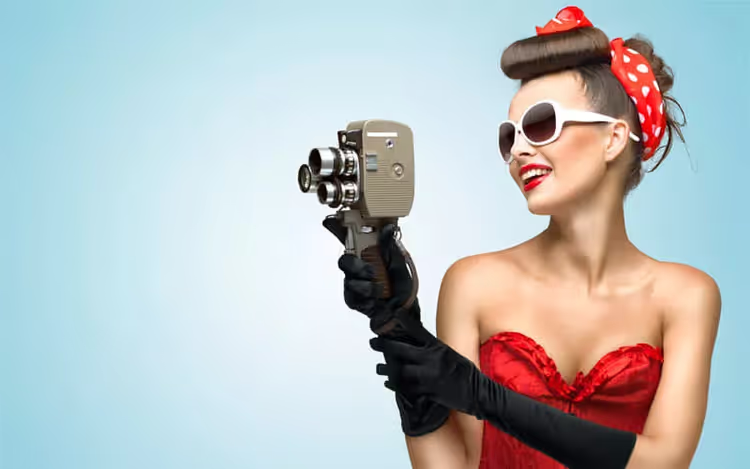
Fashion. Every few seasons, pin-up returns to the runways: Christian Dior, Dolce & Gabbana, Prada have at various times referenced the high waist, the pencil skirt and scarlet lipstick. In everyday fashion, its conduit is brands like Pinup Girl Clothing and Bettie Page Clothing, which sew vintage silhouettes in modern fabrics and for real wear, not for a costume party.
Tattoos. Platforms like Tattoodo record steady year-on-year growth in searches for "pin-up tattoo." The classic subject is a girl in the style of Elvgren on the forearm or shoulder, often framed by roses and swallows. Technically, this is a demanding genre: it requires portrait realism and an understanding of the retro palette from the artist.
Photoshoots. The "pin-up boudoir" genre, a photoshoot in lingerie and retro styling, has become a distinct niche in portrait photography. Studios from New York to Moscow offer a "day as a pin-up": makeup, hair styling, three looks and an hour of shooting. The cost varies from a few hundred dollars depending on the city and the photographer's level.
Interior design. Retro posters, metal signs with pin-up scenes, Vargas and Elvgren posters in framed molding are not garage aesthetics but a deliberate interior design device. Designers incorporate pin-up into eclectic and mid-century modern styles: a single accent poster on a brick wall changes the mood of the entire room.
Digital and AI. Contemporary illustrators are reimagining the canon in digital form: pin-up in cyberpunk aesthetics, pin-up with racial and body diversity, pin-up in pixel art style. AI-generated images are also appearing, but collectors are still voting with their wallets for the traditional brush: the Heritage Auctions sale in August 2024 confirmed that original Elvgren works sell for prices ranging from $30,000 to $80,000.
⁉️🤔 Frequent questions
The term "pin-up," what does it literally mean?
From "to pin up," to affix, to tack up. Originally, this was the name for pictures cut out of magazines and pinned to the wall with thumbtacks. Hence the aesthetic: the image must be bright and self-sufficient enough to work apart from its context, just a sheet of paper on a bare wall.
Why did the genre's heyday occur specifically in the 1940s?
Two factors coincided. First, the war: millions of men in barracks and trenches, acutely needing a visual "anchor" of peaceful life. Second, the US printing infrastructure: cheap, high-quality printing, huge print runs of magazines and calendars, centralized supplies to the army. Without this infrastructure, pin-up would have remained a niche genre.
What is the difference between "pin-up" and "burlesque"?
Burlesque is a stage genre (a show with striptease, humor, parody). Pin-up is a genre of image (illustration, photo, poster). They intersect: many pin-up models also worked in burlesque shows, but they are different mediums. Pin-up is a static frame; burlesque is live action.
Who are the main artists of the genre and how to tell them apart?
Three pillars: George Petty (long, almost unreal proportions, graphic quality), Alberto Vargas (watercolor and airbrush, translucent skin, direct gaze of the model), Gil Elvgren (oil, comical everyday scenes, photographic detailing of fabric and highlights). Petty and Vargas represent magazine illustration; Elvgren represents calendar art. If the girl in the picture has gotten into a predicament with her skirt or a puppy, it is Elvgren.
How to put together a pin-up look on your own?
The base: red matte lipstick, liquid eyeliner for the wing, powder with a porcelain finish. Clothing: a dress with a waist belt, a circle or pencil skirt, a blouse with a collar. Shoes: pumps with a 7-10 cm heel. Hair: large curls or victory rolls (there are hundreds of tutorials on YouTube). Accessories: a headband, pearl beads, a vintage brooch. A budget lifehack scheme: thrift stores or the outfit selection on Lady Pinup, where references, guides and specific stores for each element are collected.
Is pin-up art or just "pretty pictures"?
For the art market, the question is closed: the Heritage Auctions 2024 sale sold original Elvgren and Vargas works in the $30,000-$80,000 range per piece. Museum institutions, from the Museum of Modern Art in New York to London's Tate, have included pin-up in exhibitions on the history of illustration and pop culture. The technical level of Vargas and Elvgren (watercolor, oil, airbrush) is comparable to the academic painting of their time. Pin-up is a school of illustration with its own technique, canon and history, not "just pictures."
A hundred years on the wall: why pin-up does not age
Pin-up is alive because it works at an intersection. It is not glamour photography (too deliberate) and not abstract art (too distant). It is an image looking directly at the viewer, with humor, confidence and without aggression. Every element of the canon, from the red lipstick to the amusing prop, says: "Yes, I am beautiful, and I am having fun." Such a direct dialogue with the viewer does not age.
If you want to understand the aesthetic more deeply, start with two steps. Watch the documentary short about the psychology of the genre (the video above in the article). Then visit the pin-up online website, where references, look breakdowns and guides for recreating the style from makeup to interior design are collected. Pin-up is not a museum exhibit. It is a working visual language that is a hundred years old and still in dialogue with the viewer.

A professional team of writers and editors specializing in creating quality content.