













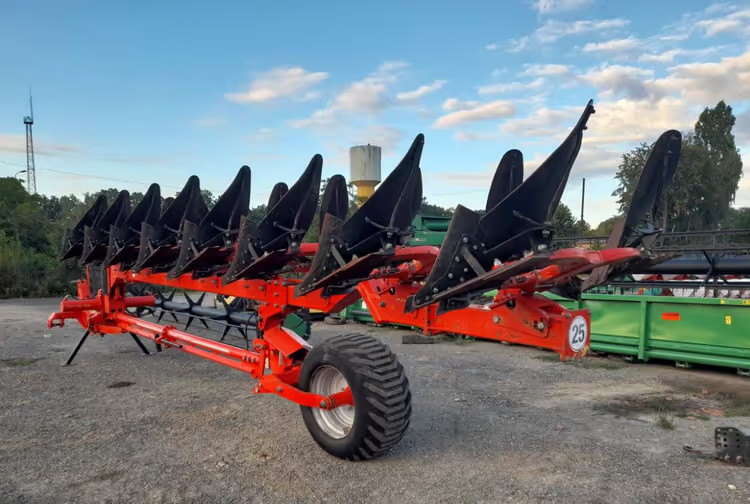
🚜 Types of plows: classification and application in agriculture
The wrong plow for your soil type: fuel goes to waste, and soil structure deteriorates for years to come. On the other hand, a precisely matched implement reduces the number of passes, conserves moisture, and works as the foundation for yield.
In practice, the choice comes down not to "expensive or cheap," but to what exactly you intend to do with the soil: invert the layer for fall plowing, loosen without inversion for cover crops, or break up a plow pan at half a meter deep. Each task has its own type of plow.
💡 Quick overview:
- Determine whether you need soil inversion: if yes, look at moldboard and reversible models; if not, chisel or disk plows.
- For continuous tillage of large areas with minimal fuel costs, go with a disk plow.
- When transitioning to no-till or minimum tillage, start with a chisel: it loosens without inverting horizons.
- A rotary plow is justified for vegetable and row crops where a fine crumb structure of the seedbed is needed.
- Before buying, check compatibility with your tractor's drawbar category: even the best plow is useless if power is insufficient.
Moldboard (share) plows: the classic for soil inversion

The most recognizable type: a body with a share cuts the layer from below, and the moldboard turns it over, incorporating crop residues and weeds to a depth of 20 to 30 cm. As a result, the top layer becomes loose, and organic matter goes down. The classic scheme for fall plowing and preparation for spring crops.
A modern subtype, the reversible plow: a set of right- and left-turning bodies on a rotating frame. The tractor moves in a shuttle pattern without idle runs, furrows are even, without back ridges. On fields with complex configurations, fuel savings reach 10-15% according to DLG tests.
- Pros: full soil inversion, better weed suppression without herbicides, quality incorporation of green manure, versatility for grain and row crops.
- Minuses: high draft resistance, on loams requires a tractor of 100 hp or more for a 4-furrow model; intensive share wear on abrasive soils.
- Price: budget 2-furrow mounted models start from several thousand dollars; professional 8-furrow reversible units cost an order of magnitude more. Check specific figures on aggregator platforms for your region.
Disk plows: the solution for heavy, dry, and stony soils
Instead of bodies with shares, concave steel disks with a diameter of 60 to 80 cm work here, set at an angle to the direction of travel. Each disk rotates, cutting roots and crumbling the layer. The advantage: the disk does not clog on wet clay and does not break when hitting a stone, it simply rolls over the obstacle.
A disk plow is especially good on fields after corn and sunflower: aggressive stalk residues pass through the sections without clogging. However, the working depth rarely exceeds 20 cm. For deeper loosening, a chisel is needed.
- Pros: works on overdried, stony, and sod-bound areas where a moldboard plow would dull in a shift; lower draft resistance, noticeable fuel savings.
- Minuses: incomplete soil inversion (some stubble remains on the surface); ridged furrow bottom, additional leveling tillage is needed.
- Price: the cost depends on the number of disks and the hitch type; mounted models are more affordable than semi-mounted ones, but have a smaller working width. Check the exact price with dealers in your region.
Chisel plows: deep loosening without inversion

A chisel (also known as a deep ripper) is designed differently: narrow shanks with a chisel point at the end go to a depth of 30 to 60 cm, breaking up compacted layers but not inverting the soil. Stubble and plant residues remain on top. This is the basis of conservation tillage technology.
The main agronomic effect is breaking up the plow pan (hardpan), which forms over years at the same depth from moldboard plowing. A broken pan means free passage for roots and capillary rise of moisture from lower horizons during drought. According to University of Nebraska data, chiseling increases water infiltration by 30-50% compared to annual moldboard plowing.
- Pros: preserves soil structure and biota, reduces erosion, increases moisture accumulation; fewer passes, lower fuel costs.
- Minuses: does not suppress weeds mechanically (additional chemical treatment or cover crops are needed); requires a powerful tractor (from 30 hp per shank).
- Price: a 5-shank mounted chisel is more affordable than an 11-shank folding one for wide-coverage work. Prices depend significantly on the region and manufacturer, check current figures on aggregators.
Rotary plows (rotary tillers): active tillage for the seedbed
Unlike passive implements, a rotary plow is driven by the tractor's PTO. A horizontal or vertical shaft with blades actively pulverizes the soil to a depth of 10 to 25 cm, creating a fine crumb, leveled structure. An ideal seedbed in one pass.
They are used mainly for vegetables, potatoes, and row crops, where the quality of soil crumbling directly affects germination. But for large-area grain fields, a rotary tiller is unprofitable: fuel consumption is 2-3 times higher than a passive chisel, and working speed is lower.
- Pros: seed-ready structure in one pass; excellent mixing of organic matter with soil.
- Minuses: high blade wear on abrasive soils; destruction of soil aggregates with excessive intensity, risk of crust formation after rain.
- Price: a mounted tiller with a 2 m width costs noticeably less than a professional 4-meter one. The price gap between consumer and industrial grade is multiple, compare at dealers before buying.
Subsoilers: a weapon against the plow pan
If a chisel works in the range of 30 to 60 cm, a subsoiler goes deeper: from 50 to 90 cm with a single tooth-shank. The task is not seedbed preparation, but a one-time destruction of deep compaction that has accumulated over years (machinery, years of plowing at one depth, passes of heavy combines in wet weather).
Such tillage is not needed every year, but once every 3-5 seasons as a "major overhaul" of the field. It requires a tracked or heavy wheeled tractor: one tooth takes 40 to 60 hp.
- Pros: restores field drainage, gives roots access to moisture from deep horizons.
- Minuses: very high draft requirements; on slopes can provoke erosion if the surface is not covered with mulch.
- Price: a single-shank mounted ripper is noticeably cheaper than a three-shank folding one. Both options are a one-time investment for several seasons, check current figures on agricultural platforms.
Specialized implements: hiller-ridgers and mini-plows
For completeness, it is worth mentioning a couple of niche types that are formally not plows, but perform related tasks.
Hiller-ridgers form ridges for potatoes, asparagus, and other row crops. They come in single- and multi-row versions: from manual to mounted on a two-wheel tractor. The depth is shallow (10 to 15 cm), the task is to create a ridge of the required height, not to till the horizon.
Mini-plows for two-wheel tractors and small tractors (up to 30 hp) are essentially scaled-down moldboard bodies with a width of 20 to 30 cm. They cover the needs of farmers with plots up to 5 ha: vegetable gardens, greenhouses, small berry patches.
Both types are selected by working width and compatibility with existing equipment. There is no universal recommendation here: read the specification of the tractor or two-wheel tractor manufacturer.
⁉️🤔 Frequent questions
How does a moldboard plow differ from a reversible one?
Moldboard is the general name for plows with a share-moldboard body. Reversible is a subtype where two mirrored sets of bodies are mounted on the frame: when the tractor turns, the frame is flipped hydraulically, and the second set goes to work. A non-reversible moldboard lays the furrow only to the right; a reversible lays it in both directions.
Which plow to choose for virgin land?
A disk plow is the first implement for sod-bound virgin land: disks cut through the sod, do not clog with roots, and do not break on hidden stones. After disking to a depth of 15 to 18 cm, you can go in with a moldboard plow for soil inversion. A chisel on virgin land with thick sod is ineffective: shanks do not cut, but tear rhizomes.
What is the difference between a chisel and a subsoiler?
Depth: chisel, 30 to 60 cm; subsoiler, 50 to 90 cm. A chisel works as primary tillage (annually or every other season); a subsoiler is a one-time implement every 3-5 years for breaking up a deep pan. Number of shanks: a chisel has 5 to 13, a subsoiler has 1 to 3. Draft requirements for a subsoiler are 1.5-2 times higher.
Can a disk plow be used on sandy soils?
You can, but you shouldn't: a disk on sand works with excessive wear (abrasive effect), and the depth is unstable. Light soil does not hold the disk's angle of attack. On sand and sandy loam, a chisel is more effective: loosened without inversion, left stubble against wind erosion, and the seeder goes right in.
Do I need to change the plow when switching to No-Till?
In full No-Till, a plow is not needed at all, seeding goes directly into stubble. But during the transition phase (3-5 years), a chisel or subsoiler is used for one-time destruction of compaction accumulated over years of plowing. After a single deep ripping, the field goes into zero tillage with direct seeding.
Which plow to choose for your task: a short summary?
On loams for grain with conventional plowing, take a reversible moldboard plow. If you are moving to conservation agriculture on large areas, your choice is a chisel. Virgin land, stones, dry clays: disk. Vegetables and row crops for the seedbed: rotary. Once every few years, give the field a subsoiler, and the roots will thank you. A universal plow does not exist, the type of implement is dictated by three factors: your soil, your technology, and your tractor.
Where to compare plow prices before buying?
Before buying, it is useful to look at an aggregator like AgriLine, where you can compare prices for new and used models. For example, plows on AgriLine is a catalog with filters by type, region, and year of manufacture, which helps understand the real market range for your budget. And lastly: choose not by catalog, but after one season with a rented implement. A day on your own field with someone else's plow will tell you more than a dozen reviews.

A professional team of writers and editors specializing in creating quality content.