













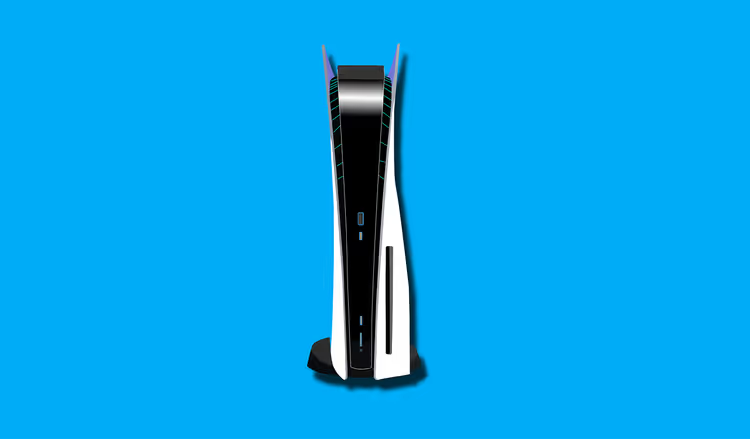
🎮 PlayStation 5 architecture: an uncompromising engineering breakdown
The console launches in 2020, and suddenly games start loading in under a second. Sound becomes three-dimensional, and the controller physically resists trigger pulls. Behind the flashy trailers was engineering work that we are still dissecting today.
In 2026, the PlayStation 5 is a mature platform with a library of thousands of games, a Pro version, and an established reputation. But its architecture still sets standards: the custom SSD with 5.5 GB/s throughput, the Tempest chip for spatial audio, and the DualSense controller with adaptive triggers have no direct equivalents among competitors. A detailed technical breakdown with figures and diagrams is published at https://rest.od.ua/blog/sony-playstation-5-pristavka-s-arhitekturoy-u-kotoroy-net-ko-745.
Below, an engineering breakdown of each key subsystem of the console: processor, storage, audio, controller. With numbers, tables, and an honest comparison with the competition.
💡 Quick overview:
- Processor: custom AMD Zen 2 (8 cores, up to 3.5 GHz) paired with an RDNA 2 GPU at 10.3 TFLOPS. An architecture proven over years.
- 825 GB SSD with 5.5 GB/s throughput (raw data) and a hardware Kraken decompressor. Load times vanish, open worlds open instantly.
- Tempest 3D Audio: a dedicated audio chip processing hundreds of sound sources simultaneously. You can hear exactly where the enemy is coming from.
- DualSense: haptic feedback and adaptive triggers. Bowstring tension, gas pedal resistance, different weapon recoil are all felt physically.
- The choice in 2026: base PS5, PS5 Pro (16.7 TFLOPS, PSSR upscaling, 2 TB SSD), or Xbox Series X. We will break down which one to get for whom.
Processor and graphics: a proven foundation
The heart of the console, a custom AMD chip based on Zen 2 (CPU) and RDNA 2 (GPU) architectures. Eight cores clocked up to 3.5 GHz operate at a variable frequency: instead of a fixed thermal budget, Sony applied a SmartShift algorithm that dynamically redistributes power between the CPU and GPU depending on the load. In practice, this means a stable framerate even in scenes with a hundred NPCs.
The graphics processor delivers up to 10.28 teraflops and supports hardware ray tracing. For 2020, this was a leap. In 2026, these specs are not record-breaking, but they are sufficient: the vast majority of games run at 4K 60 FPS, and optimization for a single architecture (unlike thousands of PC configurations) provides headroom for several more years.
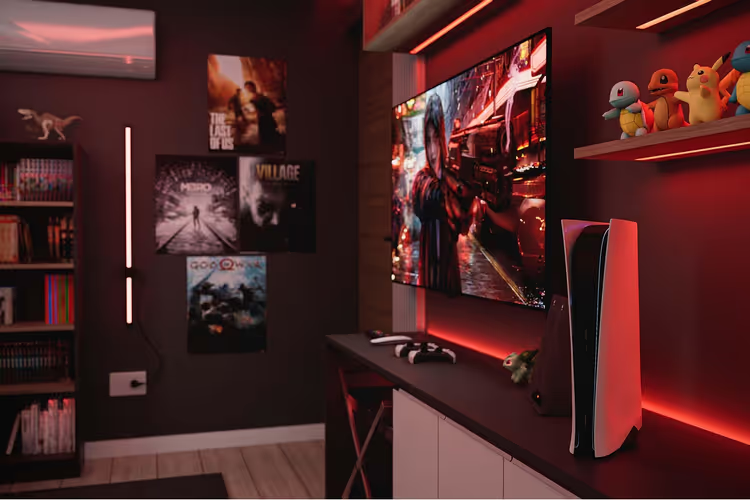
The Pro version uses the same processor, Zen 2, but the GPU is boosted to 16.7 teraflops, and the proprietary PSSR (PlayStation Spectral Super Resolution) technology upscales the image to 4K without performance loss. This is machine learning at the driver level: an analog of NVIDIA DLSS, but from Sony.
SSD and I/O: the architecture that eliminated load times
The main innovation of the PS5, not the processor and not the graphics. It is the storage subsystem.
The custom 825 GB SSD (usable capacity, 667 GB) connects via a 12-channel interface and delivers up to 5.5 GB/s on raw data. After Kraken decompression, the effective throughput reaches 8-9 GB/s. For comparison: the SATA SSD in the PS4 Pro hit a ceiling of 550 MB/s, and the hard drive in the base PS4, 100 MB/s.
The key to this speed, five components working as a single unit:
Component | Function | Result |
|---|---|---|
12-channel flash controller | Parallel reading from 12 NAND chips | 5.5 GB/s on raw data |
Hardware Kraken decompressor | Compression without CPU load | Effective 8-9 GB/s |
DMA controller | Direct memory access bypassing the CPU | Zero latency during streaming |
Two I/O coprocessors | Routing and memory mapping | Instant asset loading |
GPU cache coherency | Precision access to textures on the SSD | No "pop-in" objects |
In practice, this means that Spider-Man: Miles Morales loads from the main menu into the open world in 0.8 seconds. Ratchet & Clank: Rift Apart switches entire worlds "on the fly," without loading screens, without fade-outs. This is not an optimization of old technology, but an architectural shift: developers no longer need to hide loading behind narrow corridors and elevators.
In 2026, the PS5 Pro received a 2 TB SSD, but the throughput remained the same, 5.5 GB/s. The bottleneck now is not the hardware, but the speed of asset decompression, and the limit here has not yet been reached.
Tempest 3D Audio: why sound became a weapon
Sony designed the audio system from scratch. Instead of burdening the main processor with sound calculations (as Xbox does with a conventional DSP), the engineers offloaded processing to a dedicated chip, the Tempest Engine. This is a modified RDNA 2 GPU core that calculates hundreds of sound sources simultaneously, accounting for the geometry of the listener's ears (HRTF profile).

The difference from ordinary surround sound is radical. In Demon's Souls, you hear not just "an enemy somewhere behind," but "an armored knight three meters behind and slightly to the left." In Returnal, rain is not just background noise; drops fall on different surfaces and reflect off walls individually. This is not marketing: independent tests by Digital Foundry confirmed that Tempest processes 4-5 times more sources than the hardware DSP of the Xbox Series X.
An important nuance: for the full effect, you need compatible headphones or speakers with 3D Audio support. Sony expanded the list in stages: first only the proprietary Pulse 3D headset, then TVs with HDMI 2.1, and in 2024, any stereo headphones via a firmware update.
DualSense: the controller you play with your hands
The DualSense controller, the most underrated engineering subsystem of the console. On paper, it is a gamepad with vibration. In your hands, a device that physically resists your actions.

Two mechanisms create the effect of presence:
Adaptive triggers L2/R2, these are motors with variable resistance. The developer programs a press profile: in Astro's Playroom, the bowstring tightens with force that increases toward the end of the trigger pull. In shooters, a shotgun, pistol, and sniper rifle feel different, not visually, but tactilely. If a trigger is broken or the player does not want resistance, the function is disabled in settings in a second.
Haptic feedback, this is not a vibration motor from a 2010 phone. Instead of an eccentric rotating mass, Voice Coil Actuators are used: they reproduce a tactile "audio signal" that conveys surface texture. Footsteps on metal feel different than on sand. Raindrops, different than gravel under wheels.
The precision of the feedback is such that in Astro's Playroom, players with closed eyes could identify what surface the character was walking on; the developers themselves tested this at an exhibition before launch.
PS5 vs. Xbox Series X: architecture comparison
Comparing consoles by a single number (teraflops) is pointless. These are systems with different engineering philosophies:
Specification | PlayStation 5 | Xbox Series X |
|---|---|---|
CPU | Zen 2, 8× up to 3.5 GHz (variable) | Zen 2, 8× up to 3.8 GHz (fixed) |
GPU | RDNA 2, 36 CU, 10.3 TFLOPS | RDNA 2, 52 CU, 12.1 TFLOPS |
SSD | 825 GB, 5.5 GB/s | 1 TB, 2.4 GB/s |
Memory speed | 448 GB/s (GDDR6) | 560 GB/s (GDDR6, part at 336 GB/s) |
Audio | Tempest Engine (dedicated chip) | Standard DSP |
Controller | DualSense (haptic feedback, adaptive triggers) | Xbox Wireless (ergonomics, no haptic innovations) |

Xbox Series X takes the lead in raw computational power: more GPU cores, higher CPU frequency, wider memory bus. But Sony wins where spec sheet numbers do not reflect user experience: instant load times, haptic feedback, spatial audio. Early developers complained about the Xbox's split memory (10 GB at 560 GB/s and 6 GB at 336 GB/s), whereas on the PS5 all 16 GB operate at a single speed. By 2026, studios have learned to work around this limitation, but Microsoft's architectural compromise has not gone away.
Separately, about games. Sony exclusives (Spider-Man, God of War: Ragnarok, Final Fantasy VII Rebirth, Demon's Souls), the main argument when choosing. Game Pass from Microsoft, the counter-argument for those who play a lot and a variety of titles.
PS5 Pro and 2026: what has changed
In November 2024, Sony released the PS5 Pro, and this is important for understanding where the platform is heading:
Specification | PS5 (base) | PS5 Pro |
|---|---|---|
GPU | 10.3 TFLOPS (RDNA 2) | 16.7 TFLOPS (RDNA 2+) |
Upscaling | None | PSSR (machine learning) |
Ray tracing | Basic | Accelerated (×2-3) |
SSD | 825 GB | 2 TB |
Launch price | $500 | $700 |
Price in 2026 | from $450 | from $650-700 |
The Pro version does not change the architectural principles; it boosts the GPU and adds PSSR for 4K gaming without sacrifices in frame rate. The base PS5, meanwhile, has not become obsolete: the catalog of 8500+ games is backward compatible, and new releases are still developed with it as the primary platform in mind.
The key question of 2026, whether to get the Pro. The answer depends on the TV: if you have a 4K display with HDMI 2.1 and VRR, the PSSR improvement is visible to the naked eye. On a 1080p monitor, the difference is minimal; the base version handles things fine.
PS5 lead architect Mark Cerny, in an hour-long technical presentation, broke down every subsystem of the console at the silicon level, from the custom flash controller to the Kraken decompression pipeline.
⁉️🤔 Frequent questions
Is the PS5 compatible with PS4 games?
Yes, more than 8500 PS4 games work on PS5, from disc and digital. Some titles receive a free patch with increased resolution and frame rate.
Can the console's memory be expanded?
Yes. The internal M.2 slot accepts NVMe PCIe 4.0 drives up to 4 TB. Sony's requirement, speed from 5500 MB/s. An external USB drive is only suitable for PS4 games.
Does the PS5 support ray tracing?
Yes, at the hardware level. Ray tracing acceleration is built into the Compute Units of the RDNA 2 architecture. On the PS5 Pro, RT core performance is 2-3 times higher.
Does PlayStation VR2 work with PS5?
Yes, the PS VR2 headset connects with a single USB-C cable. A PS5 is specifically required; there is no backward compatibility with PS4.
How loud does the console run?
Significantly quieter than the PS4 Pro. A liquid metal thermal interface and a large fan (120 mm) keep noise within 35-40 dB under load, which is the level of a quiet office.
Is there a browser on the PS5?
There is no built-in browser in the usual sense. You can open a web page by sending a link in a PSN message, but full browsing is not provided; this is a deliberate decision by Sony.
Is it worth swapping a PS5 for a PS5 Pro in 2026?
If you have a 4K display with HDMI 2.1 and VRR, yes, the gain from PSSR and the doubled SSD is noticeable. On a 1080p-1440p monitor, the base version is fully relevant. The price difference between versions is justified only for visual perfectionists.
Should you get a PlayStation 5 in 2026: a decision matrix
Six years after launch, enough time to separate hype from reality. The PS5 architecture has stood the test of time: the 5.5 GB/s SSD is still faster than most PC solutions, Tempest has no analogs in positioning accuracy, and the DualSense remains the only controller with programmable trigger resistance.
The main thing is not the console, but the scenario:
- You want exclusives and immersion, get a PS5 (base or Pro, matching your display). Sony's catalog is unrivaled.
- You play multiplayer and want maximum games for minimum money, look at the Xbox Series X with Game Pass.
- You want maximum performance regardless of price, build a PC. But note: a build comparable to the PS5 in smoothness of operation will cost more.
In short: the PlayStation 5 in 2026 is not a "console of the future," but a mature, predictable, and powerful platform. From an engineering standpoint, one of the most cohesive systems in the history of gaming hardware. Get it and play.

A professional team of writers and editors specializing in creating quality content.