













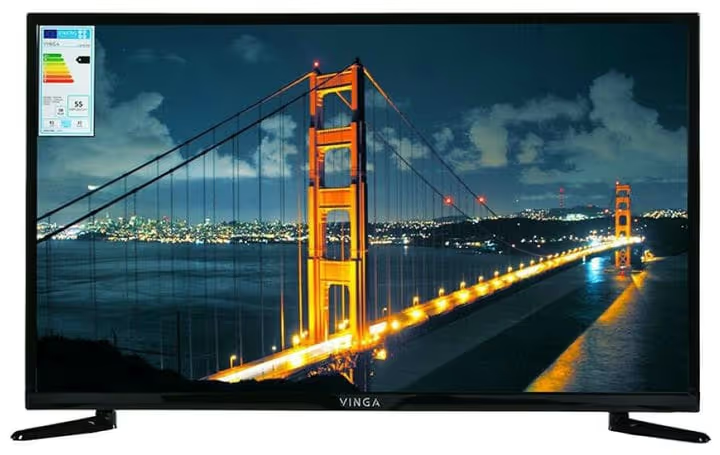
📺 Vinga TV review 2026: models, prices and which one to buy
Need a TV that doesn't cost as much as a plane wing but still delivers a decent picture? That's the ask tens of thousands of buyers in Ukraine bring every year. And increasingly, the choice lands not on the Korean giants but on a local brand that, over ten years, has gone from "no-name" to the shelves of Rozetka and Comfy.
Vinga, a Ukrainian electronics brand launched in 2016. Initially, the company focused on the budget segment: basic LED TVs without Smart TV, bought for offices, karaoke bars, and summer houses. Today, the lineup has grown to include 85-inch QLED panels with Android TV, while prices remain noticeably lower than comparable Samsung and LG models at similar screen sizes. This review covers what Vinga TVs can do in 2026, which panel types and resolutions are available, and which models to consider for specific needs.
💡 Quick overview:
- Decide your budget and screen size: Vinga offers models from 24 to 85 inches, priced from ₴4,000.
- Choose the panel type: LED for the kitchen and summer house, IPS for the living room, QLED for the home theater.
- Decide on Smart TV: models with the "S" index include Android TV and Wi-Fi, "L" models work without internet.
- Check the model table below for prices, screen sizes, and key specs.
What Vinga is today
Vinga does not design panels from scratch, like most second-tier brands, the company buys panels from major manufacturers (mostly Chinese assembly lines) and handles the software and chassis design in-house. This is standard practice for the budget and mid-range segments: Kivi, Ergo, and some TCL models operate the same way.
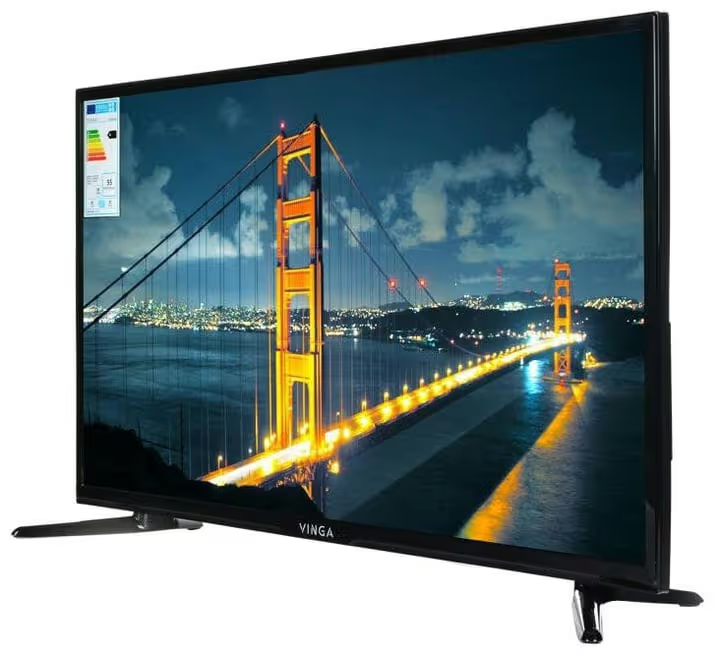
What sets Vinga apart from competitors on price:
- Honest package contents. The box always includes a stand, remote, batteries, and cable, no "stand sold separately" surprises.
- Local warranty and service. A network of service centers across Ukraine, with a warranty period of 12-24 months depending on the model. For the budget segment, this is a tangible plus: Kivi and Ergo offer the same terms but not always with the same coverage.
- Sensible unification. Remotes, firmware, and power supplies are interchangeable across generations, a small detail that saves time if you have two Vinga TVs at home.
In practice, the brand has limitations. Sound in the entry-level models is the standard 10-16 W total output (two speakers): fine for movies, but you'll want a soundbar for music. HDR rendering in the LED lines doesn't reach flagship levels, peak brightness is around 250-300 nits versus 500+ for expensive competitors. But for the money, it's a workable compromise.
Which panels Vinga uses: a technology overview
Vinga's lineup as of July 2026 includes three panel types. Let's break down which suits which scenarios.
LED (Direct LED)
The base technology found in all "L" index models and most 24-43-inch "S" models. LEDs are placed evenly behind the screen (Direct LED) rather than along the edges, which provides more uniform backlighting than Edge LED in the same price segment.
Pros: price (from ₴4,000 for 24 inches), proven reliability, low power consumption. Cons: black is more of a dark gray, viewing angles are limited (90-150° depending on the panel's final finish). For whom: kitchen, kids' room, summer house, office, anywhere that doesn't need a cinematic picture.
IPS
Used in mid-range models (from 32 to 55 inches). Viewing angles are a true 178°, the picture doesn't wash out when viewed from the side. Color reproduction is close to natural, without the oversaturated tones some VA panels are prone to.
Pros: excellent color reproduction for movies and series, wide angles for a large group in front of the screen. Cons: black depth is inferior to VA and QLED, some backlight bleed is visible in the corners in a dark room. For whom: living room and bedroom, the main household TV.
QLED
The flagship 2025-2026 line: models S55UHD25QWEB, S75UHD25QWEB, and S85UHD25QWEB. Quantum dots provide an expanded DCI-P3 color gamut and peak brightness up to 350 nits, modest compared to Samsung Neo QLED, but respectable for its price.
Pros: rich color, HDR10 support, screen sizes up to 85 inches. Cons: price approaches ₴50,000 for the 85-inch model, 60 Hz refresh rate, not for competitive gaming. For whom: a home theater on a budget that doesn't stretch to Samsung or LG.
Model comparison table (prices, Rozetka, July 2026)
Model | Screen size | Panel | Resolution | Smart TV | Price guide |
|---|---|---|---|---|---|
S24HD25B | 24" | LED | HD ready | No | from ₴4,100 |
L32HD25B | 32" | LED | HD ready | No | from ₴4,900 |
S32HD26BWEB | 32" | LED | HD ready | Android TV | from ₴6,600 |
L43FHD25B | 43" | LED | Full HD | No | from ₴7,400 |
S43FHD25B | 43" | IPS | Full HD | Android TV | from ₴8,600 |
L43UHD25B | 43" | LED | 4K UHD | No | from ₴8,500 |
S50UHD25BWEB | 50" | IPS | 4K UHD | Android TV | from ₴15,100 |
S55UHD25BWEB | 55" | IPS | 4K UHD | Android TV | from ₴15,400 |
S65UHD25BWEB | 65" | IPS | 4K UHD | Android TV | from ₴23,600 |
S75UHD25QWEB | 75" | QLED | 4K UHD | Android TV | from ₴36,600 |
S85UHD25QWEB | 85" | QLED | 4K UHD | Android TV | from ₴46,500 |
Resolution: what to get for which tasks
Vinga offers three resolution tiers, and there's no marketing trap of "only buy 4K" here, the choice depends on screen size and content.
HD ready. Sufficient for small screens. On a 24-inch TV, the pixel grid is invisible from a distance of one and a half meters. Optimal for a kitchen where a news channel or YouTube plays in the background. Models: S24HD25B, L32HD25B, S32HD26BWEB.
Full HD. The sweet spot for 32-43-inch screens. Broadcast TV, YouTube, 1080p movies, everything looks sharp without upscaling. For 4K content, the picture will be softer but not blurry. Models: L43FHD25B, S43FHD25B.
4K UHD. The standard for panels 43 inches and above. On large screens, the difference from Full HD is visible to the naked eye: menu text is crisp, faces in the frame are detailed. Netflix and YouTube in 4K, exactly the experience you buy a big screen for. All models with "UHD" in the name.
Vinga doesn't make 8K yet, and rightly so: content for that resolution is still scarce, while the price premium is double.
Smart TV and features
All models with the "S" (Smart) index run on Android TV, a full Google ecosystem with an app store, Chromecast, and voice search. In practice, this means:
- Pre-installed YouTube, Netflix, Megogo, Kyivstar TV, turn it on and watch, no messing around with flash drives and firmware.
- Google Assistant via the remote with a microphone: "play a movie" or "what's the weather," works in Ukrainian and Russian.
- Chromecast built-in, cast video from your phone or laptop in two taps.
Models without Smart (the "L" index) are pure displays with a DVB-T2/C/S2 TV tuner. Connect an external set-top box or laptop via HDMI and you get the same functionality, just with a separate device.
Nice small touches: a USB port for a flash drive with movies or live TV recording (TimeShift), HDMI ARC for a soundbar, an optical audio output. Bluetooth in S models lets you connect wireless headphones, handy when the family is asleep and you're watching an action movie.
Is Vinga worth buying: the brand's pros and cons
What's good:
- Price. For a 43-inch Full HD, you pay from ₴7,400; Samsung or LG with the same specs start from ₴12,000-14,000.
- Service center network. You won't have to haul the TV halfway across the country for warranty service.
- Android TV without compromises in the S line: not a stripped-down proprietary shell, but a full Google experience.
- Honest package contents and unified accessories.
What to be ready for:
- Build quality of the chassis: mid-grade plastic, not premium. Bezels are wider than on flagships.
- Built-in speaker sound: just enough for "watching the news." For movies and music, get a soundbar.
- Peak brightness of LED models falls short of full HDR; the "HDR compatible" spec is there, but there won't be a "wow" effect.
- The brand has almost no offline retail presence outside Ukraine, so warranty support abroad is trickier.
The most popular models: three crowd favorites
Vinga L32HD25B, the entry ticket to the Vinga world. 32 inches, HD ready, no Smart. Ideal as a second TV for the kitchen or summer house: turn it on and forget it, nothing freezes, no updates required. The price, around ₴5,000, is the main argument.
Vinga S43FHD25B, the most balanced model in the lineup. Full HD on 43 inches with an IPS panel: colors are vibrant, angles are wide, Android TV on board. Works well as the main TV for a small living room or bedroom. At ₴8,600, one of the best price-to-picture-quality ratios on the market.
Vinga S55UHD25BWEB, the entry threshold to a home 4K theater. 55 inches, IPS, Android TV, and a price tag around ₴15,400. For comparison: a Samsung 55" 4K starts from ₴22,000. A half-price difference is a serious argument if you're not chasing the brand name.
Video review of the Vinga lineup
To see Vinga TVs live, not in renders, watch a detailed review of the 32-inch model by a Ukrainian tech blogger. The video is in English, but the picture speaks for itself: menu, build quality, viewing angles, remote.
⁉️🤔 Frequent questions
Is Vinga a Ukrainian brand or a Chinese OEM?
A Ukrainian brand with headquarters in Kyiv. Design and software development are local; production is contract-based at Chinese factories. The same model is used by Kivi, Ergo, and most European "homegrown" electronics brands.
How does Vinga differ from Kivi and Ergo?
All three brands operate in the budget and mid-range segment. Kivi emphasizes design and glossy chassis materials; Ergo focuses on the lowest possible price at the expense of package contents. Vinga takes the middle path: decent design, an honest box, predictable quality with no surprises.
Where to buy a Vinga TV in Ukraine?
Main channels: Rozetka, Comfy, Eldorado, vinga TV at Stylus, as well as the official website vinga.ua. We recommend verified retailers: they handle warranty obligations without unnecessary questions, unlike small fly-by-night shops.
How long do Vinga TVs last?
The average lifespan of an LED panel is 5-7 years with daily use. The manufacturer's warranty is 12-24 months. According to reviews on Rozetka and Hotline, no widespread reliability issues have been noted for 2021-2025 models. Typical service requests involve backlight replacement after 3-4 years (common for any budget LED).
Does Vinga Smart TV lag?
Android TV on 2025 models runs smoothly: the processor is basic, but the interface isn't overloaded. Switching between apps takes 1-2 seconds. 4K video from a USB flash drive plays without stuttering. If the TV starts lagging after a year, a factory reset and disabling unused apps helps.
Which resolution to choose for movies?
Full HD at 43 inches is the minimum sufficient level. If the screen is 50+ inches and you watch Netflix in 4K, get a UHD model, the difference is visible. For broadcast TV and YouTube, HD ready at 32 inches is fine.
To buy or not to buy: the final verdict on Vinga
If your budget is ₴5,000-25,000 and you're not willing to overpay for a Samsung or LG logo, Vinga fully meets the need. You get a modern panel, Android TV (in the S line), and a local warranty. The compromises, plastic quality and built-in sound, are solved with a soundbar for a couple thousand hryvnias, and that's still cheaper than a Korean equivalent.
A short selection guide:
- Up to ₴6,000, kitchen or summer house → L32HD25B.
- Up to ₴10,000, bedroom or kids' room → S43FHD25B (Full HD + Android TV).
- Up to ₴16,000, 50-55-inch living room → S55UHD25BWEB (4K + IPS).
- Want a large QLED screen up to 85 inches → S85UHD25QWEB (around ₴46,500, half the price of a comparable Samsung QLED).
Vinga doesn't try to be premium. It does exactly what it promises: shows a picture, doesn't break down in the second year, and leaves money in your pocket. For most home scenarios, that's more than enough.

A professional team of writers and editors specializing in creating quality content.