













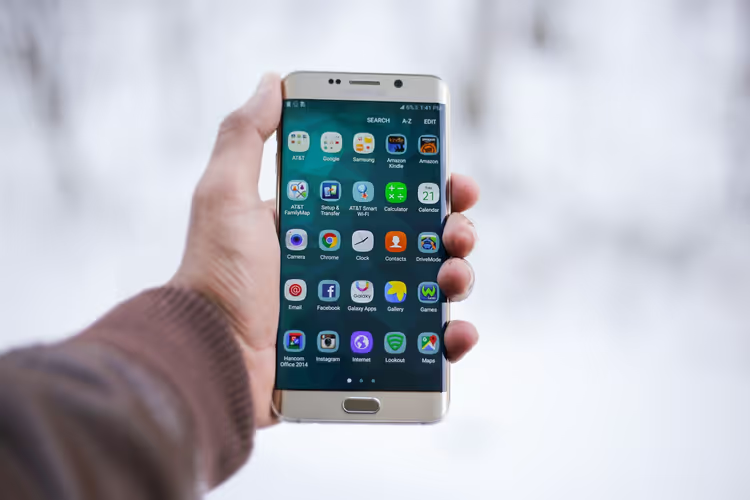
📱 Why people love Samsung smartphones
Choosing a smartphone and keep coming back to Samsung? You're not alone. The South Korean brand has held its position for years, and it's no accident, there are specific engineering and product decisions behind that loyalty.
In Q1 2026 Samsung captured 21.7% of the global smartphone market, more than any other Android manufacturer. And it's not just flagships: the company bets on the entire price range, from ultra-budget models to foldable devices at $2000. Let's break down what exactly users value in these phones, no marketing, just facts.
💡 Quick overview:
- Look at the price range: from budget models to flagships at fifteen hundred dollars, Samsung covers any wallet without compromising on build quality.
- Check the display: the company makes panels for half the market, and the screen on your next phone was very likely made by them.
- Explore the features: Knox, Samsung Pass, DeX, S Pen stylus, contactless payments, much of what competitors pitch as "premium" is available here in the mid-range.
- Connect the ecosystem: smartphone, watch, earbuds, tablet, TV, and even the fridge work as a single device.
1. Price without compromises
Everyone has flagships at fifteen hundred dollars. But try finding a well-balanced phone in the lower price segment from competitors, and you'll quickly hit compromises, cheap plastic, a weak screen, or no NFC. Samsung plays it differently: the engineering base of flagships trickles down into the budget lines.
Take a Samsung phone from the A-series: you get a Super AMOLED display, a decent camera with optical stabilization, a 5000 mAh battery, and IP67 protection, for a third of the flagship price. In the M-series, the price is even lower, and the battery lasts two days. And this isn't compromised junk: the build is tight everywhere, no gaps or creaks.
And at the top, the Galaxy S26 Ultra with a titanium frame, a 200-megapixel camera, and a built-in S Pen stylus. The gap between a "cheap Samsung" and an "expensive Samsung" is in materials and camera, not in the basic feel of quality. Few manufacturers can stretch a lineup this far without weak spots.
2. Displays you've already seen
Samsung Display is the world's largest OLED panel manufacturer. In 2023 the company controlled half of the smartphone panel market, and although the share dropped to 39.9% in the first half of 2025, that's still double the nearest competitors.
What this means for you: the screen on an iPhone, Google Pixel, Xiaomi, or OnePlus was very likely made by Samsung. But the brand's own phones get the best panels first, Super AMOLED with 2600 nits peak brightness (readable in direct sunlight), adaptive 1-120 Hz refresh rate, and color accuracy that needs no calibration out of the box.
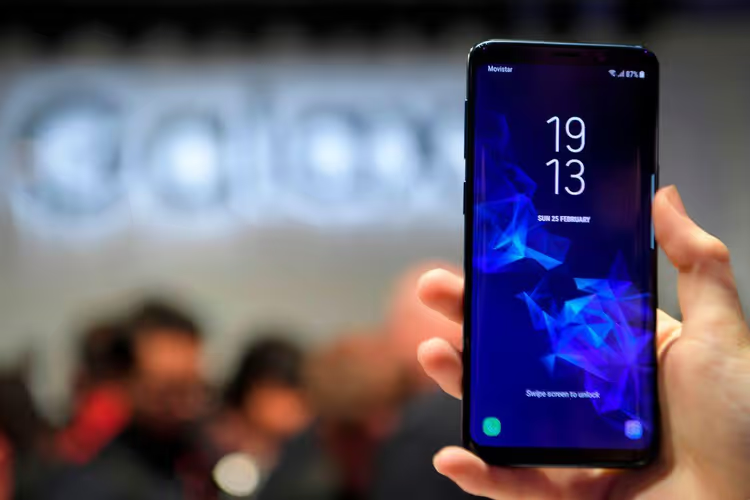
Even in budget-segment phones you get AMOLED, not a dim IPS panel, and that's probably the main visual advantage you notice the moment you turn on the screen.
3. Features without class division
Many brands have a clear caste system: NFC, only in the "senior" models, water resistance, only in flagships, an in-display scanner, pay extra. Samsung breaks that logic.
Here's what you get even in mid-budget models:
- Samsung Knox, a hardware root of trust: an isolated chip stores passwords, encryption keys, and biometrics separately from the main system. Government certifications (including US DoD), not marketing, but a fact.
- Samsung Pass, a password manager with biometric login, built into the system, with no third-party subscriptions.
- NFC + MST, contactless payments work even on terminals without NFC (MST emulates a magnetic stripe, a feature competitors dropped).
- S Pen, not just a stylus: scrolling screenshot, handwritten notes with recognition, remote camera shutter.
- DeX, plug your phone into a monitor and get a desktop interface. For working with documents and email, you don't need a laptop.
Build quality deserves a separate mention: an aluminum frame, Gorilla Glass, a haptic motor with crisp feedback, things that are usually sacrificed in the budget segment. Here, they aren't cut.
4. An ecosystem you're not locked into
Apple builds its ecosystem like a fortress with a moat: it works perfectly, but only inside. Samsung took a different path.
Yes, the "smartphone + Galaxy Watch + Galaxy Buds + tablet" combo works as a single organism: calls transfer between devices, earbuds switch based on context, the watch mirrors notifications. But unlike the competitor, Samsung doesn't forbid you from getting along with other devices: email, calendar, and contacts sync via standard protocols, files transfer via Quick Share to any Android, and SmartThings controls more than just Samsung appliances.
Through SmartThings you see what's in your fridge on your phone screen, start the laundry, turn on the air conditioner before you get home, and mirror the screen to the TV with one swipe. Meanwhile, Google Cast and Miracast haven't gone anywhere, nobody forces you to buy a Samsung TV just to cast your screen.
The result: you get the convenience of an "everything with everything" setup, but without the feeling of being locked in someone else's garden.
⁉️🤔 Common questions
What makes Samsung better than other Android manufacturers?
The main difference is vertical integration. Samsung makes its own processors (Exynos), displays, memory, and batteries, the supply chain is shorter, and quality control is higher. In practice, that means: fewer incompatibilities, a longer update commitment, and a unified approach to screen calibration and power consumption.
With competitors, each generation is a compromise between different component suppliers. Samsung assembles a phone from its own parts, and you can feel it in the stability of operation.
Is Samsung worth buying if I'm on a tight budget?
Yes, it's one of the best options in the low and mid-range. A-series models (A35, A55) in the two-to-four-hundred-dollar range give you an AMOLED screen, a decent camera with OIS, IP67 protection, and a guaranteed 4 years of Android updates. Competitors (Xiaomi, Realme) at the same price often sacrifice the screen or water resistance. If the budget is truly minimal, the M-series: a plastic body, but a 6000 mAh battery and the same One UI.
How long does Samsung support its phones?
Since 2024, flagships and the A-series get 4 major Android updates and 5 years of security patches. That's comparable to Google Pixel and noticeably better than most Chinese brands, where support ends after 2 years.
Samsung or Apple, what to choose in 2026?
If you want freedom: a file system, interface customization, app sideloading, DeX as a laptop replacement, choose Samsung. If your priority is seamless integration with other Apple devices (Mac, iPad, AirPods) and you're already in the ecosystem, your choice is predictable. In terms of camera and display quality, the flagships from both companies are now on the same level.
How do I protect data on a Samsung smartphone?
Enable Knox Vault (chip-level encryption), set up biometrics in Samsung Pass, and activate "Secure Folder", an isolated space for sensitive apps and files. To find a lost phone, use SmartThings Find: the device is visible even without internet, via the mesh network of other Samsung devices nearby.
Is Samsung worth buying in 2026?
The short answer: yes, if you're not tied to a specific ecosystem. Samsung offers the best "price / quality / features" balance on Android, and in 2026 that's still the case.
If you're buying your first smartphone, get the A35 or A55 and don't overthink it. If you need maximum capability, the Galaxy S26 Ultra justifies its price tag. If you want a foldable, the Galaxy Z Fold 6 changes how you think about why you'd even need a tablet. And if compatibility with home appliances matters, the SmartThings ecosystem has long outgrown the status of a "nice add-on."
There's a choice for everyone. That's the main reason people keep coming back to Samsung.

A professional team of writers and editors specializing in creating quality content.