













 AIIllustrative image: AI-generated
🌐 10 best text translation APIs in 2026 for developers
You rolled out a product in English, and a week later they ask for a German interface, French support, and a Japanese landing page. A startup cannot hire 10 translators, yet outsourcing content to a freelance marketplace without terminology control means losing brand voice in every language.
A machine translation API solves this problem in 5 lines of code. But the engine you choose determines everything: output text quality, the budget for scaling your audience, and response speed under peak loads. There are four major cloud providers, and their prices differ by a factor of two. Add open source solutions, services with translation memory, and the new generation of LLM-powered engines, and you get a dozen options, each of which excels at its own task and is useless for someone else's.
We selected 10 translation APIs relevant in 2026 and compared them by text quality, supported language count, price per million characters, and ease of integration into a typical REST stack.
💡 Quick overview:
- Choose Google Cloud Translation if you need maximum coverage: 249 languages, 500K characters free monthly, Google Cloud ecosystem
- Pick DeepL API when text quality on European languages is critical: 33 languages, best stylistic naturalness
- Go with Azure AI Translator when budget matters most: 130+ languages, 2M characters free with no time limit
- Use Amazon Translate if your infrastructure runs on AWS: 75 languages, native integration with Lambda and S3
- Try ModernMT if you need adaptive quality without manual retraining: 200+ language pairs, on-the-fly fine-tuning
Translation API comparison table
API | Languages | Quality | Price per 1M characters | Free tier |
|---|---|---|---|---|
249 | High | $20 | 500K chars/month | |
130+ | High | $10 | 2M chars/month, no expiration | |
33 | Very high (EU) | $25 | 500K chars/month | |
75 | High | $15 | 2M chars/month (12 months) | |
55 | Medium+ | On request | Trial period | |
30+ | Medium+ (TM) | From €299/month | 10K words/month | |
90+ | High (RU↔EN) | ~$4-5 | Trial grant | |
200+ | High (adaptive) | ~$15-20 | Trial period | |
30 | Medium | Free (self-host) | Unlimited | |
109 | Medium+ | $5 | Trial period |
1. Google Cloud Translation API
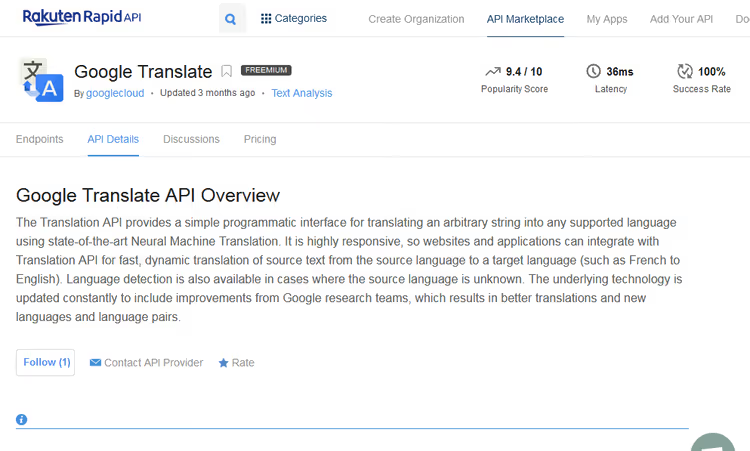
Google Cloud Translation is a cloud-based machine translation service powered by Google's neural network models. In late 2025, Google updated the engine with the Gemini model, which improved quality on idioms and conversational content. As of March 2026, it supports 249 languages, the maximum coverage among all APIs. It works in two modes: basic NMT for bulk translation and Advanced with terminology customization for a specific domain.
Pros: widest language coverage (249 languages), automatic source language detection, batch translation via Cloud Storage, native integration with Google Cloud Run and Cloud Functions.
Cons: Advanced tier is noticeably more expensive than basic, requires a Google Cloud account, quality on non-European pairs is inferior to specialized engines.
Price: free limit of 500,000 characters per month, forever. After that, $20 per million characters on the basic tier. Advanced costs more; the exact figure depends on the language pair.
🔗 Google Cloud Translation | 📄 API documentation
2. Microsoft Azure AI Translator
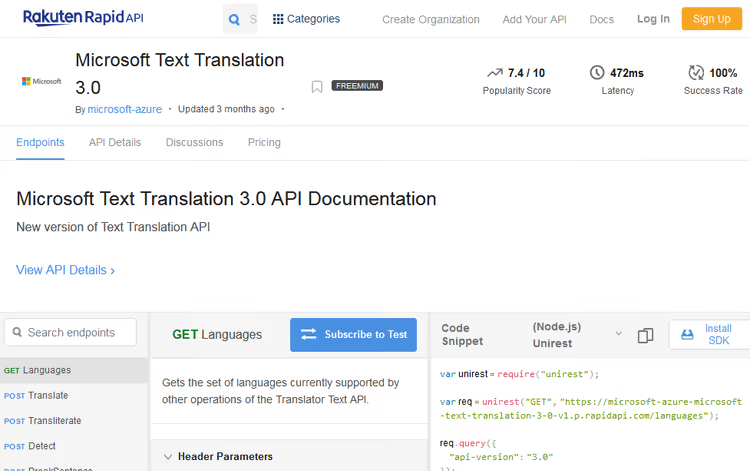
Azure AI Translator supports 130+ languages and offers not only translation but also transliteration, bilingual dictionary, and sentence length detection. In January 2025, Microsoft launched Translator Pro for enterprise users with custom phrasebooks and Government Cloud deployment. SDKs are available for Python, C#, Java, and Go.
Pros: the cheapest among cloud majors at volumes above 10M characters, 2 million characters free with no expiration date, custom glossaries, integration with Azure Logic Apps and Power Automate.
Cons: quality on complex grammatical constructions is inferior to DeepL, management through Azure Portal is not the most developer-friendly experience.
Price: 2 million characters free per month, with no expiration date. After that, $10 per million characters. Custom Translator is billed separately.
🔗 Azure AI Translator | 📄 API Reference
3. DeepL API

DeepL is a German service that since 2017 has maintained a quality bar on European language pairs above Google and Microsoft. Blind tests from 2024-2025 confirm this. In 2024, DeepL next-gen launched, an LLM-based model trained specifically for translation, which improves quality on long texts. The API provides access to the same models with settings for formal or informal tone, glossaries, and sentence splitting.
Pros: best stylistic naturalness of output for EN, DE, FR, ES, IT, NL, PL; glossaries out of the box; client libraries for Python,.NET, and Node.js.
Cons: only 33 languages (no Chinese, Arabic, or Hindi), the highest price among NMT majors, no batch mode comparable to AWS.
Price: free tier of 500,000 characters per month. Pro plan: $5.49 per month + $25 per million characters. Price decreases at enterprise volumes.
🔗 DeepL API | 📄 API Documentation
4. Amazon Translate

Amazon Translate is a native AWS neural translation service supporting 75 languages with Active Custom Translation, which adapts the model to your parallel data. It integrates with S3, Lambda, CloudWatch, and Step Functions: a serverless translation pipeline can be assembled in a couple of hours.
Pros: seamless AWS integration, real-time and batch modes, custom terminology, automatic preservation of HTML and JSON formatting.
Cons: only 75 languages (no Ukrainian or Belarusian), quality on EN↔RU is noticeably worse than Yandex, AWS lock-in.
Price: 2 million characters free per month for the first 12 months. After that, $15 per million characters. Custom Terminology is free.
🔗 Amazon Translate | 📄 Developer Guide
5. SYSTRAN Translate API
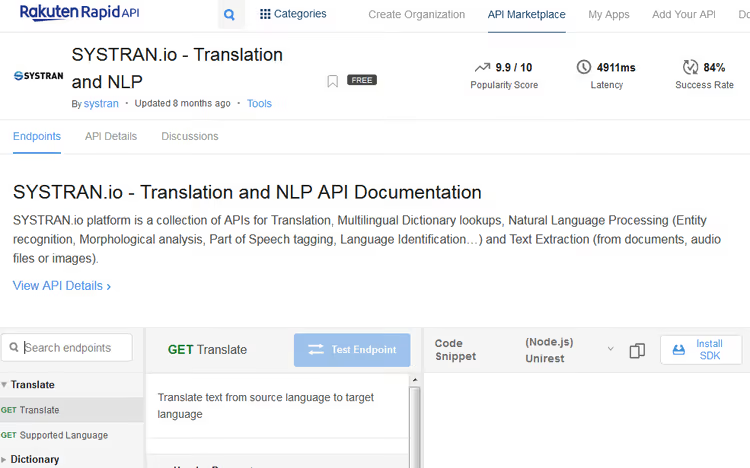
SYSTRAN is one of the oldest players in the machine translation market, operating since 1968. Now under ChapsVision, it serves enterprise clients with strict security requirements: on-premise deployment, private cloud, custom dictionaries, and domain models. REST API with detailed documentation.
Pros: on-premise for closed environments, 55+ languages, domain-specific models (legal, medical, technical translation).
Cons: no public free tier, only trial by request, enterprise pricing without a transparent grid on the website, quality on publicly available models is inferior to DeepL and Google.
Price: individual calculation after consultation. Trial period available upon request.
🔗 SYSTRAN Translate | 📄 API Reference
6. MyMemory Translation API
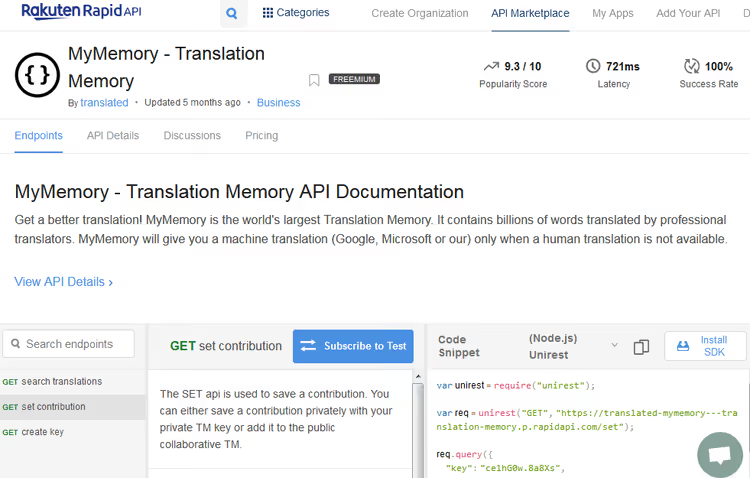
MyMemory from the company Translated is the world's largest collaborative translation memory: billions of segments annotated by professional translators. The API returns the best match from the translation memory, and when there is no match, it substitutes machine translation from ModernMT, the adaptive engine from the same company.
Pros: free tier with a generous limit (10,000 words/month), unique translation memory feature with human translations, TMX format support for glossary exchange.
Cons: quality depends on language pair coverage in the TM, paid plans from €299/month for 500,000 words (relatively expensive), API interface is simpler than cloud competitors.
Price: free up to 10,000 words per month. Pro: €299/month for 500,000 words. Enterprise: €499/month for 1,000,000 words.
7. Yandex Translate API
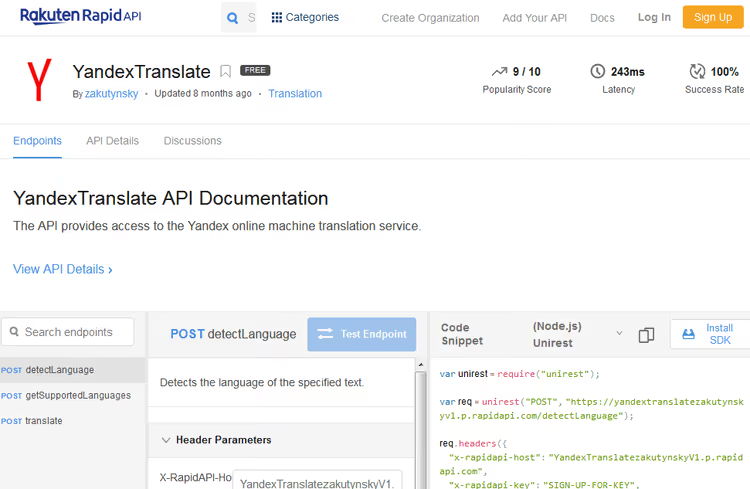
Yandex Translator via Yandex Cloud is a service that delivers higher quality than most Western alternatives on Russian-English and Russian-European language pairs. The API works with IAM tokens, supports 90+ languages, and includes a built-in dictionary with transcription and usage examples.
Pros: excellent quality for RU↔EN and RU↔European languages, automatic language detection, the lowest price among cloud majors (around $4-5 per million characters).
Cons: documentation is mostly in Russian (weaker for international teams), noticeable quality drop on exotic language pairs, tied to Yandex Cloud.
Price: ~$4-5 per million characters via Yandex Cloud. For new accounts, a trial grant is available.
🔗 Yandex Translate | 📄 API Documentation
8. ModernMT

ModernMT from the company Translated is an adaptive machine translation engine that fine-tunes in real time based on translator corrections. Unlike classical NMT models that require retraining when switching domains, ModernMT takes into account the context of the entire document and adjusts output as human corrections come in. It supports 200+ language pairs. This is the engine that powers MyMemory under the hood when there is no match in the translation memory.
Pros: adaptive fine-tuning without manual model retraining, document-level translation (considers context of the entire document), REST API with comprehensive documentation, quality up to 95% according to the developer.
Cons: price is above average at small volumes ($15-20/million characters), self-hosted version from €40/month for a personal license, community is smaller than Google and DeepL.
Price: API from $15-20 per million characters depending on the language pair and volume. Self-hosted personal license from €40-60/month. Free trial period.
🔗 ModernMT | 📄 API Documentation
9. LibreTranslate

LibreTranslate is an open source machine translation service under the AGPLv3 license, built on the Argos Translate engine. It deploys via Docker with a single command and works completely offline without connecting to external APIs. For projects that legally cannot send text to a third party, this is the only option on the list.
Pros: full autonomy (self-hosted, no character limits), REST API compatible with Google Translate response format (easy migration), active open source community.
Cons: 30 languages (no Japanese, Korean, or many Asian languages), quality is noticeably lower than commercial engines, Argos Translate is hybrid rather than full transformer, high-load scenarios require your own hardware.
Price: free when self-hosted. The cloud instance at libretranslate.com offers a free tier with limitations.
10. Lingvanex

Lingvanex is a commercial machine translation API supporting 109 languages at the lowest price per million characters among commercial providers: $5. In addition to text translation, it offers speech-to-text, voice translation, and an on-premise server for closed environments on ONNX models.
Pros: 109 languages at $5/million characters (best price/coverage ratio), ONNX models for on-premise, translation memory and custom dictionaries included in all plans.
Cons: primary interface is REST (few SDKs), less community adoption compared to Google and DeepL, quality on some Asian languages is inconsistent.
Price: $5 per million characters in the cloud. On-premise server from $10/day. Discounts with prepayment from 1B characters.
This short video from Australian Translation Services visually compares the quality of DeepL, Google, and Yandex on the same sentences. Watch it if you are choosing among the leaders.
⁉️🤔 Frequently asked questions
Which translation API delivers the best quality on European languages?
DeepL consistently shows the best results on EN↔DE, FR, ES, IT, NL, PL according to blind tests from 2024-2025. For 33 European languages, it is the first choice. If the language falls outside these (Arabic, Hindi, Chinese, Japanese, Turkish), DeepL does not support it at all, and leadership shifts to Google Cloud Translation.
What is cheaper for a startup: paying for an API or deploying LibreTranslate?
Up to 2 million characters per month, the free tiers of Google Cloud Translation or Azure Translator are more cost-effective. From 2 to 10 million, Lingvanex at $5/million. Self-hosted LibreTranslate is justified when volume exceeds 20-30 million characters per month (VPS cost is lower than the cumulative API bill) or when data cannot legally be sent externally.
Which API works best with the Russian language?
Yandex Translator delivers the best quality on RU↔EN and RU↔other European language pairs, as this is its native specialization. Google Cloud Translation handles EN↔RU well but may make mistakes with case endings and grammatical gender. DeepL has supported Russian since 2022, and quality is improving, but it still lags behind Yandex on complex grammar.
Can you use multiple APIs in parallel?
Yes, this is common practice: the main flow goes through Google or DeepL, while a fallback layer switches to Azure or Amazon Translate when the primary provider errors out. LibreTranslate is convenient to keep as an emergency channel without external dependencies. Architecturally, this is solved through an adapter pattern: a single interface
translate(text, source, target)dispatches calls by priority.
What should I choose for e-commerce with a 20-language catalog?
Google Cloud Translation Advanced with glossaries for product names and terms. For descriptions in European languages, add DeepL as a second engine for DE, FR, IT, ES. Amazon Translate is suitable if the catalog is already in the AWS ecosystem and does not require exotic languages. ModernMT works well if adapting to the catalog's style without manual retraining is important.
Is IBM Watson Language Translator still alive?
No. IBM has officially discontinued support for Watson Language Translator; the service is deprecated. IBM's recommended migration path is to watsonx.ai or NeuralSeek. We replaced this position with ModernMT, which covers the same enterprise translation niche with adaptive fine-tuning.
Which translation API to deploy in 2026
If you are in the AWS ecosystem and volumes are predictable, take Amazon Translate: $15 per million characters and no extra integration work. If text quality is critical and your audience is European, DeepL is unmatched; the $5-10 premium per million characters pays off by eliminating re-editing. If you need maximum language coverage with a good price/quality balance, Google Cloud Translation is the choice, especially after the Gemini update in late 2025.
The most pragmatic stack for B2B SaaS in 2026: Google Cloud Translation as the primary engine, DeepL as a premium layer for customer-facing text, and LibreTranslate in Docker as an emergency fallback. All three work through a single REST interface with a token and do not require rewriting your architecture.
Start with free tiers on your actual text. Synthetic benchmarks will not show how an engine handles your subject area, and 500,000 characters of free quota is enough to test all candidates from the table.

A professional team of writers and editors specializing in creating quality content.