














📺 4K UHD or Full HD: which TV to buy for the bedroom
Buying a TV for the bedroom is a trick question. For the living room we go all out: the biggest screen, a serious panel, louder sound. But the bedroom? Space is tighter, you watch from up close, and the budget is often cut. And the first big question that comes up: 4K UHD or is Full HD enough?
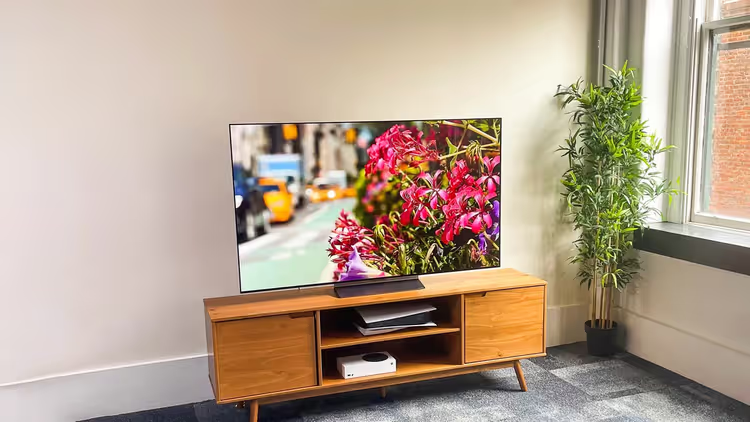
The difference between four million pixels and two million is twofold on paper, but in a real bedroom it works differently than in a showroom. Let's cut through the marketing and figure out where 4K actually wins, and where Full HD still hasn't been written off.
💡 Quick overview:
- 4K UHD resolution (3840×2160) delivers four times as many pixels as Full HD (1920×1080), but the difference is only noticeable on screens 43 inches and up and from a distance of up to 2 meters.
- For a bedroom with a typical viewing distance of 1.5-3 meters, the key factor is not resolution, but screen size, panel type, HDR, and upscaling quality.
- Full HD TVs in the 32-40 inch range are still relevant for smaller bedrooms if the budget is tight and the content is mostly broadcast TV and YouTube.
What's behind the numbers: 4K UHD vs Full HD
Full HD is 1920 by 1080 pixels, roughly two million dots on the screen. 4K UHD is 3840 by 2160, meaning 8.3 million. A fourfold increase in density means that on the same screen inch the pixel became half the size on each side, the eye stops distinguishing individual dots and sees a continuous, smooth image.
But there's a nuance. The human eye has a resolving power limit of roughly one arcminute. In practice this means you won't see the difference between 4K and Full HD on a 40-inch screen from three meters away, no matter how hard you try. The optimal distance chart looks like this:
Screen size | Full HD - min. distance | 4K UHD - min. distance for a noticeable difference |
|---|---|---|
32" | 1.2 m | 0.6 m |
40" | 1.5 m | 0.8 m |
43" | 1.7 m | 0.9 m |
50" | 1.9 m | 1.0 m |
55" | 2.1 m | 1.1 m |
The takeaway is straightforward: in a typical 12-16 m² bedroom, where the distance from pillow to screen is 2-2.5 meters, 4K on a screen smaller than 50 inches is nice, but not revolutionary. And on 32-40 inches you are simply overpaying for pixels your eye cannot resolve.
Screen size for the bedroom: where to start
The bedroom dictates its own rules. The screen shouldn't dominate the interior or blast your eyes before sleep. Practice shows: the optimal screen size for a bedroom is 40-43 inches. On a panel like that it's comfortable to watch a movie lying down without squinting at details, and at the same time the TV doesn't look like a black hole on the wall.
If the room is compact, 9-12 m², confidently look at 32-inch models. Full HD is absolutely appropriate there: the pixel grid is invisible, and the price is two to three times lower than 4K equivalents. For a spacious bedroom of 16 m² and up with a viewing distance of 2.5+ meters, go for 50-55 inches, and there 4K becomes a must.
4K UHD in the bedroom: three scenarios where it wins
First, you watch movies in high quality. Netflix, Amazon Prime, Apple TV+ have long been delivering 4K HDR streams on premium plans. The picture on a good 4K panel with HDR10+ or Dolby Vision is subjectively twice as rich as on a Full HD set of the same size.
Second, a gaming console. PlayStation 5 and Xbox Series X output 4K at 60 fps, and on a 43-inch screen with HDMI 2.1 the difference from Full HD is instantly obvious: textures are sharp, small UI text isn't blurry, particle effects don't turn into mush.
Third, you watch satellite or broadcast TV, but the TV does a good job of upscaling. Top-tier models from Samsung, LG, and Sony pull a 1080i stream up to near-4K quality thanks to neural-network scaling. On budget panels the same processor will turn broadcast into a blurry mess.
The range of 4K TVs today is enormous, from budget brands to flagship lineups. For specific prices and current availability check the catalog at https://www.ctrs.com.ua/ru/televizory/hd-format_4k-uhd-3840-x-2160/, which features 4K UHD models suitable for both the bedroom and the living room.
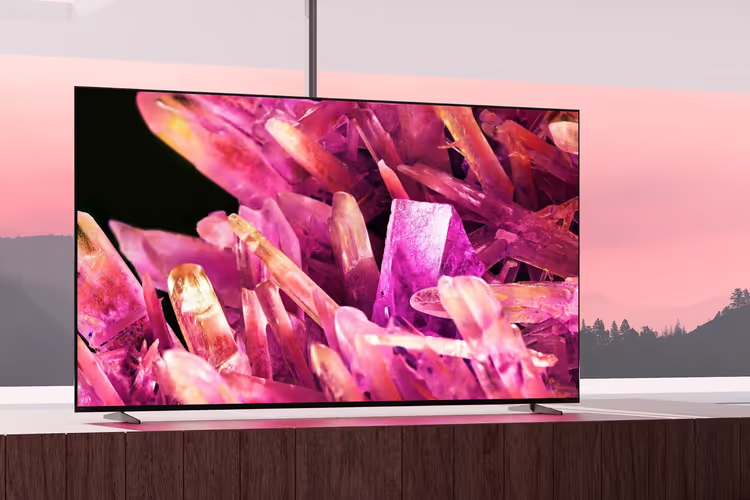
Full HD for the bedroom: when 1080p still makes sense
Full HD is not dead. In the bedroom it covers three practical use cases.
Use case one, background viewing. The TV is on "for the sound": morning news, a cooking show, kids' YouTube. Here resolution doesn't matter at all, and the savings of 200-300 dollars versus a 4K model from the same brand are tangible.
Use case two, a small screen size. At 32 inches the pixel density of Full HD is already 69 ppi, a dot is invisible from a meter away. 4K at the same size would give 138 ppi, which the eye cannot distinguish from 69 ppi without a magnifying glass. A pure overpayment.
Use case three, you fundamentally don't pay for 4K content. If your video diet is broadcast channels, 1080p YouTube, and torrents, a Full HD TV will be more than enough. The money saved on resolution is better invested in a VA panel instead of TN, or in a model with decent stereo speakers.
What to look at besides resolution: panel type, HDR, Smart TV
Resolution is just one line in the spec sheet. These factors have a much stronger impact on the experience:
Panel type. VA delivers deep blacks (contrast of 4000:1 and above), which is critical in a bedroom with the lights off. IPS wins on viewing angles, but its blacks are gray. For a bedroom, where you often lie at an angle to the screen, IPS is preferable.
HDR. High Dynamic Range is not about the number of pixels, but their quality. HDR10 is the base standard, HDR10+ and Dolby Vision add frame-by-frame metadata. Proper HDR starts at a peak brightness of 400-600 nits; below that it's just a checkbox in the spec sheet.
Smart TV. The platform matters. LG webOS, Samsung Tizen, and Google TV are three platforms that actually get updates and have apps for all streaming services. Exotic platforms like "Smart TV based on AOSP" without Netflix support out of the box are a headache.
Sound. The built-in speakers of budget TVs output 5-10 W, which is formally enough for a bedroom, but voices in movies will sound flat. If there's no room for a soundbar, at least get a model with 20 W total and Dolby Audio support.
If you want to see the difference with your own eyes, not just in words, here is a visual comparison of 4K, Full HD, and HD Ready on real content:
⁉️🤔 Common questions
Is it worth overpaying for 4K if I only watch broadcast TV?
No. Broadcast and cable TV overwhelmingly transmit in 720p or 1080i. A 4K TV will upscale that signal, but the picture quality won't exceed the source. You'll only notice the difference when you switch to streaming 4K content. If you have no plans for Netflix/Prime Video on a premium plan, Full HD fully covers the task.
At what distance is the difference between 4K and Full HD actually visible?
According to the ITU BT.2246 standard, the difference becomes noticeable when the TV occupies at least 40° of the field of view. For a 43-inch screen that's a distance of about 1.3 meters, for a 55-inch screen, 1.7 meters. In a typical bedroom where the distance from pillow to screen is 2.5 meters, the advantage of 4K over Full HD on a 43-inch set is practically unnoticeable. The takeaway: first pick the screen size for your distance, then decide on resolution.
What TV size is optimal for a 12-15 m² bedroom?
40-43 inches is the sweet spot. On a screen like that it's comfortable to watch both from the bed directly opposite and at an angle from the vanity table. 32 inches is an option for a very compact bedroom (9-11 m²) or if the TV sits on a dresser rather than on the wall. 50+ inches is for when the bedroom is spacious and the viewing distance exceeds 2.2 meters.
Does 4K affect eye strain when watching before sleep?
Resolution by itself, no. Eye strain is affected by brightness (in the bedroom before sleep keep it no higher than 120-150 nits), color temperature (warm mode, 2700-3000K), and the PWM frequency of the backlight. A high PWM frequency (above 1000 Hz) or flicker-free DC Dimming is more comfortable for the eyes; this parameter matters more than resolution. The blue spectrum suppresses melatonin regardless of whether you have 4K or Full HD.
So what to put in the bedroom: a short algorithm
The choice comes down to three variables: distance, content, budget. Walk through this chain:
- Eyes to screen less than 1.7 meters AND screen size 43+ inches → go for 4K, the difference will be visible.
- Eyes to screen 2+ meters with a 40-43 inch screen → Full HD is enough, you won't notice the difference.
- You watch Netflix 4K / play on PS5 / Xbox Series X → 4K is a must, it's a different level of detail.
- You watch broadcast TV and 1080p YouTube → Full HD, and put the money saved into a good VA panel.
And remember: a 40-inch Full HD with HDR and a VA panel is better than a 50-inch 4K on a cheap TN with a peak brightness of 200 nits. Resolution is not the only thing that makes the picture delicious.

A professional team of writers and editors specializing in creating quality content.