













🛡️ Best iPhone screen protectors in 2026: why you still need them
Cracked iPhone screens are becoming a thing of the past. The glass on the iPhone 16 and 17 series, third-generation Ceramic Shield, withstands drops that would have shattered a display just five years ago. Apple claims the iPhone 17 Pro front panel is 2x tougher than any other smartphone.
Scratches, however, are a different story. Keys in your pocket, sand at the beach, coins in your bag: microscratches accumulate unnoticed, and after six months the screen loses its pristine look. And an out-of-warranty iPhone 17 Pro Max display replacement starts at $379, while a screen protector for iPhone 13 Pro Max costs 20-30 times less than the repair. Modern protective films and glass also solve adjacent problems: fingerprints, blue light filtering, privacy from side-angle viewing.
Order straight from ZAGG.
Learn more about "straight from ZAGG" here.
Below, the five best protective solutions for iPhone in 2026: from premium glass with antimicrobial treatment to a budget three-pack for pocket change.
💡 Quick overview:
- Decide on your priority: full scratch protection, blue light filter, or privacy from side-angle viewing. Different glass for different needs.
- Choose ZAGG VisionGuard+ for maximum features in a single piece of glass: blue light filter, antimicrobial treatment, and reinforced edges.
- Get Spigen GlasTR EZ Fit for the installation tray that eliminates bubbles and misalignment. Budget alternative: Ailun, three glass protectors per pack.
- Consider Catalyst Total Protection if you need screen protection together with a waterproof case and camera lens cover.
Comparison table: all five solutions
Product | Protection type | Key feature | Price | Best for |
|---|---|---|---|---|
ZAGG VisionGuard+ | Tempered glass | HEV blue light filter + antimicrobial treatment | $20-50 | Maximum features |
Spigen GlasTR EZ Fit | Tempered glass | Auto-alignment tray | $15-25 | Flawless installation |
ZAGG Privacy+ | Tempered glass | Privacy filter (side view darkened) | $30-60 | Protection from prying eyes |
Ailun Glass | Tempered glass | Three per pack, lowest price | $6-10 | Budget |
Catalyst Total Protection | Case + glass | IP68 waterproof + camera protection | $90-120 | Total protection |
1. ZAGG InvisibleShield Glass Elite VisionGuard+
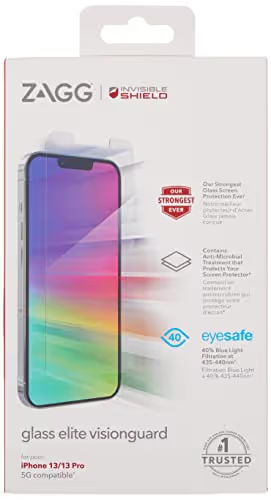
ZAGG VisionGuard+ is a flagship screen protector that does more than just guard against scratches. It is made from aluminosilicate material, similar to multi-layer safety glass, with reinforced edges that prevent chips and cracks from spreading. ZAGG claims 5x shatter protection compared to standard tempered glass.
The main feature: high-energy visible blue light (HEV) filtering without color distortion. The screen does not yellow, as happened with filter films of years past. In practice, this is noticeable during evening reading: your eyes tire less. You can debate the science of blue light's effect on sleep all day, but the subjective comfort is a fact.
The second feature: oil-dispersion treatment. Instead of collecting finger grease in smudges, the surface spreads it into a thin layer, making fingerprints barely visible. The third: antimicrobial treatment that inhibits bacteria growth on the surface. Not that we often think about microorganisms on our screens, but think back: how often do you wash your hands before picking up your phone?
VisionGuard+ is available for all current iPhone models, including the iPhone 16 and 17 lineups. ZAGG offers a limited lifetime warranty: if the glass cracks or scratches, they will replace it.
- Pros: excellent scratch and impact protection, blue light filter without yellow tint, oil-dispersion coating against fingerprints, antimicrobial treatment, lifetime warranty
- Cons: above-average price, installation requires care (no alignment tray)
- Price: $20-50 depending on iPhone model
- Buy: 🔗 ZAGG VisionGuard+ on Amazon | 🔗 On the ZAGG website
2. Spigen GlasTR EZ Fit, tempered glass with auto-alignment
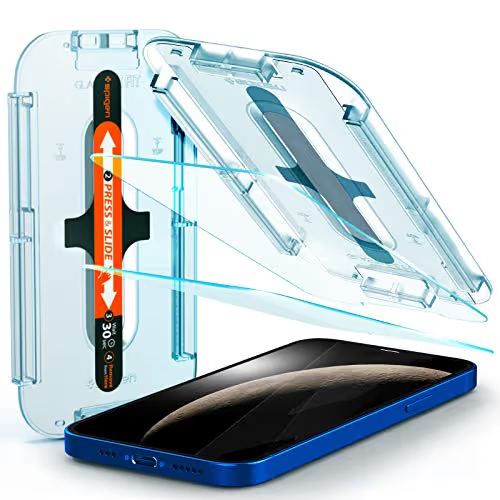
A crookedly applied screen protector or a speck of dust trapped underneath can ruin the feel of a new iPhone in a second. Spigen solved this problem radically: GlasTR EZ Fit comes in a plastic auto-alignment tray precisely fitted to the display dimensions of a specific model. Just place the tray on the phone, press down, and the glass seats perfectly, with no bubbles or misalignment. It is almost impossible to get wrong.
In terms of protective properties, this is solid tempered glass with no frills: 9H hardness, scratch and chip protection, oleophobic coating against fingerprints. There is no blue light filter or antimicrobial treatment here. This is deliberate minimalism for those who want simple, reliable glass with flawless installation.
Spigen includes two glass protectors in the box: one for now, one as a spare. Models are available for all iPhones starting from iPhone X, including SE and Mini, as well as the latest iPhone 16 and 17. A privacy filter version is available in select sizes.
- Pros: error-free installation thanks to the tray, two glass protectors included, reasonable price, oleophobic coating
- Cons: only basic protection features, more plastic packaging
- Price: $15-25 depending on model
- Buy: 🔗 Spigen GlasTR EZ Fit on Amazon
3. ZAGG InvisibleShield Glass Elite Privacy+
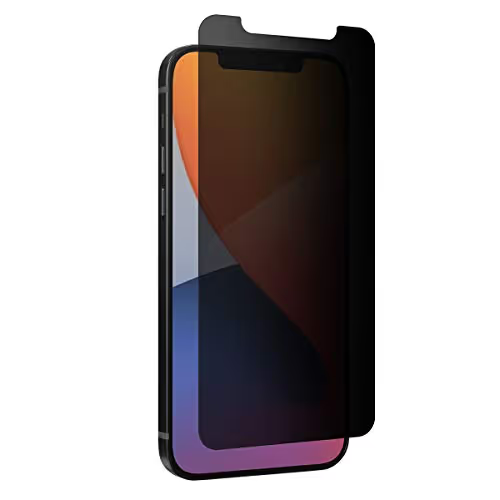
Whether you are typing a personal message on the subway, entering a password at a café, or checking your banking app in a queue, someone will inevitably glance at your screen. The larger iPhone displays get, the easier it is to snoop. ZAGG Privacy+ solves this with two-way darkening technology: anyone standing to the side sees only a black screen, while for you, looking straight on, the picture remains full-color and bright.
At its core, it is the same aluminosilicate glass with reinforced edges as VisionGuard+, plus oil-dispersion treatment against fingerprints. What is missing: blue light filter and antimicrobial layer. That is the trade-off for the privacy prism. ZAGG also makes a "360" model that works in both portrait and landscape orientation, useful for tablets and horizontal video.
Privacy+ is available for iPhone 16 and 17 in all sizes. Like the higher-end model, it comes with ZAGG's limited lifetime warranty.
- Pros: effective privacy filter for side-angle viewing, excellent scratch protection, oil-dispersion coating, lifetime warranty
- Cons: pricier than privacy alternatives, no blue light filter
- Price: $30-60 depending on model
- Buy: 🔗 ZAGG Privacy+ on the manufacturer's website
4. Ailun glass screen protector, budget three-pack
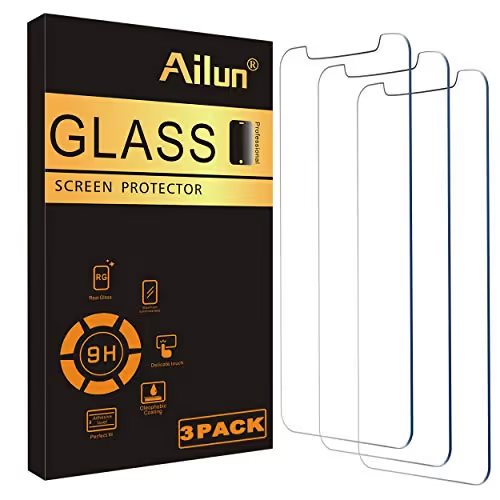
If budget matters more than extra features, Ailun covers the basic need for pocket change. Tempered glass, oleophobic coating against fingerprints, three per pack. No alignment trays, blue light filters, or antimicrobial layers: you get exactly what you pay for, scratch protection for the price of a cup of coffee.
Ailun is available for iPhone 16e, 17e, 14, 13, and older models, mostly for 6.1-inch displays. There is a tinted privacy screen version for a small upcharge, but it darkens the entire screen uniformly, like a tinted window, and you will have to crank the brightness to maximum. It does not compare to ZAGG's prism technology, but it works for undemanding scenarios.
Ailun's main compromise: imperfect fit on some models. The edges may fall short of the display edge by a fraction of a millimeter, which is noticeable when swiping from the edge. Still, at $6-10 for three glass protectors, it is forgivable: swap one out every six months and forget about scratches.
- Pros: very low price, three glass protectors per pack, scratch and fingerprint protection
- Cons: only basic features, may not perfectly align with display edges, weak privacy filter
- Price: $6-10 per three-pack
- Buy: 🔗 Ailun Screen Protector on Amazon
5. Catalyst Total Protection, case with built-in screen protection
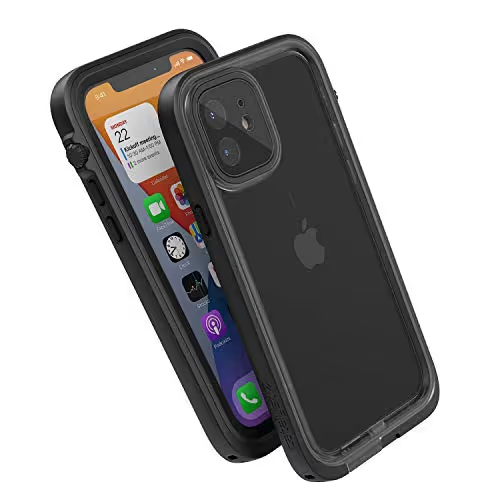
Catalyst Total Protection is not just a screen protector, but a full-fledged case that covers the screen, body, and camera lens simultaneously. Unlike most cases where the display remains exposed, here the front panel is fully sealed and sits flush against the screen, though it is not adhered to it like a standalone glass protector.
The case meets the IP68 standard and withstands submersion in water up to 10 meters deep. Drops from up to 2 meters are also within the claimed protection. Catalyst designs its cases for extreme conditions: construction sites, hiking, underwater photography. That said, the case adds noticeable bulk. Your iPhone will not be slim with it on.
The trade-off: touch sensitivity. Because the front panel is not bonded to the display but makes mechanical contact, the tactile response is slightly more muted than with a standalone glass protector. For everyday use this is not critical, but in games requiring fast swipes and taps, the difference is felt.
Catalyst Total Protection is available for iPhone 16 Pro, 16 Pro Max, and models from previous years. The iPhone 17 lineup is expected shortly after the new models launch.
- Pros: two-in-one protection (case + screen), IP68 waterproof (up to 10 meters), drop protection up to 2 meters, covered camera lens
- Cons: bulky, high price, slightly reduced screen touch sensitivity
- Price: $90-120 depending on model
- Buy: 🔗 Catalyst Total Protection on the manufacturer's website
If you want to see installation and a hands-on comparison, here is a detailed video review of screen protectors for current iPhones, including Spigen and ESR with a scratch resistance test.
⁉️🤔 Frequently asked questions
Why do I need a screen protector if the iPhone has Ceramic Shield?
Ceramic Shield is excellent at protecting against impacts and drops, but not against scratches. The micro-hardness of the glass on the Mohs scale is around 6-7, while sand, dust, and metal objects in your pocket have higher hardness and leave microscratches. A screen protector takes those scratches instead, and replacing it costs $6-50 versus $379 and up for a display outside Apple warranty.
Tempered glass or plastic film: which to choose?
Glass, hands down. Plastic films are thinner, provide worse impact protection, become cloudy over time, and collect fingerprints. The only upside of plastic is reusability, but after several months of use you are unlikely to want to peel off and reapply a film. Glass offers better clarity, an oleophobic coating, and feels nicer to the touch: your finger glides as if on the original display.
Blue light filter in a screen protector: marketing or real benefit?
The scientific consensus on the effect of blue light from screens on vision is not yet final, but subjectively many users report less eye fatigue during evening reading with a filter. ZAGG VisionGuard+ implements filtering without the yellow tint, unlike software filters such as Night Shift. If you do a lot of reading on your phone before bed, the difference is noticeable.
Does the Catalyst Total Protection case replace a standalone screen protector?
It does, but with caveats. The case's front panel is not bonded to the display but makes mechanical contact, so touch sensitivity is slightly lower than with a standalone glass protector. Additionally, the case adds noticeable bulk. For extreme conditions (water, construction, hiking) this is an ideal option. For everyday city use, a standalone glass protector is more convenient.
How often should I replace a screen protector?
A screen protector is a consumable. With active use, microscratches appear within 3-6 months. If the glass cracks from an impact, it has done its job protecting the display, and it is time to replace it. Brands like Spigen include a second glass protector in the box for exactly this reason.
Which screen protector to choose in 2026: the final breakdown
Screen protectors for iPhone in 2026 are not just "scratch film." They are multi-layer aluminosilicate panels with blue light filtering, prismatic privacy, and antimicrobial treatment. The market has segmented, and the choice depends on your scenario:
- Maximum features with no compromises: ZAGG InvisibleShield Glass Elite VisionGuard+. Get it if you are willing to pay for a blue light filter, bacteria protection, and best-in-class scratch protection.
- Flawless installation on the first try: Spigen GlasTR EZ Fit. The auto-alignment tray eliminates bubbles and crooked placement. Two glass protectors included, practical.
- Protection from prying eyes: ZAGG InvisibleShield Glass Elite Privacy+. For those who frequently enter passwords and read personal content in public places.
- Budget with no overpaying: Ailun Glass Screen Protector. Three glass protectors for the price of one premium brand. Swap them out as they wear and forget about scratches.
- Total protection in extreme conditions: Catalyst Total Protection. A case that covers everything: screen, body, camera. Waterproof to 10 meters.
Keep in mind: a screen protector is a consumable. After six months, microscratches will appear, and that is normal: it took the hit for you. Keep a spare glass protector in your desk drawer and replace it without regret. It is dozens of times cheaper than a display replacement.

A professional team of writers and editors specializing in creating quality content.