🔧 Crypto futures trading strategy: a complete guide
How to build crypto futures trading without blowing your deposit: five strategies, a trading plan, risk management…

Not everything fits into neat categories. This section is exactly about that.
Here you'll find content that didn't make it into the blog's main categories. Blogging and naming, general guides, internet statistics, server monitoring, IT humour, and assorted technical notes. The section is a collection, not a dumping ground. Every piece is useful on its own — the topics are just different.
A big chunk is about blogs. How to name a blog so the name works for you, not against you. What kinds of bloggers and formats exist in the first place. Why blog at all when there are so many ready-made platforms around. In articles like «How to Name Your Blog: 50+ Ideas» or «8 Types of Blogs and Bloggers», we share what we've tested ourselves in practice.
We also break down the process itself. How to pick the right platform for your goal, how a personal blog differs from a niche project, how not to quit everything by month two. Naming is just the first step. Then come category structure, consistency, and the author's voice — things beginners rarely think about in advance.
There is data-driven content. Year-by-year internet statistics: how many people are online, what they use, how audience behaviour is changing. This kind of data comes in handy when you're planning a project or writing a commercial proposal. We pull numbers from public reports and cite the source so you can check for yourself.
Some articles are structured as general guides. Basic things that nobody really explains properly: how a domain works, how hosting differs from a CMS, what actually happens when you open a website. We explain it in plain language, for those just stepping into the topic who don't want to drown in jargon.
A separate thread for those who administer servers. Resource monitoring, metrics, load. For example, how to keep an eye on EC2 instance memory via CloudWatch so the instance doesn't go down at the worst possible moment. These are technical notes for practitioners, complete with commands and screenshots from a real console.
This is also where near-technical marginalia settle. Short observations, a breakdown of a common mistake, a neat trick from hands-on experience. They don't warrant a full section of their own, but it'd be a shame to lose them. Often it's exactly this small thing that solves the problem you'd otherwise spend half a day on.
Occasionally we publish IT humour. Posters, jokes, memes about development and sysadmin life. Can't do without it — working in tech can be stressful. A short pause for a smile is part of the profession too.
Sometimes cheat sheets and quick-reference cards end up here. A list of keyboard shortcuts, a short how-to, a table for quick lookup. Handy to keep within reach and open when needed. We collect such notes when they don't justify a standalone article but genuinely save time at work.
The section is written by people who have been in the field for years. That's why the content is straightforward and to the point. First, a short answer to the question or the takeaway. Then a breakdown with examples, no fluff or unnecessary theory. You quickly find what you were looking for and move on.
We know it's easy to turn «Miscellaneous» into a dumping ground. We try not to let that happen. When a topic gathers several pieces, we spin it off into its own section. What stays here is the stuff that stands on its own and doesn't need a whole department.
Who will find it useful. Those launching a blog and thinking about its name. Those needing fresh statistics for work or study. Admins keeping an eye on servers and metrics. And anyone who enjoys reading about technology a little beyond the daily grind.
Drop by when you feel like something new. There is no single overarching theme here, and that's fine. In return, you'll almost always find a piece that helps with work or simply broadens your outlook. We keep adding to the section, picking only what we consider genuinely useful.
How to build crypto futures trading without blowing your deposit: five strategies, a trading plan, risk management…
Key slot selection criteria: RTP, volatility, and bonus mechanics. How to avoid draining your bankroll and where to…
Which IT specializations are growing faster than the market, how much developers earn, and how to build a career with a…
Five steps for fast cryptocurrency exchange: from checking the reserve to crediting your card. No fluff -- only what…
How home 4G internet works: real speeds, prices and traffic limits in 2026. An honest breakdown of pros and cons…
Nine tested 4K monitors for gaming, design, and office: from budget IPS at $220 to Mini LED with 160 Hz. Comparison…
EcoFlow 160W solar panel review: specs, compatibility with RIVER and DELTA, pros and cons. Is it worth buying in 2026?…
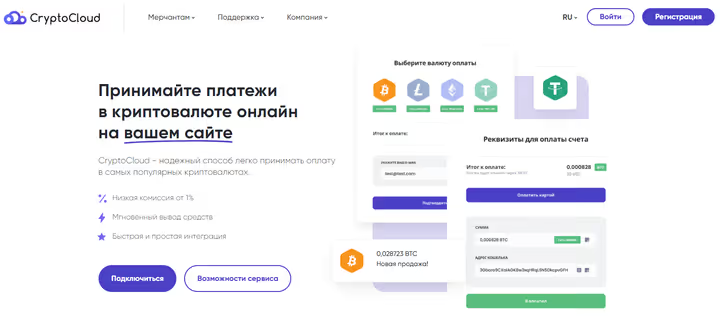
CryptoCloud review: 0.4% commission, no KYC. Accept Bitcoin, USDT and Monero with built-in widget and 30-minute…
Is your original charger broken? A breakdown of power supply specs: which characteristics matter, what the numbers on…
Who coined the word 'blog' and created the first weblog? The story of Jorn Barger, a programmer and AI researcher whose…