













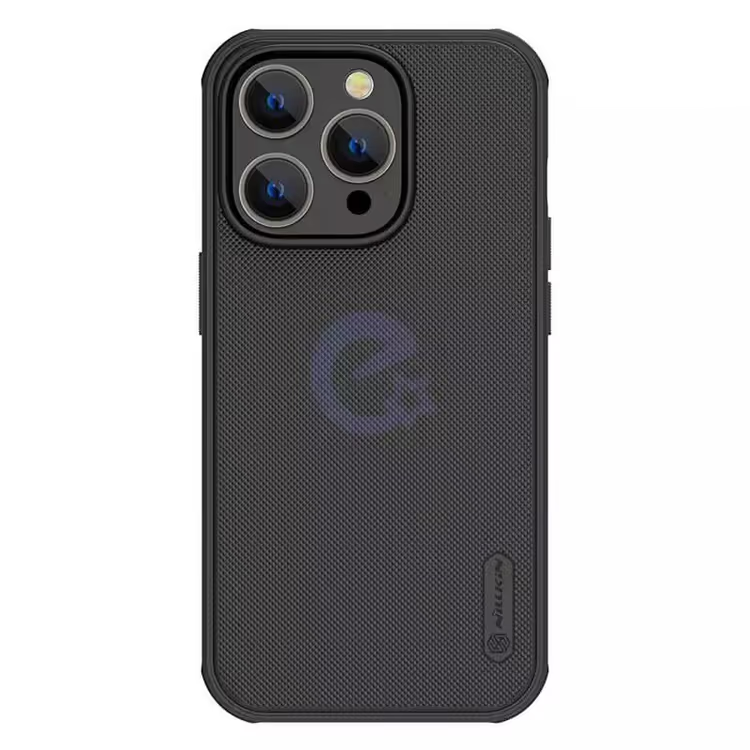
📱 How to choose a case for iPhone 14 Pro: a guide to materials, protection and features
Bought an iPhone 14 Pro and immediately thought: what if it slips out of your hands onto the pavement? That familiar chill. Replacing the back glass at an official Apple service center costs about a third of the price of a new phone, and that's not counting the ruined mood. A good case completely eliminates that anxiety.
The choice seems simple until you open the catalog: silicone, leather, plastic, clear, with a stand, with a card slot, MagSafe-compatible... It's overwhelming. Meanwhile, you wear the case every day, and its material, shape, and features determine how comfortable you'll be using the phone for those months.
Below, a detailed breakdown: which types of protection actually work, how materials differ in feel and wear, which features are worth the extra cost, and which are just marketing. By the end, you'll know exactly which iPhone 14 Pro case to get for your lifestyle.
💡 Quick overview:
- Define your scenario: office, construction site, gym, or party, and get a case for that, not a "universal" one.
- Material directly affects grip: silicone clings to your palm, glossy plastic slips, leather only gets nicer over time.
- MagSafe compatibility is not a checkbox, it's real convenience: wireless charging, magnetic car mounts, magnetic wallets.
- Additional features (stand, cardholder) only get them if you actually use them; they add weight and bulk.
What protection levels mean in practice
Manufacturers love words like "shockproof," "military standard," and "MIL-STD-810G." There is concrete meaning behind them, and it's worth understanding before you buy.
A thin silicone or polycarbonate case 1-2 mm thick protects against scratches, scuffs, and minor bumps, like when the phone falls off the couch onto a hardwood floor. This is enough for an office scenario. Such cases don't change the device's dimensions; the phone remains slim and comfortable in jeans pockets.
Medium level: cases with reinforced corners and a two-layer construction. The outer layer of hard polycarbonate takes the impact, the inner layer of thermoplastic polyurethane (TPU) absorbs the energy. The best models in this class pass MIL-STD-810G certification under method 516.8, which is 26 drops from a height of 1.2 meters onto all faces and corners. For a city dweller who drops their phone on concrete or tile a couple of times a month, this is the sweet spot.
Maximum protection: brands like OtterBox, UAG, and Spigen make cases with a three-layer construction, including a rigid frame, a shock-absorbing layer, and an outer bumper. They add 3-5 mm of thickness and noticeable weight, but withstand drops from 2-3 meters onto concrete. It makes sense to get one if you work in construction, travel a lot with a backpack, or regularly drop your phone onto hard surfaces.

How materials differ in real life
A case's material determines three things: tactile feel, wear resistance, and how the phone sits in your hand. Let's go through each one.
Silicone and TPU. Soft to the touch, excellent at absorbing shocks due to elasticity, easy to clean. Silicone slightly "clings" to your palm and pocket fabric; the phone won't slip out accidentally. The downside: it collects dust and lint, and after 8-12 months of active use, it can start to get shiny in areas of constant contact. Official Apple silicone cases are noticeably more expensive; quality alternatives from trusted brands (Spigen, ESR) cost several times less with comparable quality.
Genuine leather. Looks expensive and, over time, develops a patina, an individual pattern of wear that makes each case unique. Pleasant to the touch, doesn't slip. Requires care: once every couple of months, treat with leather conditioner, otherwise it dries out and cracks at the edges. A good leather case lasts 1.5-2 years, but by that point, you'll likely have already changed your phone. Prices: from budget leatherette to the premium segment for genuine leather from top brands (Nomad, Apple, Mujjo).
Polycarbonate and hard plastic. Hold their shape, don't yellow (unlike cheap TPU), transmit color and texture without distortion, which is why the best clear cases are made from polycarbonate. The downside: hard plastic absorbs shocks less effectively and can crack itself during a severe drop. Clear polycarbonate cases like the Apple Clear Case and its quality alternatives sit in the mid-price segment.
Hybrids. Most medium-protection cases today are a combination of a polycarbonate back and a TPU bumper. The back holds its shape and doesn't yellow, the bumper cushions impacts on the corners. This is the most common and balanced option.

Features worth paying extra for, and ones to skip
A case has long ceased to be just a piece of plastic. Manufacturers build everything into them; let's figure out what's actually useful and what's just a nice line in the description.
Built-in kickstand. Indispensable if you regularly watch YouTube during lunch, make hands-free video calls, or use your phone as a second screen on your desk. A good stand is metal, sits flush with the case body, and doesn't wobble. Plastic pop-out legs last six months to a year, then become loose.
Cardholder and wallet cases. Convenient if you don't carry a bag and want to combine your phone with a couple of bank cards. But: it adds 3-5 mm of thickness, and if stolen, you lose both your phone and cards at once. If you need a cardholder, look for models with a magnetic or snap-shut cover (not just a side slot where cards fall out).
Water and dust protection. The iPhone 14 Pro itself has an IP68 rating (protection during submersion up to 6 meters for 30 minutes). A case with "water protection" usually means port and button covers. It makes sense for the beach, construction sites, or bike rides in the rain. For the office and home, it's overkill.
Built-in battery (battery case). Roughly doubles battery life but makes the phone significantly thicker and heavier. Apple has officially discontinued the Smart Battery Case, but there are quality alternatives for the iPhone 14 Pro from Mophie and other brands. Only get one if you consistently can't make it to the evening without recharging.

MagSafe and wireless charging: what you need to know before buying
The iPhone 14 Pro supports MagSafe, a system of magnets on the back panel to which chargers, car mounts, wallets, and external batteries attach. Not every case plays well with this.
If you use wireless charging, make sure the case is labeled "Made for MagSafe" or at least "MagSafe-compatible." The difference: Apple-certified cases hold the magnetic connection at full strength (up to 15W charging); merely compatible ones have a weaker magnet (charging works, but a car mount might fall off on a bump). Thick protective cases (over 3 mm back) almost always block MagSafe; the magnetic field is too weak at that distance.
A practical compromise: get a thin MagSafe-compatible case for daily wear and a separate thick protective one for trips and outdoor activities. The cost is the price of a second case versus the risk of breaking your phone on vacation.
Video review: best cases for iPhone 14 Pro
Watch a 9-minute review of the best cases for the iPhone 14 Pro, from thin to shockproof. The author shows each one in hand and provides thickness measurements after installation.
⁉️🤔 Frequent questions
Do I need a case if the iPhone 14 Pro has a ceramic shield on the front and sapphire crystal on the camera?
The Ceramic Shield is more resistant to cracking when dropped face down, but it scratches from sand and keys in your pocket just as easily as regular glass. And the back panel is standard strengthened glass without the ceramic additive. A case protects both sides and, more importantly, the corners and frame: it's the corners that take the most destructive hits during a fall.
Yes, Ceramic Shield is stronger than regular glass in compression and bending, but replacing an iPhone 14 Pro display out of warranty costs hundreds of dollars; the price depends on the region. A case drastically reduces the risk of such a repair and pays for itself instantly.
Why do clear cases turn yellow and can it be avoided?
It's not the polycarbonate that yellows, but the TPU bumper around the edges under the influence of UV light, heat, and skin oils. It can't be completely avoided, but it can be slowed down: get cases marked "anti-yellowing coating" or "UV-resistant TPU." Polycarbonate cases without a TPU bumper (hard, fully clear) don't yellow at all, but they absorb shocks less effectively.
The lifespan of a good clear case before noticeable yellowing is 6-12 months with active use. The Apple Clear Case is a rare example of a fully polycarbonate clear case that doesn't yellow for years.
Wallet case or a regular case plus a separate wallet?
If you carry more than two cards, get a separate wallet or a MagSafe wallet that attaches magnetically. If it's just a couple of cards and your ID, a wallet case saves pocket space. Note: when using a MagSafe wallet, it only holds securely with a MagSafe-compatible case, not a wallet case (they conflict in thickness).
Apple's MagSafe wallet holds 3 cards. Third-party alternatives (Spigen, ESR) with the same functionality cost noticeably less. The main inconvenience: to take out a card, you have to remove the wallet from the phone.
Does the case affect photo quality with flash?
Yes, if the case has a thick cutout around the camera or a dark rim. Light from the flash reflects off the walls of the cutout and creates parasitic glare (bloom) in the photo. Good cases have either a wide, teardrop-shaped cutout or a black matte rim around the cutout that absorbs scattered light.
In practice, the problem is only noticeable when shooting with flash in complete darkness. In daylight and indoors, the difference disappears. If you often shoot at night, google " flash bleed" before buying.
Is it worth overpaying for an original Apple case?
The question boils down to three points. Tactile feel: Apple's silicone cases have a pleasant microfiber lining inside and a velvety exterior; inexpensive alternatives are usually rougher to the touch. Precision: the cutouts for speakers and buttons on originals are perfect; alternatives can have 0.5-1 mm misalignments. Durability: Apple's silicone cases start peeling at the corners after 8-12 months; leather ones, after a year to a year and a half. For the price of an original, you get an ideal feel for a year; for half the amount, you get an acceptable one for the same period.
If tactile feel is important, get the original or premium alternatives (Nomad, Mujjo, Spigen). If you change your case every six months on a whim, a quality no-name brand for little money is sufficient.
Is it worth the hassle: which case to get for your scenario
There is no "best case for everyone." There is a case that suits you personally, and now you have the criteria to find it. A short matrix:
- Office, city, meetings: a thin leather or silicone case. Looks neat, doesn't ruin the phone's silhouette in a jacket pocket, pleasant to the touch.
- Active lifestyle, sports, travel: a hybrid case with a TPU bumper and a polycarbonate back, preferably with MIL-STD-810G certification. Adds bulk, but the phone will survive any drop onto concrete.
- Minimalism and lightness: an ultra-thin polycarbonate case 0.5-1 mm thick. Protects against scratches, not against drops. But the phone feels almost like it has no case.
- All-in-one: a wallet case with a magnetic cover, if you consistently carry your phone in a bag or backpack, not in your pocket.
Before buying, look at live photos of the case on an actual phone (YouTube reviews, customer photos on marketplaces). The picture on the manufacturer's website often differs from what you'll get in your hands, especially in shade, texture, and the lip around the camera.

A professional team of writers and editors specializing in creating quality content.