













 AIIllustrative image: AI-generated
📝 How to write a good resume step by step
A resume is not just a file listing places of employment. It is your personal marketing document that has 6-10 seconds to convince a recruiter to open it rather than scroll past. According to researchers at Ladders, that is exactly how much time a recruiter spends on average during the initial scan of a single resume. And if the document fails to grab attention within those seconds, nobody reads any further.
More details: fighting blogger burnout.
Read more about this on the website.
The problem with most resumes is not a lack of experience, but the inability to present it. Responsibilities merged into a wall of text, boilerplate phrases about "communication skills and stress tolerance," a messy format that falls apart when opened on a phone, typical mistakes that cost an interview invitation. The good news: all of this is fixable in one evening.
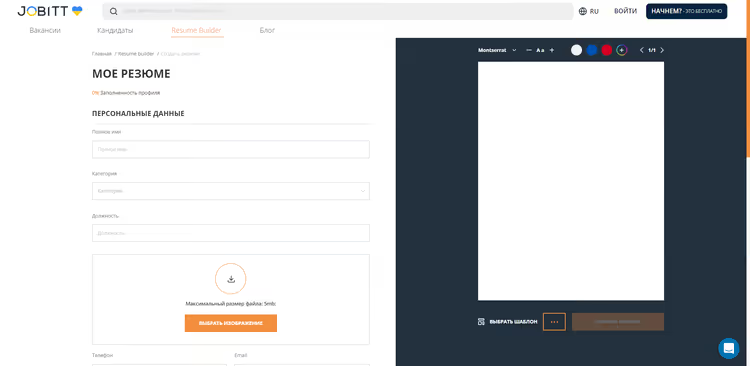
Below is a step-by-step system for building a resume that works regardless of industry or grade. From the header to the final proofread, no fluff, with concrete examples and formats. And if you want to assemble the document as quickly as possible without wrestling with formatting, a handy online builder at https://jobitt.com/ru/resume-builder will come to the rescue.
💡 Quick overview:
Gather personal details: full name, current contact information, city, and links to profiles
Formulate one clear objective tailored to a specific vacancy, without listing options "with a slash"
Describe skills and competencies relevant to the role, not everything you have
Present professional experience from most recent to oldest in a "result" format, not a "duty" format
Add sections for education, languages, and technical tools, honestly
Personal details: what to put in the resume header
The resume header is the first thing a recruiter sees, and it must answer three questions in a second: who you are, how to contact you, and where you are located. No "Resume" as a heading, just your full name.
Required fields: first and last name, a current phone number (messengers are linked to it as well), email address, and city of residence. Check your email for appropriateness; bruninhasimpatica@… or sexylady1990@… will make a recruiter doubt your professionalism faster than gaps in experience. The ideal format: имя.фамилия@gmail.com.
A photo is optional. In Russia and the CIS it is still often expected, but include one only if: a) the vacancy involves contact with people (sales, administration, public speaking); b) the photo is of professional quality, neutral background, business attire, you alone in the frame. A party selfie or a cropped group photo does more harm than having no photo at all.
Objective: one vacancy, one statement
The "Objective" or "Desired Position" block is not an essay about career aspirations, but a short line that tells the recruiter: "I understand which position I am applying for, and my resume is tailored specifically for it."
The golden rule: one objective = one vacancy. If you write "Sales Manager / Administrator / Executive Assistant," the recruiter reads it as "I haven't decided yet, I'll take whatever is offered." For each position you are interested in, create a separate version of the resume with a corresponding objective.
Good examples: "Intern in Marketing Communications Department," "Legal Counsel," "HR Analyst," "Middle Frontend Developer (React)." Take the job title from the vacancy text; if the employer is looking for a "Technical Support Specialist" and your resume says "Customer Service Manager," your resume may not even pass the automatic keyword filter.
Skills and competencies: show, don't declare
The skills section is not a graveyard of buzzwords. "Responsible, goal-oriented, stress-tolerant": these words are so worn out that recruiters stopped noticing them back in the mid-2000s. Your personal qualities will emerge during the interview; the resume must speak in facts.
Divide skills into two groups. Hard skills: specific tools, technologies, and methodologies you command, such as Python, Google Analytics, 1C:Accounting, Adobe Photoshop, knowledge of 44-FZ. Soft skills, only with context: not "negotiation skills," but "experience conducting negotiations with FMCG suppliers with an annual spend >$50M." Not "teamwork," but "coordination of a cross-functional team of 12 people in two-week agile sprints."
Cross-check the list against the vacancy requirements. If the employer is looking for someone with SQL and Tableau, those words must appear in the skills section (provided you actually possess them, of course). This matters not only to the recruiter but also to the ATS, the automatic screening system that filters resumes before a living person sees them.
Professional experience: "result" format, not "duty" format
The most important section of the resume. Most candidates describe it like a job description: "Conducted negotiations with clients," "Compiled reports," "Handled objections." A recruiter reads this and understands only one thing: the person showed up to work.
Instead, use the STAR format with an emphasis on results. Each position: company name, job title, start and end dates (month and year). Below them, 2-3 bullet points, each showing what exactly you changed or improved:
- Not "handled incoming requests," but "processed 60+ incoming requests daily, reduced average response time from 4 hours to 45 minutes by implementing templates"
- Not "did SMM," but "grew the brand's Instagram account from 3,200 to 18,500 followers over 8 months through a Reels strategy and collaborations"
Numbers work without fail. If you lack exact data, give an honest order-of-magnitude estimate: "optimized warehouse inventory, reducing excess stock by roughly a quarter." But do not invent numbers out of thin air; during the interview you will be asked to show how you calculated them.
Structure experience in reverse chronological order: current or most recent position first, then the previous one. Include internships and volunteering if this is your first entry into the job market; for junior positions this is a valuable signal of real experience.

Education and courses: what to include and what to leave out
The education block on a resume is not an autobiography. School is listed only if this is your first resume ever and there are no other lines to add. For everyone else: university, major, year of graduation. If your degree is not in the vacancy's field, list it anyway, but shift the focus to relevant courses and certifications.
List courses and additional training selectively. A specialized "Machine Learning" course from Stanford on Coursera is worth mentioning. A three-hour webinar on "Finding Yourself" is not. Priority goes to anything that ends with a measurable result: a certificate, a portfolio project, an acquired skill that can be verified through a test assignment.
Languages: state your level honestly
The language block is one of the few sections where exaggeration is exposed instantly. If a vacancy requires Upper-Intermediate English, be prepared for part of the interview to be conducted in English. A recruiter is not an examiner, but you will have to sustain a basic conversation.
Use a clear scale: A1-A2 (beginner), B1-B2 (intermediate), C1-C2 (advanced). The phrase "read and translate with a dictionary" holds no value today; it signals that you are incapable of workplace communication. If the language is required for the position but your level is currently insufficient, state your current level and add that you are taking a course or working with a tutor. This shows the recruiter that you are investing in the skill.
Computer literacy and technical tools
Last in order, but not in importance. This block lists the programs, services, and platforms you can work with: MS Office / Google Workspace, specialized software (AutoCAD, Figma, Jira, SAP, 1C), CRM systems (amoCRM, Salesforce), BI tools (Power BI, Tableau).
Specify proficiency level for non-obvious tools. "Excel" is something everyone knows, but "Excel: pivot tables, Power Query, VBA macros" is a concrete skillset that sets you apart from other candidates. The same goes for npm and Git: "confident user" says nothing, while "npm (package publishing and management), Git (branching, rebase, code review via pull requests)" says a lot.
And again: do not claim things you do not have. If a vacancy requires specific software and you do not know it, the employer will verify through a test assignment, and the lie will be exposed.
Final proofread: spelling and formatting
Resumes with errors are discarded first. This is not a matter of grammar pedantry; it is a matter of attention to detail. If a candidate failed to proofread two pages of their own resume, what will they overlook in a work task?
Sequence of actions: run the text through a spellchecker, then read it aloud; errors missed by the eyes are often caught by the ears. Have one or two acquaintances read the resume; a fresh pair of eyes catches inconsistencies and typos you no longer notice.
Regarding formatting: the entire document, two pages maximum. One font (Calibri, Arial, Helvetica, sans-serif, 10-12 pt), uniform line spacing, no tables or WordArt text boxes. Save as PDF; this format is guaranteed to open identically on any device and will not shift when printed.
⁉️🤔 Frequent questions
Is it mandatory to include date of birth and marital status?
In Russia and the CIS, age is still often requested, but by law you are not required to provide it. Marital status has no bearing on professional qualities; feel free to remove it. City of residence is important; the exact address is not.
Should I write a cover letter?
Yes, if the vacancy explicitly requires it or you have something to add beyond the resume. A good cover letter is 3-4 short paragraphs: why this specific company interested you, what relevant experience you have, and how you can solve a specific problem for the employer. Do not rehash the resume; supplement it.
What should I do about employment gaps?
Do not hide them and do not invent non-existent jobs. A year of freelancing, maternity leave, study, a break for relocation: these are normal life circumstances. State honestly: "2023-2024, career break: relocation and studying Data Science" looks far more convincing than a hole in the timeline.
What if this is my first resume and I have no experience?
Experience is not only formal employment. Internships, academic projects (coursework with practical results, hackathons), volunteering, running a thematic blog or Telegram channel, community moderation: all of this demonstrates your skills. In the "Experience" section, list projects as if they were jobs: task → your actions → result.
We also recommend:.
Do I need to tailor my resume for each vacancy?
Ideally, yes. This does not mean rewriting the entire document from scratch, but rather adjusting the emphasis: bring to the top those skills and projects that are relevant to the specific position. This is 15-20 minutes of work per version, but a response with a customized resume is far more effective than mass-mailing the same file.
The bottom line: your resume is your product
A resume is not an autobiography or a questionnaire. It is a sales document where the product is you and the buyer is the employer. And like any product, it must answer the question "why this one and not another" within the first seconds of introduction.
Go through the checklist: header with contacts and no "creative" addresses → one clear objective → skills with tools and numbers, not adjectives → experience in "result" format, not "duty" format → an error-free PDF file. If even one item is weak, fix it now, before sending.
And remember: the recruiter is not looking for the perfect candidate, but for the one whose resume gives them sufficient grounds to schedule an interview. Your job is to provide those grounds.

A professional team of writers and editors specializing in creating quality content.