













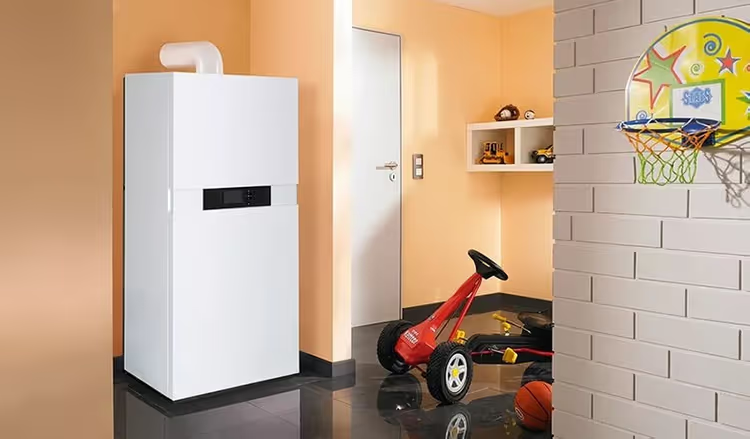
🔥 How to choose a heating boiler for your home: types, power, nuances
Bought a boiler and it can't keep up? Heating bills twice what you expected? The situation is familiar to anyone who chose equipment "by eye" or on a neighbor's advice. Poor selection results in either a cold house or overpaying for capacity that will never be used. And if something goes wrong, you'll need boiler repair in Kyiv, which is a separate expense item.
The market offers dozens of types, hundreds of models, and even more opinions on which boiler is "the best." In practice, there is no universal answer: the choice comes down to available fuel, house size, and hot water needs. Below is a step-by-step breakdown of criteria so you walk into the store with clear understanding, not relying on the salesperson.
💡 Quick overview:
- Determine the type of fuel available in your region; this dictates the boiler type
- Calculate capacity not by the "1 kW per 10 m²" formula, but accounting for heat loss and ceiling height
- Decide whether you need a second circuit for hot water or if a boiler plus a storage tank is more cost-effective
- Compare efficiency and heat exchanger material: this directly affects service life and bills
- Plan the installation location, chimney, and ventilation before buying, not after
Fuel types: what is available in your region
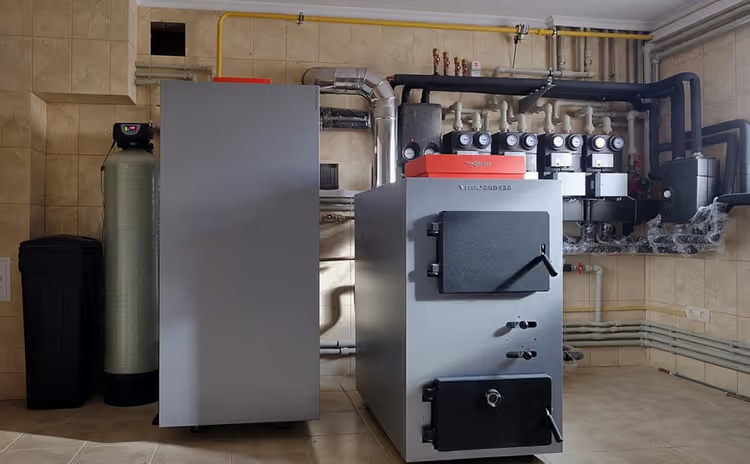
The first thing a buyer faces is fuel choice. And it's not a question of "what's better," but "what's available." If gas is connected to the property, go with gas and don't complicate things. If there's no mains supply, consider solid fuel, electric, or a combi option.
Gas boilers are the most common choice. High efficiency, operation without constant human involvement, capable of heating even a large area. Downsides: dependence on mains pressure. Gas pressure fluctuations wear out the burner and automation, and if there's a line failure, you're left without heating entirely.
Solid fuel: coal, wood, coke, pellets. Fully autonomous: not tied to gas or a stable electricity supply. But they require physical involvement: loading fuel every 4-8 hours, regular ash pan cleaning. And a chimney with fire safety measures is not an option, it's a mandatory requirement.
Electric: silent, eco-friendly, requiring no chimney or separate boiler room. A compact option for an apartment or small house. The main downside is electricity bills. And if there are power outages in winter, the house is left without both heat and hot water.
Diesel: economical in fuel consumption, but finicky to maintain: nozzles, diesel storage, odor. More of an industrial or backup scenario than a primary one for a residential house.
Combi: run on two or three fuel types and switch between them. You heat with wood during the day, and at night the automation switches to gas. Optimal for regions with an unstable supply of a single resource. The premium you pay for versatility pays off in reliability.
Capacity: why "1 kW per 10 m²" doesn't work
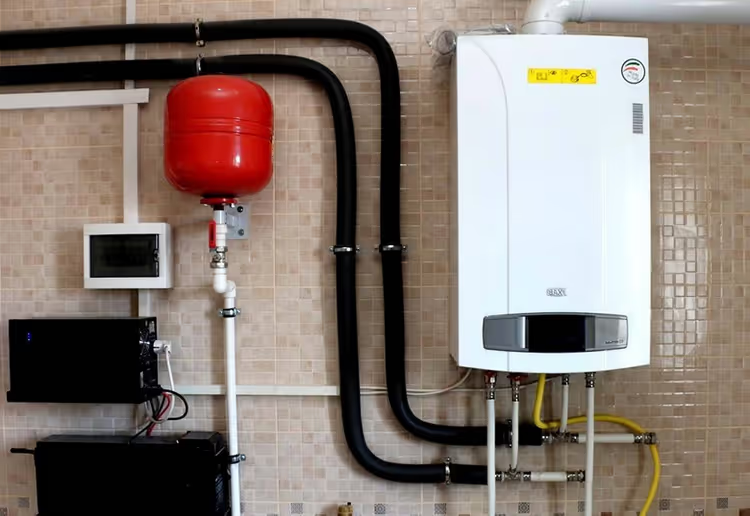
The simplified formula "1 kW per 10 square meters" has been copied from article to article for decades. It doesn't lie in the numbers, but it omits factors that turn a "calculated" boiler into cold radiators.
What actually affects capacity:
- Region. For the middle climate zone, the benchmark is 1 kW per 10 m². For northern latitudes, 1.5-2 kW for the same area. Southern regions, 0.7-0.9 kW.
- Ceiling height. The standard 2.5-2.7 meters is already factored into the formula. For ceilings of 3+ meters, multiply the result by a correction factor of 1.1-1.2.
- Insulation. Foam block or brick without insulation loses up to a third of heat through the walls. Quality thermal insulation reduces the required capacity by a fifth or more and pays for itself within one or two heating seasons.
Excess capacity beyond the calculated value is not insurance, it's a problem. A boiler with double the capacity operates in frequent on-off mode: short cycling reduces efficiency and accelerates wear. The optimal reserve is no more than a fifth above the calculated requirement. No more.
If you doubt your own calculations, order a heat engineering calculation from a specialist. It's a one-time expense that saves years of overpaying for gas or electricity.
Hot water supply: one circuit or two
A boiler heats more than just radiators. How hot water supply is organized determines the comfort of the entire family.
A single-circuit boiler works only for heating. For hot water, an indirect heating storage tank is connected to it, a separate 100-200 liter tank. Advantage: a reserve of hot water for several points simultaneously. Disadvantage: the tank takes up space, and heating it requires time after a standstill.
A double-circuit boiler heats water in a flow-through manner: you open the tap, heating starts. Compact, no tank. But the flow rate is limited: a 24 kW model delivers 9-11 liters per minute. This is enough for a shower and a kitchen tap simultaneously, but not for two bathrooms plus a dishwasher.
A practical rule: for an apartment or a house with one bathroom, a double-circuit boiler is sufficient. For a cottage with two bathrooms and the prospect of simultaneous use, a single-circuit boiler plus a storage tank. Yes, it's more expensive and takes more space, but saving on comfort here is questionable.
Pay attention to summer mode: a double-circuit boiler in summer heats only tap water without touching the radiators. This is a standard feature of modern models, but budget versions may lack it.
Efficiency, material, and brands: what to look at besides price
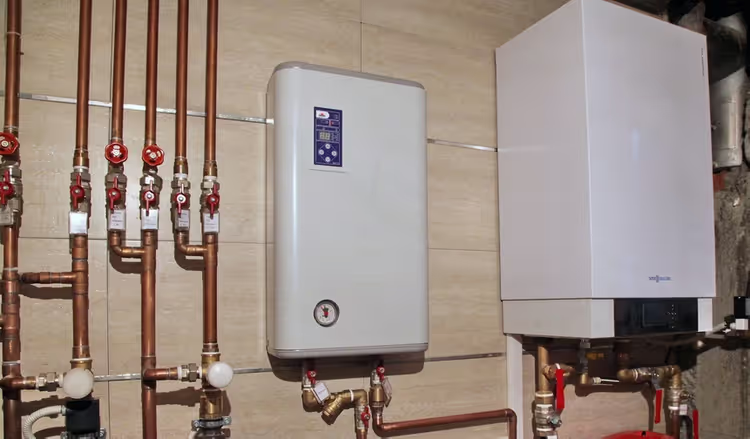
The boiler price is the tip of the iceberg. Service life and operating cost are determined by three things: efficiency, heat exchanger material, and automation.
Efficiency. Modern condensing gas boilers, according to their specifications, achieve maximum efficiency; almost all heat goes into the house, not up the flue. Conventional non-condensing models are noticeably inferior. Even a difference of a few percent over a heating season translates into thousands of hryvnias in savings. When choosing, look at models with high efficiency.
Heat exchanger material. Steel: the most affordable, last 10-15 years. Cast iron: heavy, more expensive, but last 25-30 years and are less prone to corrosion. Copper: lightweight, with high thermal conductivity, but sensitive to water quality. For hard water with impurities, cast iron is preferable.
Brands. Among gas boiler manufacturers, Bosch (German quality, extensive service network), Vaillant (global market leader in heating equipment, wide range of accessories), and Ferroli (Italian balance of price and quality, popular among Ukrainian consumers) consistently rank highly. Roda offers both gas and solid fuel models. The budget segment is represented by Chinese manufacturers, but here saving at the start can result in frequent service calls.
The position of connections also matters: boilers come with left, right, and universal connections. Clarify this point before buying; it affects the ease of installation in your boiler room or kitchen.
Installation: what to plan before buying
You've already chosen the boiler, but there's nowhere to put it. A typical situation if you didn't think ahead.
Separate boiler room or kitchen? A gas boiler with a capacity of up to 60 kW is allowed to be installed in the kitchen, provided the room volume and ventilation standards are met. Anything more powerful goes into a separate room with a window and supply ventilation.
A chimney is not just a pipe. For gas boilers with a closed combustion chamber, a coaxial chimney is suitable (pipe within a pipe: the inner one exhausts smoke, the outer one supplies air). For solid fuel, a full vertical chimney with good draft. An error in chimney calculation equals carbon monoxide in the house. You cannot cut corners on design here.
Control automation is an option that is becoming standard. Basic models turn on and off by thermostat. Advanced ones support remote control from a smartphone, programming by day of the week, and weather-compensated automation: the boiler itself adjusts the supply temperature depending on the weather outside. For an apartment, a minimal set is enough. For a house, take a closer look at models with remote access: arriving at a cold house after a week's absence is a dubious pleasure.
A clear breakdown of boiler selection criteria in one video: fuel, type, size.
⁉️🤔 Frequent questions
Which boiler is the most economical?
In terms of total cost of ownership, a gas condensing boiler: its rated efficiency is noticeably higher than a conventional one, and the difference pays off in 2-3 heating seasons at current tariffs. If there is no gas, a pellet solid fuel boiler: automatic feed, high and stable combustion, minimal manual labor.
Can I install a boiler myself?
Gas: no. Connection to the mains is performed only by a certified specialist with a permit. Unauthorized installation means a fine and disconnection. An electric or solid fuel boiler can be installed with your own hands, but chimney design and electrical connection are best left to a professional. A chimney mistake costs your health.
Which is better: a boiler or a heat pump?
A heat pump is more efficient in the long term (COP 3-5 versus efficiency of 0.9-0.98 for a boiler), but requires significant initial investment and a well-insulated house. For Ukrainian realities with accessible gas, a boiler is still more pragmatic. A pump makes sense for new construction with underfloor heating and a low-temperature heating regime.
How often does a boiler need servicing?
Gas: once a year before the heating season: burner cleaning, automation and chimney check. Solid fuel: ash pan cleaning every 2-3 days, chimney once a season. Electric: the most "lazy" one: a preventive inspection every 2-3 years. Neglecting maintenance noticeably reduces efficiency and shortens service life.
What capacity reserve should I take?
No more than a fifth above the calculated heat loss. A double reserve forces the boiler to short cycle: frequent on-off switching wears out the automation and reduces efficiency below the rated value. If the calculation shows 20 kW, take 24 kW, not 35.
Which boiler to choose: the final breakdown
There is no universal "best boiler." There is a correct choice for your specific inputs.
If gas is connected to the house, take a gas condensing boiler with high efficiency. A double-circuit one for an apartment or small house, a single-circuit one plus a storage tank for a cottage with two bathrooms.
If there is no gas but wood or coal is available, a solid fuel steel or cast iron boiler with a reserve in firebox volume. A pellet version with auto-feed eliminates the issue of constant loading but requires space for a hopper.
If the house is small and well-insulated, an electric boiler as the primary or backup. With a night-time electricity tariff, it becomes noticeably cheaper to operate.
Before going to the store, calculate heat loss (don't be lazy: it pays off), check where the boiler will go, and plan the chimney. These three points, done before buying, save nerves and money afterward. And what type of boiler do you have and how many seasons has it worked? Tell us in the comments.

A professional team of writers and editors specializing in creating quality content.