













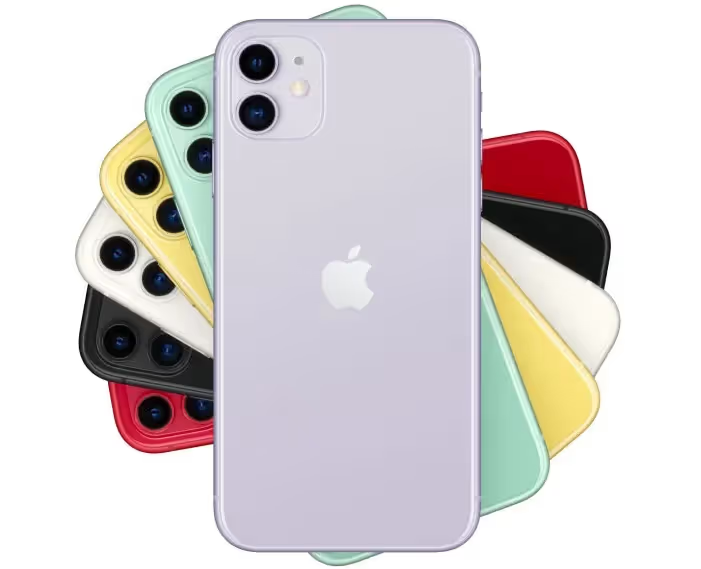
📱 IPhone 11 128GB in 2026: is it worth buying and who will it be enough for
Buying an iPhone in 2026 at the price of a budget Android smartphone and still getting 2-3 years of normal use. Sounds like a scam, but that's exactly what's happening with the iPhone 11. Six years after its release, the phone is still selling on the secondary market and handles everyday tasks without throwing a fit.
The problem is that reviews from three years ago paint a rosy picture of a flagship, while the reality of 2026 is a compromise. Let's break down exactly where that line is and for whom this compromise makes sense.
💡 Quick overview:
- Who it's for: those looking for an affordable iPhone for calls, messaging, YouTube, and casual photos, not for a blog.
- Performance: the A13 Bionic + 4 GB RAM keep iOS smooth, but demanding games and pro apps are already at their limit.
- Cameras: two 12 MP sensors without a telephoto, but with night mode and 4K video, good enough for social media.
- Battery life: up to 17 hours of video, but on a used device the battery capacity is rarely close to factory spec; it lasts a day, no more.
- Main downside: no 5G, LCD display, mono sound. In 2026, you feel it.
Design and display: what you get for your money

The iPhone 11 is Apple's last "classic" iPhone with rounded edges and an aluminum frame. No oversized slab, 150 grams, sits comfortably in the hand. The back is glass and supports Qi wireless charging. Available in six colors; white shows fingerprints the least.
The display is a 6.1-inch Liquid Retina. Essentially, it's an LCD with a resolution of 1792×828 pixels and a density of 326 ppi, Apple specifications. No OLED, no 120 Hz, no Always-On. On paper, a compromise. In practice, it's bright, color accuracy is solid, and text is perfectly readable. The only thing you really miss is deep blacks in dark interfaces. You get used to it in a day.
On the plus side, Face ID works lightning fast; the TrueDepth sensor is the same as in the iPhone 11 Pro. Face unlock even in dim light, with no lag. The IP68 rating means you can drop the phone in water up to 2 meters deep for 30 minutes, tested by more than one rainstorm and more than one sink.
A13 Bionic performance in 2026
The A13 Bionic is a 7nm chip with six cores: two high-performance Lightning and four energy-efficient Thunder. At launch, it crushed the competition. Today, in 2026, it's at the level of a mid-range budget phone.
iOS 19 (and the apps that come with it) has become heavier than iOS 13 was in 2019. Simple scenarios, Safari, Telegram, YouTube, Apple Music, run smoothly. Heavy games like Genshin Impact run at medium settings with dips to 30 fps. Professional 4K video editing in iMovie is possible, but rendering demands patience.
4 GB of RAM is the bottleneck. Apps get kicked out of the background more often than you'd like: open the camera, and your messenger restarts. For an everyday user, it's annoying but not a dealbreaker.
A hands-on test on YouTube confirms it: with a new battery and the latest firmware, the phone remains usable. The video's creator spent a month using the iPhone 11 as their primary device in late 2025, and the conclusions match ours: fine for the basics, but you need a newer device for anything more.
Camera system: two, but enough
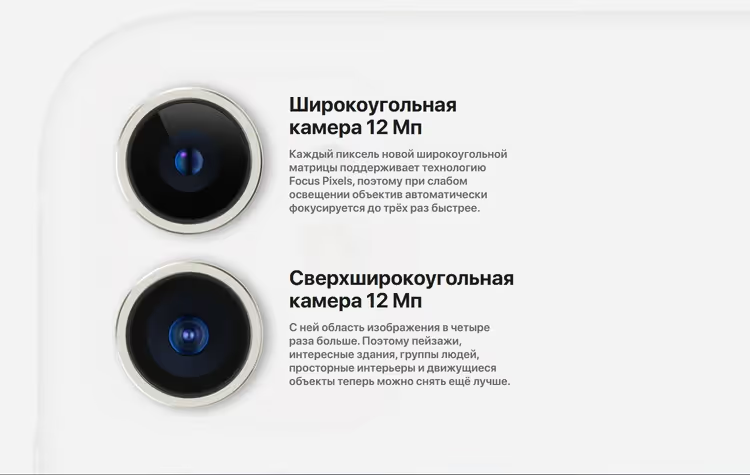
Two 12 MP modules: wide (f/1.8, optical stabilization) and ultra-wide (f/2.4, 120°). No telephoto; portrait mode is software-based, via machine learning.
What works well:
- Daytime photos: high detail, natural colors, wide dynamic range. Almost no signs of over-sharpening.
- Night mode: activates automatically in the dark, holds exposure for 2-3 seconds. The result is a lit frame without blur (if your hands are steady).
- 4K 60 fps video: smooth picture, cinematic stabilization. More than enough for family archives and social media.
What's missing: optical zoom (digital zoom only, quality drops), RAW capture, LiDAR for night portraits. But if you're not a blogger or a photographer, the difference from an iPhone 15/16 in everyday shots will only be noticeable in a side-by-side comparison.
Battery life: still lasts a day

From the factory, the iPhone 11 came with a 3110 mAh battery, rated by Apple's data for up to 17 hours of streaming video and up to 65 hours of music. In 2026, the battery of a used device is almost certainly degraded.
With the remaining capacity typical of a three-to-four-year-old phone, you get:
- A full workday in mixed use (calls, messaging, an hour of YouTube, navigation).
- Very little charge left by evening; you'll need a top-up during the day with active use.
- A battery replacement at a service center costs about the same as a couple of movie tickets and restores battery life to factory specs.
Charging: the included adapter is 5 W (slow), but the phone supports 18 W fast charging via USB-C/Lightning, per Apple's specification 50% in 30 minutes. Qi wireless charging at 7.5 W is perfect for overnight charging.
Who should buy an iPhone 11 today
The iPhone 11 in 2026 is a conscious compromise. Here are the scenarios where it makes sense:
- A first iPhone for a child or an elderly relative. Cheap, reliable, iOS updates are still coming. If they break it, it's not as painful as a 16-series model.
- A second phone for work or travel. Compact, durable, with a good camera for documents and navigation.
- Switching from Android without blowing the budget. For the price of a decent Android budget phone, you get the Apple ecosystem: iMessage, FaceTime, AirDrop, seamless integration with Mac and AirPods.
- A temporary solution. Buy it now while you save for a flagship, then sell it later for most of what you paid; the iPhone 11 holds its value on the secondary market.
And here's when you should NOT buy it:
- You take photos for a blog or social media professionally; there's no telephoto and no RAW.
- You play demanding games for hours; the heat and fps drops will frustrate you.
- You live in a region where 5G is already the standard and 4G is being phased out; the iPhone 11's LTE-only modem will be a bottleneck.
- You're not willing to live with an LCD and mono sound; Android competitors offer OLED and stereo at this price.
⁉️🤔 Common questions
Will the iPhone 11 support iOS 20?
There's a high probability that iOS 19 will be the last major version for the iPhone 11. Apple typically provides 6-7 years of updates, and the 2019 model is approaching that milestone. Security patches will continue for another 1-2 years after major updates stop.
Plan on iOS 19 as the final version with full support. If new iOS features are critical for you, look at the iPhone 13 and newer. If stable operation of your current apps is enough, an iPhone 11 on iOS 19 will serve you for another 2-3 years.
How is the iPhone 11 different from the iPhone 12?
There are three main differences: the 12 has an OLED display instead of LCD, 5G support, and a design in the style of the iPhone 4/5 with flat edges. The A14 chip is slightly faster than the A13, but in everyday use the difference is barely noticeable. The cameras are similar; the 12 has a better night mode. The price on the secondary market differs by $70-100, which is the deciding factor for many.
If your budget allows, get the iPhone 12 for the OLED and 5G. But if that $100 difference matters to you, the iPhone 11 won't feel like a poor relation; it gets the job done.
Is 128 GB enough in 2026?
Yes, for most scenarios. The system takes about 15 GB; photos and videos in iCloud save space. Without the cloud, 128 GB holds roughly 25,000 photos or 40 hours of 4K video. If you shoot a lot of video and don't use the cloud, look at 256 GB on newer models.
For a typical user who stores photos in iCloud, streams music, and doesn't keep movies on the phone, 128 GB is a comfortable amount with headroom for 2-3 years ahead.
Where is the best place to buy an iPhone 11 in 2026, new or used?
New iPhone 11 units are almost nonexistent in official retail. The main market is resale: trusted sellers on the secondary market, Apple's refurbished programs, major retailers with display models. When buying used, check three things: battery health (no lower than 85%, Apple's recommendation), no iCloud lock, and an original display. A non-original screen replacement kills True Tone and worsens battery life.
Buy from a seller with a return policy and a warranty of at least 14 days. That's enough time for the battery and overall condition to become clear. Avoid gray-market lots with a locked iCloud; that's a brick.
Is it worth replacing the battery on an old iPhone 11, or is it easier to buy a new phone?
A battery replacement extends the phone's life by 1.5-2 years. If the other components are fine and the performance is sufficient, a replacement is more cost-effective than buying a new device. Replacing the whole phone makes sense only if you simultaneously need more battery life, a better camera, a better screen, and 5G, meaning you've outgrown the iPhone 11 functionally.
Replace the battery when its capacity drops below 80% (the phone will warn you in Settings, Apple's threshold). This gives the device a second life for reasonable money, the best way to postpone an expensive purchase by a year or two.
Verdict: buy an iPhone 11 in 2026 or pass?
The iPhone 11 128 White is not about technology and not about "impressing your friends." It's about a pragmatic choice: a decent phone for little money that won't let you down in basic scenarios. The A13 still holds up, the cameras shoot respectably, and the battery lasts a day after a replacement.
Don't expect miracles. The screen is LCD, the modem is LTE, the sound is mono, and the charging is not MagSafe. In 2026, these are compromises you either accept and live with, or you pay extra for an iPhone 13/14 and forget about them.
In short: if you need an affordable iPhone for real life, not for showing off, get the 11 with 128 GB, replace the battery, and use it for another 2-3 years. If you need a better screen, 5G, and a power reserve for the future, save up for the 13 and above.

A professional team of writers and editors specializing in creating quality content.