













📱 IPhone XS Max glass replacement: when regluing is more profitable than a new display
You dropped your iPhone XS Max, and a spiderweb of cracks spread across the screen. First thought: "That's it, the whole display needs replacing, this is going to be expensive." But don't panic yet: in most cases, only the glass is broken, while the OLED panel and touch sensor are still intact. That means the repair will cost 2-3 times less than a full module replacement.
The catch is that since the iPhone 4, Apple stopped making displays with an air gap: the glass, touch layer, and OLED panel are now bonded into a single module. Separating the glass without damaging the pixels is a job for a professional with the right equipment. In service centers, this is exactly the service they call iPhone XS Max glass replacement. Below, we'll break down how the display is built, when glass-only repair is feasible, and what stages the screen restoration goes through in a repair shop.
💡 Quick overview:
- Understand the XS Max display structure and why the glass can't be removed manually
- Check four signs that only the glass is broken, not the entire module
- Learn the four stages of professional glass-only repair: from the hot-plate separator to the pressure chamber
- Compare the cost of glass replacement with other repair options in 2026
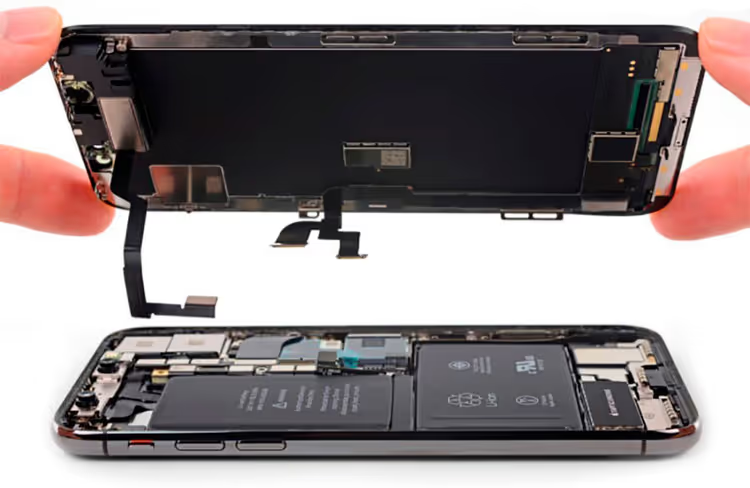
How the iPhone XS Max display is built and why the glass can't be separated manually
The iPhone XS Max display is a 6.5-inch Super Retina OLED panel with a resolution of 2688×1242 pixels. It's not just a "screen" but a layered sandwich of five components:
- Protective glass, the top layer that takes the impact when dropped.
- Touch layer (digitizer), which recognizes touches. Bonded to the glass with transparent OCA optical adhesive.
- Polarizer, which reduces glare and improves sunlight readability.
- OLED panel, the self-emissive pixel layer that forms the image.
- Rigid substrate with the display controller.
Starting with the iPhone 4, all these layers are bonded into a monolithic block; there is no air gap between the glass and the OLED panel. That's precisely why "heat it with a hair dryer and pry it with a blade" doesn't work: the blade catches the polarizer or the pixels, and the panel is ruined. Back in 2010, when there was an air gap between the glass and the screen, that trick still worked. Now, it doesn't.
How to tell if only the glass is broken, not the entire module
Before taking your phone to a technician, you can assess the nature of the damage in a couple of minutes. Here are four signs that the OLED panel is intact and glass-only repair is possible:
- Image has no defects. No green or pink lines, dead pixels, spots, or flickering. The picture is sharp across the entire area.
- Touch works everywhere. Swipe your finger across all corners of the screen; there are no dead zones, phantom touches, or lag.
- No "ink" stains. Dark, spreading blotches under the glass are a sign of OLED layer damage. That means module replacement only.
- Face ID functions. The drop didn't damage the front camera and sensors in the notch. Test face unlock before visiting the service center.
If even one of these points fails, glass-only repair won't cut it; you need a full display assembly replacement. Before starting work, a reputable service center always runs diagnostics: they connect the module to a test board and check the panel, touch, and backlight individually.
How professionals do glass-only repair: 4 stages
Glass-only repair is not a "remove and stick back on" job; it's microsurgery with micron-level precision. In repair shops, the process is broken down into four stages, each with its own equipment.
Stage 1: Glass separation on a hot-plate separator
The technician secures the module on a vacuum separation table. The separator chamber is heated to 80-90°C, just enough to soften the OCA adhesive without damaging the polarizer. An ultra-thin molybdenum wire (0.04 mm) passes between the glass and the OLED panel, slicing through the adhesive layer. The process takes 15 to 30 minutes for the XS Max; the large display requires extra care along the edges where the flex cables run.
One awkward move, and the touchscreen flex cable is torn. On models with Face ID, the flex cables run right under the top edge of the glass, so the technician navigates this zone at the wire's minimum feed speed.
Stage 2: Cleaning the OLED panel of adhesive residue
After separation, a layer of old OCA adhesive remains on the panel. It's cleaned off in a dust-free chamber or laminar flow hood: the tiniest speck of dust between the glass and the panel will cause a bubble or spot on the finished screen. Using cotton swabs and isopropyl alcohol, the technician manually removes the adhesive across the entire surface; this is the most painstaking part of the job, taking up to 40 minutes.
Stage 3: Laminating the new glass
A new layer of liquid OCA adhesive is applied to the cleaned panel, or a ready-made OCA film is laid down. A new protective glass is placed on top, with the identical 2.5D curved edges of the XS Max. The assembly is placed in a laminator: under pressure and heat, the adhesive spreads evenly, leaving no voids. Then, into the UV chamber: UV radiation cures the adhesive in 3-5 minutes.
Stage 4: Pressure chamber and seal check
The bonded module is placed in a pressure chamber, a sealed container where 4-5 atmospheres of pressure are created. Under pressure, any remaining micro-bubbles of air "collapse" into an imperceptible point. After this, the technician checks backlight uniformity, color rendition, touchscreen response, and Force Touch functionality (the XS Max has it). The final touch is installing a new moisture-resistant gasket around the perimeter. The factory IP68 rating is not fully restored after opening, but a fresh gasket provides protection against splashes and dust.
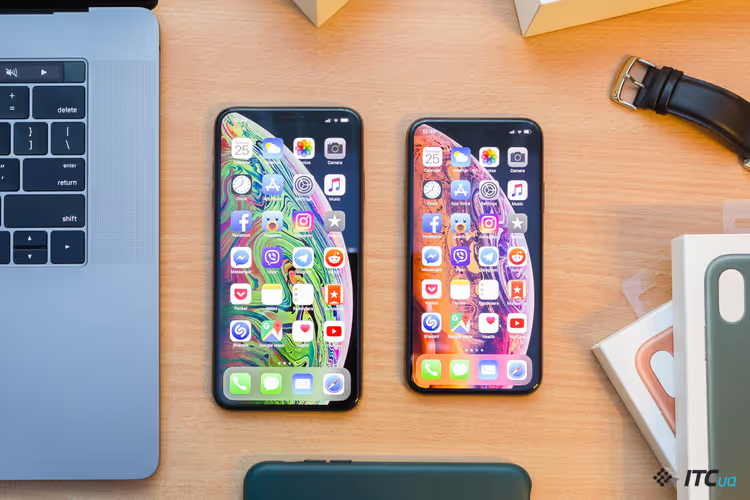
A shop repair usually takes one to two hours, and you get your iPhone back with the original OLED panel, new glass, and working Face ID. No "DIY" method will deliver this result: damaging the panel during a self-repair attempt is almost inevitable.
How much does iPhone XS Max glass replacement cost in 2026
The price depends on three factors: who does the work, in which city, and how badly the module is damaged. Here's the current landscape for Ukraine:
Option | Price (approximate) | Pros | Cons |
|---|---|---|---|
Glass replacement (glass-only repair) at a service center | from 1500 to 3500 UAH | Original OLED panel is preserved, price is 2-3 times lower than a module | Not always possible (see signs above) |
Display module replacement at a service center | from 4000 to 7000 UAH | Faster, suitable for any damage | More expensive; module may be a copy, not original |
Apple Authorized Service | ~$279 (≈11,500 UAH) | Guaranteed original, 90-day warranty | Highest price, waiting line |
Buy a display and replace it yourself | from $35 (part) | Minimal material cost | No warranty, risk of damaging flex cables, Face ID cannot be calibrated without a programmer |
The difference between glass-only repair and module replacement is significant: savings from 1500 to 4000 UAH. But if the OLED panel is damaged, you have no choice but to go with the module. Before paying at a service center, always clarify exactly what warranty they offer: for glass-only repair, 30-90 days is standard; for a module, up to 180 days.
If the phone is over 3-4 years old and the repair cost approaches half its current value, it might be wiser to sell the device and put the money toward a newer model. But if the OLED panel is alive and the crack is only in the glass, glass-only repair is definitely the better deal.
⁉️🤔 Frequently asked questions
Can I replace the iPhone XS Max glass myself?
No, without professional equipment, this is practically guaranteed to destroy the OLED panel. Even in YouTube videos, technicians work on separators with a vacuum table, not with "a hair dryer and a blade." Temperature control, wire tension, cleanliness in a laminar flow hood: all of this is impossible to replicate at home. Out of dozens of DIY attempts described on iFixit forums, successful ones are rare, and those were on older models like the iPhone 6.
How long does a screen last after glass-only repair?
Properly bonded glass with new OCA adhesive and factory-standard curing lasts no less than the original: 2-3 years of active use. The weak point is not the glass but the adhesive seam: if the technician skimped on adhesive or skipped the pressure chamber, micro-bubbles and delamination appear along the edges after 3-6 months. That's why the warranty on the work is just as important a criterion for choosing a service center as the price.
Is the IP68 water resistance restored after glass replacement?
Fully, no. The factory perimeter adhesive and connector sealing are disrupted when the housing is opened, and replicating the factory process outside of Apple's assembly line is impossible. A service center installs a new adhesive gasket that provides protection against splashes and dust, but you shouldn't submerge the phone in water after the repair.
What should I do if backlight bleeding or spots appear after glass replacement?
Return to the service center immediately. Backlight bleeding along the edges is a sign of poor glass adhesion or residual stress after lamination. Dark spots mean dust got between the layers (skimping on the dust-free chamber). Yellow spots indicate the OLED panel was overheated during separation. In a quality service center, all of these are warranty cases and are redone free of charge.
Does it make sense to repair an iPhone XS Max in 2026?
If the OLED panel is intact and the phone meets your needs for speed and battery life, then absolutely yes. The XS Max on the A12 Bionic handles everyday tasks without noticeable lag, the camera shoots in 4K, and the OLED display is on par with many modern models. The cost of glass-only repair (1500-3500 UAH) is incomparable to the price of a new iPhone. But if, in addition to the glass, the battery is noticeably worn and there is other damage, it might be time to start looking at a replacement.
Glass or module: the final verdict
In short: a crack in the glass is not a death sentence for the display. If the image is sharp, the touch is responsive, and Face ID is alive, in most cases you need glass-only repair, not a module replacement. This will save you from 1500 UAH and preserve the original color accuracy of the OLED panel.
The key is to choose a service center with transparent diagnostics and a warranty on the work. Glass is bonded using equipment, not "on a kitchen table": a hot-plate separator, laminar flow hood, UV chamber, and pressure chamber. Find out if the technician has all of this before you leave your phone.
If you've had the glass replaced on your iPhone, write in the comments how long the screen lasted after the repair and whether glass-only repair was worth it.

A professional team of writers and editors specializing in creating quality content.