













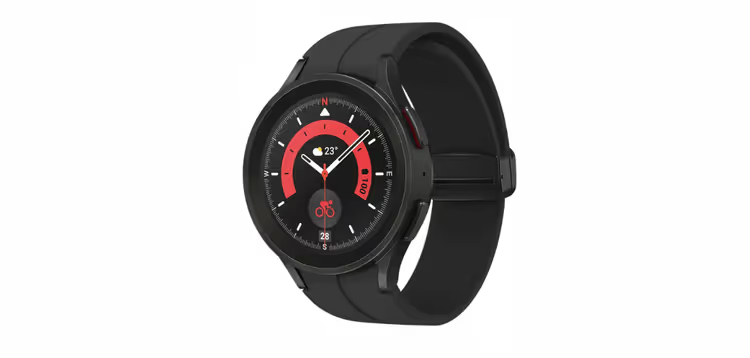
⌚ Popular smartwatch features: what wearable devices can do in 2026
Smartwatches have stopped being a niche gadget for geeks. Today they are a full-fledged wearable computer that gives you access to notifications, health, music, and home control in a couple of taps, all from your wrist, without taking out your phone.
The problem is that many users only use a small fraction of their watch's capabilities: read a notification, checked the time, counted steps. Meanwhile, even budget models can do many times more.
Below, a breakdown of key features that turn a smartwatch from a passive accessory into a true hub of daily life.
💡 Quick overview:
- Track physical activity: steps, heart rate, SpO2, and dozens of workout modes right on your wrist
- Take calls and read messages without pulling your smartphone out of your pocket
- Change watch faces and bands in seconds: sports, office, evening, sleep
- Listen to music through wireless earbuds without your phone, on a run or at the gym
- Control your smart home: lights, climate, cameras, and locks with a single tap
Activity and health tracking
The main feature many people buy a smartwatch for is real-time body monitoring. Built-in accelerometer, gyroscope, and optical heart rate sensor collect data continuously, and the phone app compiles it into charts and trends.
The basic set, available even in budget models: step counting, distance covered, calories burned. Mid-range models add 24/7 heart rate monitoring with alerts when it goes outside normal limits, blood oxygen level (SpO2), and sleep tracking by phases.
Flagship models, for example, a Samsung smartwatch with the BioActive biosensor, add ECG, blood pressure measurement, and body composition analysis. A watch does not replace a doctor, but it gives an early signal: chronically elevated heart rate, consistently fragmented sleep, oxygen below normal, that is a reason to book an appointment with a specialist, not to ignore it.
A separate plus is automatic workout detection. You start running, the watch automatically activates running mode; you start swimming, it records your stroke and distance. Models with GPS record your route track without a phone, which is critical for runners and cyclists.
Smart notifications: a communication hub on your wrist
A smartwatch takes on the role of a filter for the incoming stream. A call, a message, a calendar event, you see the sender and the gist at a glance, without pulling out your phone. This is especially valuable when driving, in a meeting, or when your hands are full.
Models with a microphone and speaker let you answer a call directly from the watch. Microphone quality has improved so much that the other person does not always realize it is a "watch call." Support for voice assistants, Google Assistant, Bixby, Siri, adds hands-free scenarios: "set a timer for 10 minutes," "what's the weather for tomorrow."
An important nuance is notification settings. If you leave everything enabled by default, the watch turns into vibration spam. The right approach: keep calls, messengers, and calendar, disable the rest. Then the watch becomes a quiet assistant, not another source of noise.
Style and personalization
Modern smartwatches are also a fashion accessory. Manufacturers have long moved on from the "plastic box on a strap": metal cases, sapphire crystal, ceramic bezels, watches look respectable with a suit and with casual clothes alike.
Interchangeable bands solve the context problem. Silicone for workouts and an active day, leather or a Milanese loop for the office, woven nylon for sleep (it is lighter and does not chafe). Swapping takes 10 seconds: most models use a standard quick-release mechanism.
Watch faces are a whole world of customization. From classic analog hands to information dashboards with weather, heart rate, and calendar on one screen. Users change the watch face to suit the situation: a minimalist analog for a meeting, data-rich for a workout, clean and simple for the evening. Watch face stores (Galaxy Store, Google Play) offer thousands of options, including premium ones from watch brands.
Music and audio without your phone
The ability to listen to music without a smartphone is one of the most underrated smartwatch features. You connect wireless earbuds, load a playlist onto the watch's storage (ranging from 4 to 32 GB depending on the model), and head out for a run with just the device on your wrist.
Scenarios where this wins: a run or cycling workout (no phone bouncing around in your pocket), swimming laps with waterproof earbuds, walking the dog when you do not want to carry anything extra. For streaming, Spotify, YouTube Music, and Deezer support offline mode on Wear OS and watchOS.
Some models go further: a built-in speaker lets you play music or a podcast "out loud," say, as background at a picnic or when you are cooking and want to listen to the news without earbuds. The volume is enough for a small room.
Smart home on your wrist
Smartwatches increasingly act as a remote control for the smart home ecosystem. Owners of Google Home, Apple HomeKit, Samsung SmartThings, or Amazon Alexa devices can control their home right from their wrist, without a phone or nearby smart speakers.
Real use cases: turn off the lights in the entire apartment before sleep without getting out of bed; lower the blinds with a single button press; check the front door camera when the doorbell rings on your watch; adjust the thermostat without putting down your book. For parents, quickly turn on white noise in the nursery via the watch app, without entering the room and risking waking the child.
Compatibility depends on the ecosystem: Apple Watch is tightly integrated with HomeKit, Wear OS watches with Google Home, Galaxy Watch with SmartThings. But even within a single ecosystem, the coverage is impressive: lights, outlets, thermostats, cameras, door locks, robot vacuums, dozens of devices are controlled with a tap on the watch screen.
In the video above, a visual overview of key features of modern smartwatches and a comparative breakdown of models hitting the market this year.
⁉️🤔 Frequent questions
Do I need a smartwatch if I already have a fitness band?
A smartwatch gives you a larger screen with a full interface, app installation, answering calls and notifications by voice or text, GPS without a phone, and music storage. A fitness band is a data "reader": it shows, but does not control. If you only count steps, a band is enough. If you want to reply to messages, listen to music, and control your home, you need a watch.
What is the battery life of modern smartwatches?
Most models with a color Always-On display last 1-2 days (Apple Watch, Galaxy Watch, Pixel Watch). Models with a simplified display like Amazfit or Huawei can last a week or more. Actual consumption heavily depends on the Always-On Display and constant GPS: with AOD off and no workouts, many watches stretch to two full days; with it on, they require charging every night.
Can I swim with a smartwatch?
Most modern models with a 5 ATM or IP68 rating are designed for pool and open water swimming. Apple Watch, Galaxy Watch, and Garmin automatically recognize your swimming stroke and count distance. But before diving in, make sure the band is also water-resistant, a leather band is irreversibly damaged by water. And after saltwater, rinse the watch with fresh water: salt corrodes the seals.
Which smartwatch should I choose for an elderly person?
Key criteria: a large and bright screen, fall detection with automatic emergency calling, long battery life without daily charging, heart rate and ECG measurement. Apple Watch with Family Setup is good for the iPhone ecosystem, Samsung Galaxy Watch for Android. Among specialized models, Garmin with button controls and up to two weeks of battery life on a single charge.
Do smartwatches work without a phone nearby?
Yes, to varying degrees. Models with LTE (eSIM) are fully autonomous: calls, messages, music streaming, and navigation work without a phone. Models without LTE lose connectivity for calls and messages, but retain: playback of music loaded onto storage, workout recording with GPS, payments (Google Pay / Apple Pay work offline), alarms, and timers. So as a fitness tracker and music player, they always work.
What to get for your needs
A smartwatch makes sense not "in general," but for a specific scenario. If your main goal is sports and health: look at models with GPS, an accurate heart rate monitor, and long battery life (Garmin, Coros). If you need a "phone on your wrist" with LTE and apps, Apple Watch or Galaxy Watch in the eSIM version. If style and customization matter, choose models with a standard band lug width (22 mm or 20 mm) and an active watch face store.
The main thing is not to overpay for features you will not use. A flagship with ECG and LTE is useless if you only need the watch for step counting and viewing notifications. Start with an honest list of three scenarios you truly need, and pick a model to match them.

A professional team of writers and editors specializing in creating quality content.