













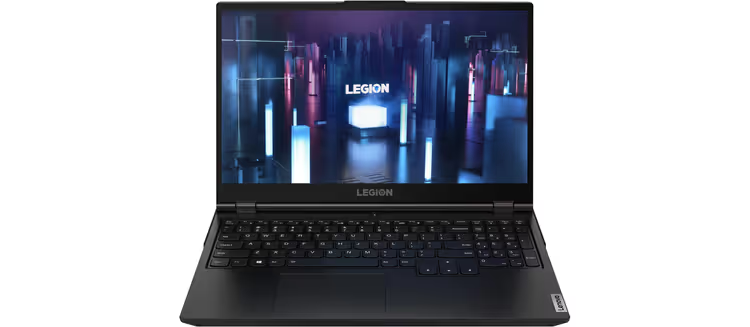
🚀 Three reasons to buy Lenovo Legion 5
A gaming laptop for reasonable money is always a compromise. Skimp on the chassis and you get creaky plastic. Skimp on the screen and lag plus washed-out colors start hurting your eyes within an hour. Skimp on the processor and your shooter turns into a slideshow on minimum settings.
The Lenovo Legion 5 broke that axiom. The series that started as "just another gaming laptop" has, by 2025, become the benchmark for the mid-range segment. Thinner than its predecessors, lighter than its competitors, and with hardware that handles AAA titles on high settings without throttling.
We broke down the specs of the current generation and identified three reasons why the Lenovo Legion 5 remains one of the most sensible choices for a gamer who knows how to count their money.
💡 Quick overview:
- Check the processor: 8 cores, 16 threads, and up to 5.1 GHz without throttling
- Check the display: 165 Hz IPS panel with factory calibration and 300 nits brightness
- Weigh the chassis: 1.9 kg with an aluminum lid and 180-degree hinge
1. A processor that asks no quarter
The current Legion 5 Gen 10 lineup is built on AMD Ryzen processors, the Ryzen 7 260 and Ryzen AI 7 350. Both chips use a 4nm process, have 8 cores and 16 threads, and in turbo mode climb past 5 GHz. For a gaming laptop that means exactly one thing: the processor does not become a bottleneck even when paired with an RTX 5070.
Paired with GeForce RTX 5050, 5060, or 5070 graphics cards (8 GB GDDR7), the laptop delivers a stable 60+ fps in Cyberpunk 2077 on high settings and over 100 fps in esports titles like CS2 and Valorant. And all without overheating: the two cooling fans keep temperatures in the 80-85 °C range under a stress test.
The 165 Hz refresh rate deserves a special mention. For shooters and battle royales, where decisions are made in milliseconds, the difference between 60 and 165 Hz is the difference between "you got them" and "your corpse is already being looted." The panel is responsive, response time is minimal, and there is no ghosting trailing your crosshair.
Watch a video review of the current Legion 5 Gen 10 model for a hands-on look at performance, display, and build quality.
In games, the picture stays sharp even in fast-paced scenes, with no tearing or smearing thanks to the combination of 165 Hz and G-Sync.

2. Weight and chassis: engineering respect
The first thing that surprises you about the Legion 5 Gen 10 is how genuinely light it is. Just 1.9 kg for a 15.1-inch gaming laptop with a discrete GPU. For comparison, its predecessors weighed close to 2.4 kg, and many competitors still cannot slim down below 2.2 kg today.
The secret is in the materials. The lid is aluminum, rigid, and does not flex under your fingers. The keyboard deck and bottom panel are quality matte plastic with a texture that hides fingerprints. None of that glossy nightmare that looks like a forensics exhibit after a week. The island-style keyboard has a full numpad and customizable backlighting, equally comfortable for typing and gaming.
Lenovo kept one of the series' best features: the 180-degree hinge. The hinge is sturdy, has no play, and the screen can be laid flat if you work standing up or need to show something to a colleague across the desk. A small thing, but it is the kind of small thing you quickly get used to and then find inconvenient to live without.
The dimensions have also been tightened up: 345 × 255 × 20-21.5 mm, roughly a centimeter narrower and a couple of millimeters thinner than the previous generation. It slips into a backpack with no trouble, and the 170-245 W power brick does not overload your bag.
3. Display: an honest picture with no compromises
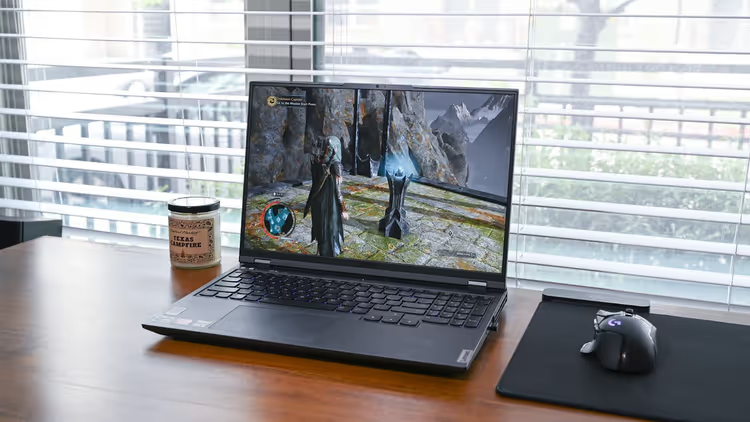
The Legion 5 Gen 10 comes with a 15.1-inch IPS panel in a 16:10 aspect ratio. Resolution is 1920 × 1200 in the base config or 2560 × 1600 in the top-tier configuration. Not 4K, but for a 15-inch diagonal it is the sweet spot: enough pixels without making the GPU struggle.
Color gamut is 100% sRGB. That is more than enough for gaming: colors are natural, without the acidic oversaturation that plagues some "gaming" panels. White is actually white, black is deep, with no gray veil in the corners. Brightness headroom is 300 nits, an average figure for the market. In direct sunlight the screen does have glare (the coating is matte, but not premium anti-glare), but indoors and during night sessions your eyes do not get tired even after 3-4 hours.
The 165 Hz refresh rate combined with G-Sync support delivers a smooth, tear-free picture. In fast-paced scenes, drifting in Forza Horizon 5 or sprinting through Hogwarts Legacy, the image stays sharp with no smearing. For esports, the refresh rate headroom is more than sufficient.
The panel impresses with its viewing angles: at 45 degrees, colors barely shift. This matters if you occasionally play two-player on one screen or watch a movie while leaning back in your chair.

⁉️🤔 Common questions
Is the Lenovo Legion 5 suitable for work, not just gaming?
Yes, and it does quite well. The Ryzen 7 260 processor with 8 cores and 16 threads handles code compilation, rendering, and running a dozen browser tabs in parallel. The 16:10 screen adds vertical space for documents and spreadsheets. The only caveat is the battery: it lasts an hour to an hour and a half while gaming, and 5-6 hours in office mode. That is a bit short for a full workday away from an outlet.
How loud is the Legion 5 under load?
Under a stress test, the noise level reaches 50 dB, which is comparable to background office air conditioning. In everyday scenarios (browser, documents, YouTube), the fans are nearly inaudible. You can hear them while gaming, but without the high-frequency whine that is more irritating than the volume itself.
Can you upgrade the RAM and storage?
Yes. The Legion 5 Gen 10 has two DDR5 slots with a maximum capacity of 64 GB and two M.2 NVMe PCIe Gen 4.0 slots. Replacement requires no soldering: you remove the bottom cover and get direct access to the slots. The stock configuration starts at 16 GB and 512 GB, which is enough for most games.
Should you get the RTX 5070 version or is the RTX 5060 enough?
It depends on your games. The RTX 5060 confidently handles AAA titles on high settings at 1080p, and according to Notebookcheck tests, you get a stable 60 fps in most titles. The RTX 5070 provides a 15-20% boost and comfortable 60 fps at 1440p. If you plan to connect an external 2K monitor or play with ray tracing, the premium for the 5070 is justified.
How does the Legion 5 stack up against competitors like the Acer Nitro and ASUS TUF?
The Legion 5 stands out from the Acer Nitro and ASUS TUF with its more premium build: an aluminum lid instead of plastic, plus a panel with full sRGB coverage, which is not always found in the competitors' base configurations. In terms of raw performance within the same price bracket, the difference is minimal. The Legion's main compromise is the lack of Thunderbolt: Intel-based competitors have it.
Is the Lenovo Legion 5 worth buying in 2026?
The Legion 5 addresses the three most painful points of the budget gaming segment: a weak processor, a cheap chassis, and a mediocre screen. Lenovo has produced a laptop where you do not need to qualify your opinion with "well, it is decent for the price." It is simply decent, with no price-related disclaimers needed.
If your budget is tight but you want to game without compromises on frame rate and color accuracy, the Legion 5 is one of the most honest options on the market. Go for the Ryzen 7 version with the RTX 5060 and 16 GB of RAM: that configuration will not feel outdated for at least 3-4 years.

A professional team of writers and editors specializing in creating quality content.