













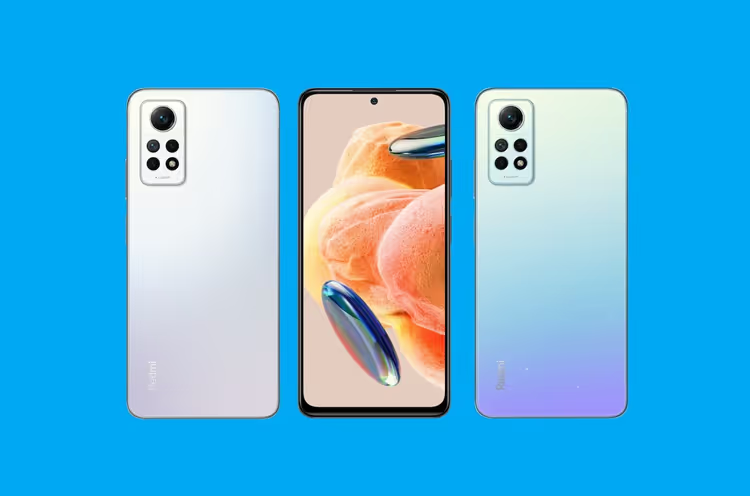
📱 Xiaomi Redmi Note 12 Pro 8/256 GB review: is it worth buying in 2026
A $250 smartphone with AMOLED 120 Hz, an OIS camera, and 67 W charging sounds like a top pick for the money three years ago. What about 2026?
Almost four years have passed since the Redmi Note 12 Pro launched. The Note 15 and 16 are already on the market, flagship prices keep creeping up, and the budget segment is packed with lookalike models. Yet this particular device still pops up in recommendations and is sold on platforms like Comfy.
We tested the Xiaomi Redmi Note 12 PRO 8 256 Glacier blue in real-world 2026 scenarios: daily workload, camera, battery life. Here is an honest, no-marketing breakdown: what the device can do now and who should still buy it.
💡 Quick overview:
- Check out the build: a Glacier Blue glass back, 8 mm thin and 187 grams, lighter than many competitors with the same battery
- Turn on the display: a 120 Hz AMOLED with Dolby Vision and HDR10+, 900 nits peak brightness, text is readable in sunlight
- Launch your apps: the Dimensity 1080 and 8 GB of RAM handle a smooth UI and most games without stuttering
- Test the camera: the 50 MP main sensor with OIS delivers decent daytime shots and passable evening results, a rarity in the budget segment
- Do the battery math: the 5000 mAh battery lasts a full day, the included 67 W charger powers the phone to 50% in 15 minutes
Design and build

The first thing you notice is the 8 mm body and 187-gram weight. For a device with a 5000 mAh battery, this is noticeably lighter than many competitors. The back is glass, the frame is plastic, a standard mid-range compromise. The assembly is tight, nothing wobbles or creaks after years of use.
The Glacier Blue color is a light blue with a gradient that shifts shade depending on the lighting. It looks fresh and does not collect fingerprints as aggressively as glossy black panels. On the right edge, a fingerprint scanner integrated into the power button. Unlocking is instant, with minimal errors.
On the plus side: there is a 3.5 mm headphone jack (a nearly extinct species in 2026) and an IR blaster for controlling home appliances. On the compromise side, IP53 protection: it will survive rain and splashes, but do not dunk it in the sink.
The Glacier Blue color proved practical in the long run: minor scratches on a light background are less visible than on darker variants. The included silicone case protects the edges but hides the back's pleasant gradient, so many users carry the device without a case, relying on Gorilla Glass 5.
Display and multimedia
A 6.67-inch AMOLED panel with 1080×2400 resolution and a 120 Hz refresh rate is the lineup's calling card. The 900-nit peak brightness (HBM) means text is readable in sunlight, although the display struggles with direct summer rays. The factory color calibration is decent: no shift toward harsh blue or excessive warmth.
Dolby Vision and HDR10+ support for a screen in this class is an unexpected bonus. When watching Netflix with Dolby Vision content, the difference from regular SDR is noticeable: deeper shadows, highlights that are not blown out. The 120 Hz refresh rate makes scrolling and UI animations smooth, although demanding games hold steady at 60 fps, the chip cannot push 120 in heavy titles.
Corning Gorilla Glass 5 protects against scratches. After three years of active use without a screen protector, micro-scratches appear, but there are no deep grooves.
Performance: Dimensity 1080 in daily life and gaming

The MediaTek Dimensity 1080 is a 6-nanometer chip with two Cortex-A78 cores at 2.6 GHz and six Cortex-A55 cores at 2.0 GHz. Paired with 8 GB of LPDDR4X RAM and 256 GB of UFS 2.2 storage, it scores around 490,000 points in AnTuTu v9. For 2022, a solid mid-ranger; for 2026, a proven workhorse.
Everyday scenarios: messengers, a browser with a dozen tabs, YouTube, maps, the device handles them with no hint of lag. The UI flies, apps are not prematurely kicked out of memory. Heavy games like Genshin Impact run at medium settings with a stable 40-50 fps. Call of Duty Mobile holds 60 fps on high, thanks to the Mali-G68 MC4.
There is heating under load, but no throttling. After an hour of gaming, the body around the camera area is warm, but not scorching. For resource-heavy tasks like video editing in CapCut or RAW processing, the speed is just barely enough, but the fact that a phone with a budget price tag handles this at all is impressive.
An important nuance: there is no microSD slot. 256 GB is a lot, but if you shoot 4K video and store music locally, space can run out faster than you expect.
Camera and photography
The 50 MP main module (1/1.56" sensor, f/1.9, OIS) is the same sensor that was used in more expensive devices at launch. Optical stabilization for the mid-range segment was rare in its release year, and in 2026 it remains a strong argument.
Daytime shots are pleasing: natural color reproduction, good dynamic range, minimal noise. HDR works carefully, without turning the frame into an acid-drenched postcard. In the evening, OIS allows for longer exposure, so shots come out brighter and cleaner than those from competitors without stabilization. But do not expect a miracle: in deep twilight, detail drops and noise appears.
The 8 MP ultra-wide (120 degrees) is a standard companion: usable during the day for architecture and landscapes, but frankly smeary in the evening. The 2 MP macro module is a checkbox feature, with zero practical use.
Night mode activates automatically in low light and takes 2-3 seconds to process. The result: more detail in shadows, less noise on uniform surfaces, although textures under heavy magnification can look slightly artificial. The quality is more than sufficient for social media and messenger posts.
Video: 4K at 30 fps from the main camera, 1080p at 60 fps, enough for amateur shooting. OIS also works in video, compensating for hand shake. The microphones record clean audio, and software wind reduction handles moderate outdoor wind. For vlogs and video calls, the quality is above average for the segment. The 16 MP front camera records 1080p at 60 fps, which is more than enough for video calls and stories.
Battery and runtime

The 5000 mAh battery is the gold standard that Xiaomi has maintained for several generations. In mixed use (messengers, an hour of YouTube, half an hour of navigation, a few photos), there is enough charge left by evening to last until morning. If you do not game, it easily lasts a day and a half.
67 W charging via the included adapter is a "plug in for 15 minutes, get 50%" scenario. A full cycle: 46 minutes from 0 to 100%. In a daily rhythm, it looks like this: you take it off the charger in the morning, by lunchtime 70-75 percent remains, you plug it in for 10 minutes while getting ready for a meeting, and you have a full day ahead again. This scenario is a lifesaver for those who forget to charge their phone overnight. There is no wireless charging, which is still normal for the budget segment in 2026.
Software and updates
The device launched on Android 12 with MIUI 13, but by 2026 it received an update to HyperOS (Android 14). The interface became cleaner: less advertising in system apps, smoother animations, improved multitasking. Security support continues, with patches arriving quarterly.
There is a small set of pre-installed software out of the box, but everything unnecessary can be removed in a couple of taps. Xiaomi's signature features, a second profile, app cloning, flexible Always-On Display settings, are all in place.
It is important to understand: Android 14 is the final major version for this model. Beyond that, only security patches. At the time of writing (July 2026), the device is still receiving updates, but the support horizon is a year to a year and a half, no more.
HyperOS brought several nice improvements: an updated control center with notification grouping by category, better background process management, and more aggressive battery optimization in standby mode. Overnight, the device loses only 2-3 percent of charge, which is noticeably better than the figures on the old MIUI 13.
⁉️🤔 Frequent questions
Is it worth buying the Redmi Note 12 Pro in 2026 if the Note 15 exists?
It depends on the price. If you find the 8/256 GB version for under $200, it is a solid device with a 120 Hz AMOLED, an OIS camera, and 67 W charging. The Note 15 will be faster in games and will get another year or two of Android updates, but its price tag is different.
The performance difference between the Dimensity 1080 and the Dimensity 6100+ (Note 15), according to benchmark data, is negligible in everyday tasks. You will not notice it in daily use. The extra cost is only justified if you critically need a fresh Android version out of the box and maximum gaming performance.
Does NFC work on the version for the Ukrainian market?
Yes, model 22101316G (global version) has full NFC. Contactless payment via Google Wallet works without issues. Before buying, verify the firmware region, as Chinese versions may have limited support.
How much does the phone heat up under load?
The Dimensity 1080 chip is built on a 6nm process, making it energy-efficient for its time. During normal use, the body stays at room temperature. An hour of Genshin Impact results in heating up to 40-42 degrees Celsius around the camera area.
This does not cause discomfort: the phone does not burn your hands. No throttling (forced frequency reduction) was observed in our tests, and performance remained stable throughout an hour-long session.
Does it make sense to get the 256 GB version without a microSD slot?
256 GB is spacious. With typical use (photos, apps, messenger cache), about 80-100 GB is used over a year. If you shoot a lot of 4K video and are not willing to periodically offload footage to a computer, consider an external OTG drive.
Alternative: the 128 GB version is noticeably cheaper, but then the storage question becomes more pressing after just six months to a year of active use. The price difference between 128 and 256 GB on the secondary market is about $20-25, and we advise against skimping.
Does the device update to HyperOS 2.0?
As of January 2026, Xiaomi released HyperOS 2.0 based on Android 14 for the Redmi Note 12 series, including the Pro version. The update brings an improved control center, redesigned animations, and battery consumption optimization.
Buy or pass: the verdict on the Redmi Note 12 Pro in 2026
The Redmi Note 12 Pro is one of those devices that "hit big" at launch and have not lost relevance years later. A 120 Hz AMOLED, a camera with OIS, and 67 W charging in a $200 body is a set that, even today, would be embarrassing to offer only in the low-end segment.
If your budget is tight and you are looking for a smartphone with a one-to-two-year horizon of confident performance, buy it. The main thing: check the firmware region (global, not Chinese), make sure there are no signs of the device having been opened, and that the battery holds a charge within normal limits. The 256 GB device in Glacier Blue is one of the most balanced options on the secondary market right now.

A professional team of writers and editors specializing in creating quality content.