













 AIIllustrative image: AI-generated
🛠️ 6 best open source project management tools in 2026: Jira alternatives
When your team outgrows Trello and your Jira bills start to hurt, you reach a moment of truth. You look for a replacement: self-hosted, open-source code, no per-user subscription. So you type "open source project management" into search and drown in hundreds of options, half of which haven't been updated since 2019.
The problem isn't a shortage of tools. There are too many. And neither a team lead nor a CTO at a small company has time to deploy and test each one.
We combed through the open-source project management solutions market as of mid-2026 and selected 6 tools that are alive, actively maintained, and cover different scenarios: from a lightweight Agile tracker to an enterprise combine with financials and compliance. Not a single abandoned repository. Only what actually works.
💡 Quick overview:
- Comparison table of all 6 tools, stack, license, Agile support, and best use case
- Six detailed breakdowns with live screenshots, pros, cons, and pricing
- Answers to common questions: what to use instead of Jira, whether you need hosting, and which stack is easier to deploy
Comparison table: 6 tools in 30 seconds
Tool | Stack | License | Agile | Self-hosted | Best use case |
|---|---|---|---|---|---|
OpenProject | Ruby on Rails, PostgreSQL | GPLv3 | Scrum, Kanban | Yes | Full Jira replacement with migration |
Taiga | Python, Django, PostgreSQL | MPL 2.0 | Scrum, Kanban | Yes | Startups and agile teams |
Tuleap | PHP, MySQL/PostgreSQL | GPLv2 | Scrum, XP, Kanban | Yes | Enterprise with compliance (CMMI) |
EGroupware | PHP, MySQL/MariaDB | GPLv2 | No | Yes | Small business: PM + CRM + calendar |
Project Open | TCL, PostgreSQL/Oracle | GPLv2 | No | Yes | Project office with budget control |
Redmine | Ruby on Rails, MySQL/PostgreSQL | GPLv2 | Via plugins | Yes | Task and bug tracking for IT departments |
1. OpenProject

OpenProject, the most active open-source Jira competitor in 2026. The project has been alive since 2011, runs on Ruby on Rails and PostgreSQL under the hood, GPLv3 license. According to the project repository, as of June 2026, OpenProject has over 15,000 stars on GitHub, 20+ million downloads, and more than 300 releases. Development happens in the open: commits almost daily, version 17.5 came out on June 10, 2026.
The main feature that sets OpenProject apart from the rest, built-in Jira Migrator. If your team is tired of Atlassian bills, the migrator moves tasks, custom fields, and projects from Jira to OpenProject with minimal loss. Hybrid methodologies are supported: you can run some projects on Waterfall with Gantt charts, and others on Kanban boards.
What we liked:
- Jira Migrator out of the box: tasks, fields, and projects transfer without external connectors
- Hybrid mode: classic Gantt charts and agile boards in one interface
- Advanced role model and access control at the project and work package level
- On-premises deployment or Enterprise Cloud in EU data centers
What to consider:
- The interface is functional but not lightweight: the learning curve is steeper than Taiga or Plane
- Community version is free, but enterprise features (project aggregation, custom reporting) require a paid license
Price: Community edition, free (GPLv3, self-hosted). Enterprise on-premises and Enterprise Cloud, paid licenses with professional support, exact cost depends on number of users.
🔗 OpenProject on official website
2. Taiga

Taiga was created as an answer to Jira from agile teams tired of clunky interfaces. Stack: Python, Django, and PostgreSQL on the backend, MPL 2.0 license. The project launched in 2014 by the Spanish Kaleidos team and has since kept its focus on three things: Scrum, Kanban, and interface clarity.
Unlike OpenProject with its hybrid breadth, Taiga doesn't try to please everyone. Epics, user stories, sprints, backlog, and boards, only what a Scrum team needs. For Kanban teams there's a separate mode with WIP limits and swimlanes. The design is minimalist, performance is high, subjectively, one of the most responsive web interfaces among open-source PM tools.
What we liked:
- Intuitive Scrum workflow: backlog, sprint, board, bug tracking, no extra entities
- Clean and fast UI: minimalist design without visual noise
- Free tier for small teams (up to 5 members in cloud, no limits on self-hosted)
- Active community: open repository, public roadmap, regular releases
What to consider:
- No built-in Gantt charts and Waterfall planning
- No Jira migrator, moving tasks requires manual work or API
- Self-hosted version requires deploying Python/Django stack
Price: Self-hosted, free (MPL 2.0, no user limits). Cloud: free up to 5 members, then paid subscription with per-user pricing.
3. Tuleap

Tuleap grew out of Codendi, a Xerox product released in 2009 as an open-source application lifecycle management platform. Today Tuleap, an independent project under French company Enalean, with GPLv2 license and a focus on enterprise teams that need not just boards with sticky notes, but full ALM with compliance trails.
Stack is familiar: PHP, MySQL or PostgreSQL, works on any LAMP server. Tuleap supports Scrum, XP, and Kanban, and most importantly, is CMMI Level 2 certified and compatible with ISO 9001 and ITIL processes. This is the only tool in the roundup that provides out-of-the-box requirements traceability down to code lines and test cases.
What we liked:
- Complete ALM cycle: task tracker, requirements management, Git repository, CI integration, and test management in one interface
- Compliance out of the box: CMMI, ISO 9001, ITIL without external add-ons
- Flexible role model with permission separation at the project, branch, and individual artifact level
- Active development: the project is alive, updating, community growing
What to consider:
- Interface is conservative: learning curve steeper than Taiga or OpenProject
- Overkill for 3-5 person teams where compliance isn't needed
- Installation is not the lightest: requires dedicated LAMP server and configuration
Price: Community version, free (GPLv2). Enterprise subscription (extended support, SLA, plugins), paid license, cost depends on number of users.
4. EGroupware
EGroupware, a veteran from the early 2000s, written in PHP, that didn't just survive but steadily updates. The latest release, version 26.5 from May 2026. Unlike other tools in this roundup, EGroupware doesn't position itself as a pure PM tool: it's a groupware office suite where calendar, CRM, email client, file server, and project management live in one interface.

For small businesses this means you don't need to integrate project management with calendar and contacts, everything is already inside. Tasks are linked to meetings, meetings to CRM contacts, project files are accessible through the built-in file manager with version control.
What we liked:
- All-in-one: calendar, CRM, tasks, email client, and file server without integrations
- Stability: 20+ years of development, predictable release cycle (2-3 major versions per year)
- Flexible permission system: roles and access configured at module and individual record level
- Mobile access via browser and supported clients (CalDAV, CardDAV)
What to consider:
- Not suitable for pure agile teams: no built-in Scrum boards and Kanban
- Interface is functional but stylistically dated compared to Taiga or OpenProject
- Stack, PHP: Ruby/Python teams will need a separate environment
Price: Community version, free (GPLv2). EPL subscription (extended support and hosting), paid license.
🔗 EGroupware on official website
5. Project Open

]project-open[ (yes, the name is written exactly like that, with brackets), the only tool in the roundup that enters ERP territory. While other competitors focus on task tracking and boards, Project Open looks at projects through the lens of money: budgets, labor costs, billing, financial reports, and portfolio management.
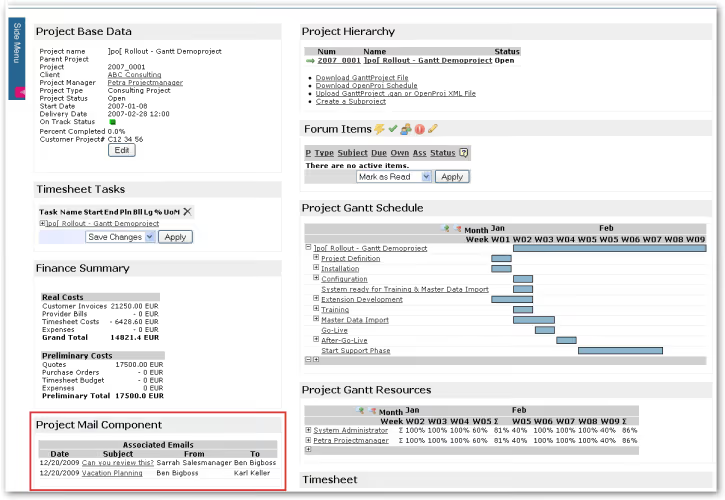
Release 5.2 came out in May 2025, support is announced until December 2028. The core is written in TCL (yes, that Tool Command Language) and works with PostgreSQL or Oracle. For small studios and agencies where projects equal money and the manager is responsible not just for deadlines but also for margins, this is an invaluable tool.
What we liked:
- Financial accounting at project level: budgeting, actual costs, billing, and profitability report
- Portfolio management: multi-project dashboard with financial KPIs
- Modular architecture: add CRM, timesheets, HR planning, and procurement as business grows
- Installers for Windows and Linux, no need to deal with TCL manually
What to consider:
- TCL + PostgreSQL/Oracle stack: TCL developers are rare in the market, customization is expensive
- No built-in Kanban boards and Scrum rituals, this is a budgeting tool, not an agile facilitator
- Interface is visually outdated, learning curve is steep
Price: Community version, free (GPLv2, self-hosted). Enterprise support and hosting, paid license.
🔗 Project Open on official website
6. Redmine
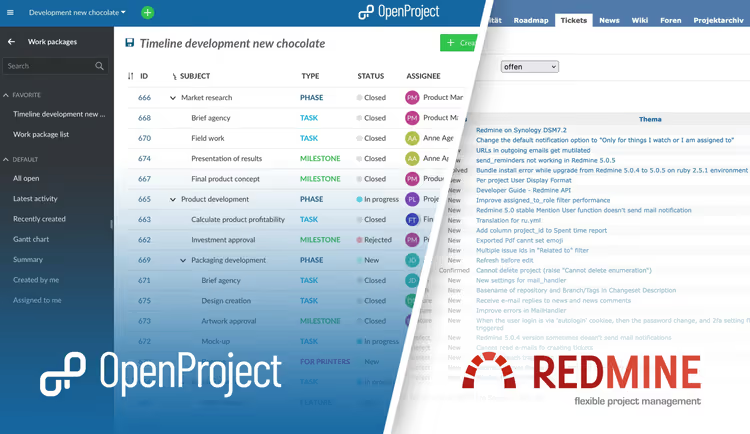
Redmine, possibly the most famous open-source issue tracker period. The project started in 2006, stack, Ruby on Rails, database, MySQL or PostgreSQL. The key word here, "tracker". Redmine doesn't teach you Agile and doesn't impose processes: it gives you issues, roadmap, Gantt charts, calendar, and role model, and then you build the workflow yourself.
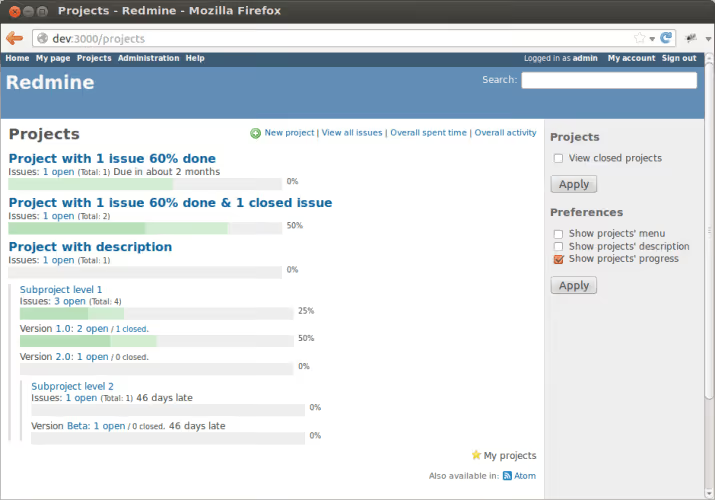
Redmine's main advantage in 2026, the plugin ecosystem. Over 20 years the community has written hundreds of extensions: from Kanban boards and Scrum sprints to Git repository integration and Slack. 34 interface languages are supported, making Redmine convenient for distributed international teams.
What we liked:
- Huge plugin ecosystem: Kanban, Scrum, Git integration, everything installs on top of the core
- 34 interface languages out of the box
- Batch task updates and flexible custom fields system
- Lightweight and fast: deploys in 10 minutes on minimal VPS
What to consider:
- Basic functionality is spartan: real Agile requires plugins
- Default interface is minimalist and visually dated, themes to the rescue
- No proprietary cloud hosting: only self-hosted or third-party hosting providers
Price: Completely free (GPLv2, self-hosted). Third-party Redmine hosting (Planio, Hosted Redmine), paid subscription with per-user pricing.
⁉️🤔 Common questions
Can you completely replace Jira with an open-source tool without losing functionality?
Depends on how you use Jira. If your workflow doesn't go beyond tasks, sprints, and Kanban boards, Taiga or OpenProject give the overwhelming majority of the same experience, free and on your own servers. But if you're heavily invested in Jira Automation, Advanced Roadmaps, and an ecosystem of 15 Marketplace plugins, migration will require compromises. OpenProject with its Jira Migrator removes the most painful part, data transfer, but custom automations will need to be rewritten. Practical advice: start with a pilot project on OpenProject Community without shutting down Jira, and measure actual speed losses.
Do you need a separate server for self-hosted solutions from the roundup?
All 6 tools run on their own servers. Minimum requirements vary: Redmine and Taiga will take off on a VPS with 2 GB RAM, OpenProject asks for 4 GB for comfortable work, and Tuleap and Project Open with their enterprise stacks are better deployed on a dedicated server with 8+ GB. Docker images are available for OpenProject, Taiga, and Redmine, this is the fastest way to start. EGroupware and Tuleap offer ready virtual machines.
Which tool to choose if the team has never worked Agile?
Taiga. It has the lowest entry barrier: clean interface, intuitive Scrum workflow, minimal distracting elements. The team sees backlog, sprint, and board, three entities that are enough to start. OpenProject is more powerful, but beginners drown in the abundance of modules and settings. Redmine requires self-assembly of agile stack through plugins, for first acquaintance with Agile that's extra.
What to choose for a project office with budgets and financial reporting?
Project Open, the only candidate. It was originally designed as an ERP for project business: budgets, actual labor costs, billing, project margins, and portfolio dashboard. OpenProject can track time and calculate costs at rate per hour level, but financial accounting in the "revenue minus expenses per project" style only exists in Project Open.
Is there a risk that an open-source project will be abandoned and you'll be stuck with a dead repository?
From our six, no. OpenProject (15,000+ GitHub stars, release every 2-4 weeks), Redmine (20 years of continuous development), EGroupware (26th major version), and Tuleap (active enterprise vendor Enalean) aren't planning to stop. Taiga is supported by Kaleidos, the company that makes money from it through cloud hosting. Project Open released version 5.2 in 2025 with announced support until 2028. All 6 projects either have a commercial sponsor or an active community with regular commits.
What to deploy in 2026: the final breakdown
The choice comes down to two questions. First: what's your infrastructure budget? If you already have your own server, take OpenProject Community (universal option) or Taiga (if you're pure Agile). Second: what do you need besides task tracking? Need finances, Project Open. Need compliance with ISO/CMMI, Tuleap. Need calendar, CRM, and files in one package, EGroupware. Need a lightweight tracker with 10-minute deployment, Redmine.
If you're paying for Jira right now and want to get off the Atlassian needle, start with OpenProject. Jira Migrator eats the most painful part of the transition, and then in a week you'll understand exactly what your team is missing. And yes, all 6 tools from this review we checked personally, deployed on test VPS and ran on real project scenarios. No theoretical recommendations.

A professional team of writers and editors specializing in creating quality content.