














🚀 5 best WooCommerce alternatives in 2026
You launched a store on WooCommerce. Six months in, and you're no longer sure you chose the right platform. The payment gateway doesn't support your use case, subscriptions require a bundle of four plugins, and you're still rigging together a solution for digital products that works completely differently "out of the box."
WooCommerce, a powerful all-in-one platform. 60 million downloads, the largest ecosystem of extensions, full control over code. But "powerful for most" doesn't equal "perfect for you." When your core product is software, a course, a subscription, or membership, a universal platform loses to specialized tools across the board: price, speed of setup, and stability.
We took five WooCommerce alternatives and broke them down by use case, not by rankings. Digital products, creative sales, membership, enterprise, and all-in-one, each has its own tool. With 2026 pricing, honest drawbacks, and a decision map at the end.
💡 Quick overview:
- Selling digital products (software, courses, music, licenses), go with Easy Digital Downloads. The plugin is built for digital from the first line of code, WooCommerce can't match that focus without a dozen extensions.
- Want a ready-made store without touching a server, Shopify. Three-day trial, pricing from €19/month, checkout with 15% higher conversion than market average.
- Creator with a direct audience (artist, musician, author), Gumroad. Free start, pay only on sales, worldwide taxes handled by the platform as Merchant of Record.
- Building a membership site or subscription courses, MemberPress. One plugin for $199.50/year provides everything WooCommerce would require a bundle of 4-5 extensions for.
- Enterprise and scale, Adobe Commerce (formerly Magento). 200,000 orders per hour, multi-brand, AI search and headless architecture.
Why WooCommerce might not fit your specific case
WooCommerce, a universal platform. That's its strength. And that's also its limitation. When you're selling physical products from inventory, it's in its element. But e-commerce has long moved beyond the "product, cart, payment" paradigm. Today a store might be a subscription to a monthly box of source files, a catalog of courses with drip access, a showcase of software licenses, or donation collection for drafts.
For each non-standard scenario WooCommerce drags along plugins. Payment gateway, separate, subscriptions, separate, membership, separate, license keys, separate. A dozen extensions, each with its own price, updates, and potential conflicts. In total, more expensive, more complex, and less stable than one specialized solution.
Second point: hosted versus self-hosted. WooCommerce requires hosting, regular backups, core updates, vulnerability monitoring. Not everyone wants to deal with this. Hosted solutions like Shopify remove this headache completely: pay a fixed amount, sell.
Below, five alternatives, broken down by niche. Choose based on your use case, not someone else's ranking.
1. Easy Digital Downloads, for digital products
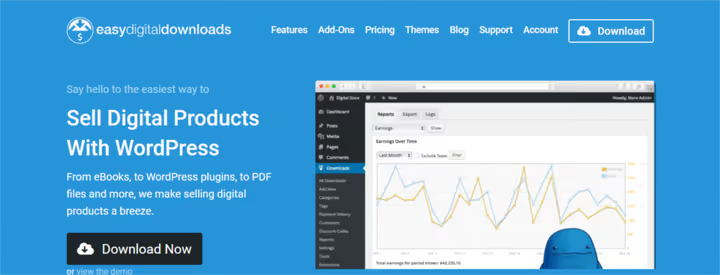
Easy Digital Downloads, a WordPress plugin designed specifically for selling digital products. Not an adapted physical store, but a tool where every function, from file protection to license keys, works out of the box.
What EDD can do
The basic plugin is free and covers key digital store needs: product cards, full-featured cart, optimized checkout, payment processing through Stripe and PayPal, protected download links with time and IP limits, customer management, discount codes, and detailed analytics.
Pro version adds: subscriptions and recurring payments, software licensing with activation keys and auto-updates, content restriction (essentially membership), abandoned cart recovery, and AI product recommendations. Over 70 paid extensions cover everything from Mailchimp integration to Multisite sales. Extension bundles start at $99 per year.
The plugin has processed over 30 million orders and passed verification from Stripe, PayPal, and Square, payment integrations meet their security standards.
EDD versus WooCommerce for digital products
Criteria | Easy Digital Downloads | WooCommerce |
|---|---|---|
Selling digital products out of the box | ✅ Fully | ⚠️ Requires setup |
File protection (unique links, download limits) | ✅ Base version | ❌ Requires extension |
License keys and auto-updates | ✅ Pro | ❌ Separate plugin |
Subscriptions and recurring payments | ✅ Pro | ❌ Separate plugin ($199/year) |
Free start | ✅ Base plugin | ✅ Base plugin |
If your core product is digital, EDD provides everything needed without a zoo of extensions. WooCommerce for digital is the same all-in-one, but with a dozen attachments, each requiring separate payment and updates.
Downside: if you're mixing digital and physical products in one store, EDD isn't your option. It can sell physical products through extensions, but that's not its territory. For a mixed catalog WooCommerce remains king.
🔗 Easy Digital Downloads on WordPress.org | 🔗 EDD website
2. Shopify, turnkey store, no hosting or headaches
Shopify, the world's largest hosted e-commerce platform. Over one trillion dollars in total sales through the platform. Every 26 seconds someone makes their first sale. From a blogger with merch to enterprise, scales without changing the platform.

2026 pricing
Plan | Price (annual) | Key difference |
|---|---|---|
Basic | €19/month | 1 store, up to 10 locations, basic reporting |
Grow | €56/month | Up to 5 staff, shipping discounts, reports |
Advanced | €289/month | Up to 15 staff, custom reports, regional customization |
Plus | from €2100/month | Unlimited staff, headless, B2B catalogs, 200 POS |
Three-day trial without a card, then €1/month for the first 3 months. Commission for third-party payment gateways: 2% on Basic, 1% on Grow, 0.6% on Advanced. When using Shopify Payments, no transaction commission.
What you get
Shopify, not just a platform, but a complete builder: hosting out of the box, free SSL, domain, 100+ mobile themes, drag-and-drop editor, AI assistant Sidekick for content generation and store management. Checkout converts 15% better than market average, figure from Shopify, based on internal A/B tests of the platform.
Multi-channel support out of the box: online storefront, POS for physical locations, Shop App, social media and marketplace integration. Plus B2B features: separate catalogs, wholesale pricing, corporate accounts.
Shopify + WordPress
The official WordPress plugin for Shopify was discontinued several years ago, and the free WP Shopify stopped working. Today for connecting Shopify with WordPress use ShopWP Pro, a commercial plugin with product sync, custom cart, and SEO-optimized product display on a WordPress site. For a content site wanting to add a storefront without migration, this is the best hybrid option.
Main Shopify downside: you don't own the platform. Your store is on their servers, their rules. Commissions for third-party payments are annoying, and full checkout customization is only available on Plus for €2100/month. For those who need complete control over every line of code, Shopify is a compromise.
Verdict: if you don't want to think about hosting, security, and patches, Shopify. If WordPress is essential to you and WooCommerce is overloaded, look at EDD or MemberPress below.
3. Gumroad, for creators and direct sales
Gumroad occupies a unique niche: it's not a store in the traditional sense, but a platform for creators who sell directly to their audience. Digital products, courses, subscriptions, pre-orders, anything that can be packaged as a file or access.
Business model
Gumroad doesn't charge monthly fees. You only pay on sales:
- 10% + $0.50 per transaction when selling through your profile or direct links.
- 30%, if the buyer came through Discover, Gumroad's marketplace.
As of January 2025 Gumroad is a Merchant of Record: the platform automatically calculates, collects, and remits taxes (VAT, GST, sales tax) for all countries. For creators this means zero bureaucracy, you simply receive a payout once a week to your account or PayPal.
Who is this for
Gumroad is ideal for creative professionals: artists sell brushes and source files, musicians, samples and albums, writers, ebooks, developers, software licenses. Built-in abuse protection: PDF stamping, download disabling, limits. The platform supports subscriptions, "pay what you want" (+), license key generation, and drip content.
Per week Gumroad creators collectively earn over $2.1 million. Not Shopify scale, but for an individual creator, solid income without infrastructure hassle.
Downside: 10% commission is higher than running your own store on WooCommerce + Stripe (2.9% + $0.30). But you save on hosting, SSL, tax reporting, and dozens of hours of setup. For a side project or creative passive income the time savings often outweigh the percentage.
4. MemberPress, membership and subscriptions without a zoo of plugins
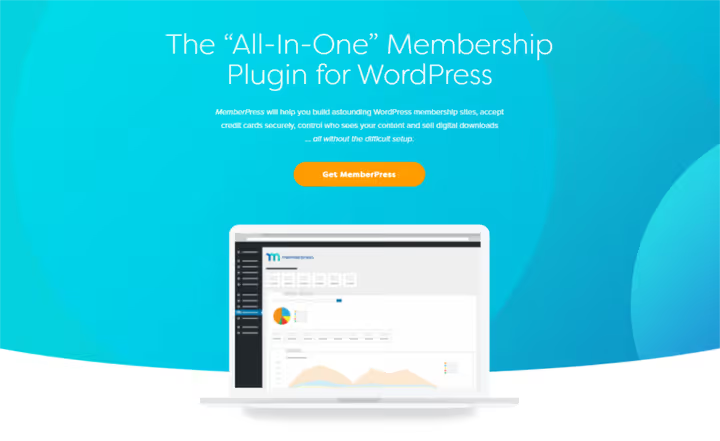
MemberPress, a WordPress plugin for selling membership, subscriptions, and online courses. One plugin replaces the bundle of WooCommerce + WooCommerce Subscriptions + WooCommerce Memberships + LMS, and costs noticeably less.
2026 pricing
Plan | Price/year | Key features |
|---|---|---|
Launch | $199.50 | +4.9% on transactions, Stripe, courses, coupons, content protection |
Growth | $349.50 | 0% on transactions, PayPal, Square, CoachKit, forums, certificates |
Scale | $499.50 | 0% on transactions, Easy Affiliate, corporate accounts, Zapier, REST API |
14-day no-questions-asked refund. MemberPress users have collectively earned over $2.5 billion, figure from vendor, but shows product maturity.
What's inside
MemberPress provides: unlimited membership levels, drip content, page, post, and file protection through Smart Rules, LMS with course builder (drag & drop), quizzes, assignments, and certificates. Starting with Growth tier comes CoachKit, a coaching platform with direct messaging and client progress tracking. Scale adds Easy Affiliate, a full affiliate program.
AI Course Generator, available on all tiers, generates course structure and lesson content by topic. Not a replacement for an instructional designer, but speeds up launch for drafts.
Comparison with WooCommerce: to get the same functionality on WooCommerce, you need WooCommerce Subscriptions ($199/year) + Memberships ($199/year) + a suite of extensions for courses and drip content. MemberPress on Growth for $349.50/year covers everything with one installation.
Downside: fewer payment gateways, only Stripe on Launch, PayPal and Square added with Growth. WooCommerce has a wider gateway selection. If a specific exotic gateway is critical to you, verify compatibility before purchase.
🔗 MemberPress, pricing and demo
5. Adobe Commerce (Magento), for corporate e-commerce
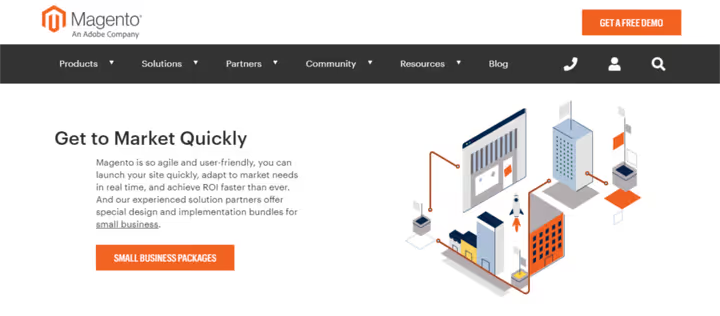
Adobe Commerce, formerly Magento, an enterprise platform for large businesses. If WooCommerce is a minibus, Adobe Commerce is a semi-truck with autopilot.
What it is
Adobe Commerce, headless architecture, AI search, personalization through Adobe Experience Cloud, 200,000+ orders per hour at peak, multi-brand and multi-market from one instance. The platform supports B2C and B2B simultaneously: corporate accounts, custom catalogs, wholesale pricing.
New features: built-in support for agentic commerce, your catalog is optimized for LLM and AI agents that search for products on behalf of users. Adobe Brand Concierge, conversational shopping powered by AI.
Who needs this
Retailers with millions of SKUs, international B2B operators, companies needing maximum control over every checkout pixel and full backend customization. Magento Open Source, the free version, exists, but without AI tools, headless architecture, and Adobe Commerce-level scaling.
What about WordPress
For Magento integration with WordPress there's Magento 2 WP Integration, a plugin with shared sessions, cart, shortcodes, and widgets for displaying Magento products on a WordPress site. Suitable for a content facade over a Magento backend, but requires both installations on the same server.

Main downside: cost. Pricing is not public, calculated through Adobe partners. Implementation takes months, requires a team of developers or a certified partner. For small and medium businesses, overkill.
Comparison table: all five
| WooCommerce | EDD | Shopify | Gumroad | MemberPress | Adobe Commerce |
|---|---|---|---|---|---|---|
Type | Self-hosted | Self-hosted WP | Hosted | Hosted | Self-hosted WP | Hosted / Self-hosted |
Free start | ✅ | ✅ | 3-day trial | ✅ | ❌ ($199/year) | ❌ |
Price (from) | $0 + hosting | $0 + hosting | €19/month | 10% + $0.50 | $199.50/year | By request |
Digital products | ⚠️ Extensions | ✅ Core | ✅ | ✅ | ✅ | ✅ |
Subscriptions | ❌ Extension | ✅ Pro | ✅ | ✅ | ✅ Core | ✅ |
Membership / courses | ❌ Extensions | ⚠️ Pro | ❌ | ❌ | ✅ Core | ❌ |
B2B / Enterprise | ❌ | ❌ | ✅ Plus | ❌ | ❌ | ✅ Core |
File protection | ❌ | ✅ | ❌ | ✅ | ✅ | ❌ |
Merchant of Record | ❌ | ❌ | ❌ | ✅ | ❌ | ❌ |
WordPress integration | ✅ Core | ✅ Core | ⚠️ ShopWP Pro | ❌ | ✅ Core | ⚠️ m2wp plugin |
⁉️🤔 Frequently asked questions
Can I migrate from WooCommerce to Shopify?
Migration from WooCommerce to Shopify is technically straightforward, but requires manual work with themes. Shopify uses its own Liquid template system, the store's appearance will need to be rebuilt. Products, customers, and orders transfer via CSV or paid apps like Cart2Cart. SEO redirects are configured through the built-in URL redirects tool. For a catalog under 500 products you can realistically fit it into a weekend.
Is Gumroad suitable for selling services?
Through Gumroad you can sell consultations (packaged as a digital product with email confirmation), subscriptions to monthly reviews, membership with exclusive content. For complex services, custom development, agency packages, Gumroad is too simple: you need full billing with custom proposals. But for a solo creator with a clear service format, excellent start without programming.
What to choose: MemberPress or WooCommerce Memberships?
If a WooCommerce store is already running and generating revenue, get WooCommerce Memberships, don't dismantle a working system. If starting from scratch and the core product is membership or courses, MemberPress on Growth ($349.50/year, 0% on transactions) will provide more out of the box: drip content, quizzes, certificates, forums, coaching through CoachKit. WooCommerce stack with similar functionality will cost 2-3 times more and require 3-4 times more plugins.
Does Magento Open Source work for small businesses?
Magento Open Source is technically free, but total cost of ownership for small businesses is high. Requires a VPS with above-average resources (Magento is heavier than WooCommerce), a developer for installation and updates, regular security monitoring. Typical support budget, from several hundred dollars per month just for server and administration, excluding development. For small volumes WooCommerce on good hosting or Shopify Basic/Grow provide more for less money.
Does Shopify have a commission beyond the monthly fee?
Yes, Shopify charges a commission for third-party payment gateways: 2% on Basic, 1% on Grow, 0.6% on Advanced. When using Shopify Payments the transaction commission is absent, but standard processing applies (from 2.4% + €0.25 in Europe). Shopify transaction commissions do not apply to POS sales and manual payment methods.
What to choose in 2026: final breakdown
Decision map, no illusions or marketing promises:
Selling only digital products → Easy Digital Downloads. Free start, Pro covers licensing and subscriptions without extra extensions. If mixing digital and physical products, stay on WooCommerce.
Want a turnkey store and forget about the server → Shopify. €19/month to start, proven checkout, hundreds of themes. Downside, commission for third-party payments. Upside, three-day trial without a card.
Creative product and your own audience, no monthly fee → Gumroad. Free start, 10% only on sales. Taxes for all countries handled by the platform. Ideal for a side project that should make money, not demand time.
Membership portal or course platform → MemberPress. $199.50/year to start, $349.50/year with no transaction fees. One plugin instead of a bundle of 4-5 WooCommerce extensions.
Enterprise with international scale → Adobe Commerce. 200K orders per hour, AI search, agentic commerce, headless. Price, by request, implementation measured in months.
If your case is a combination of two niches (say, digital products + membership), don't mix solutions. Take one core (EDD Pro for software, MemberPress for courses) and extend it with addons. This is cheaper and more stable than crossing two plugins with overlapping functionality.

A professional team of writers and editors specializing in creating quality content.